Download Mendeley
Tazobactam Forms a Stoichiometric trans-Enamine Intermediate in the E166A Variant of SHV-1 beta-Lactamase: 1.63 A Crystal Structure
Padayatti, P.S., Helfand, M.S., Totir, M.A., Carey, M.P., Hujer, A.M., Carey, P.R., Bonomo, R.A., Van Den Akker, F.(2004) Biochemistry 43: 843-848
- PubMed: 14744126 Search on PubMed
- DOI: https://doi.org/10.1021/bi035985m
- Primary Citation Related Structures:
1RCJ - PubMed Abstract:
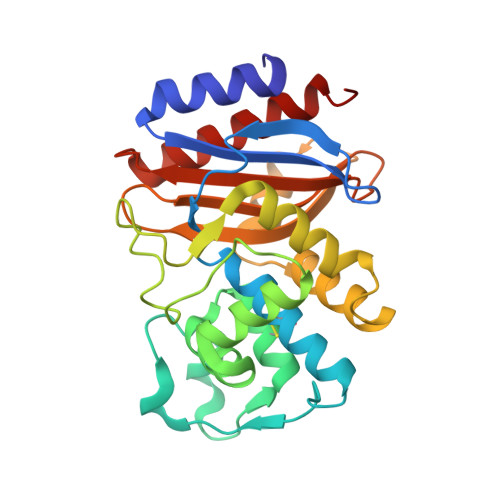
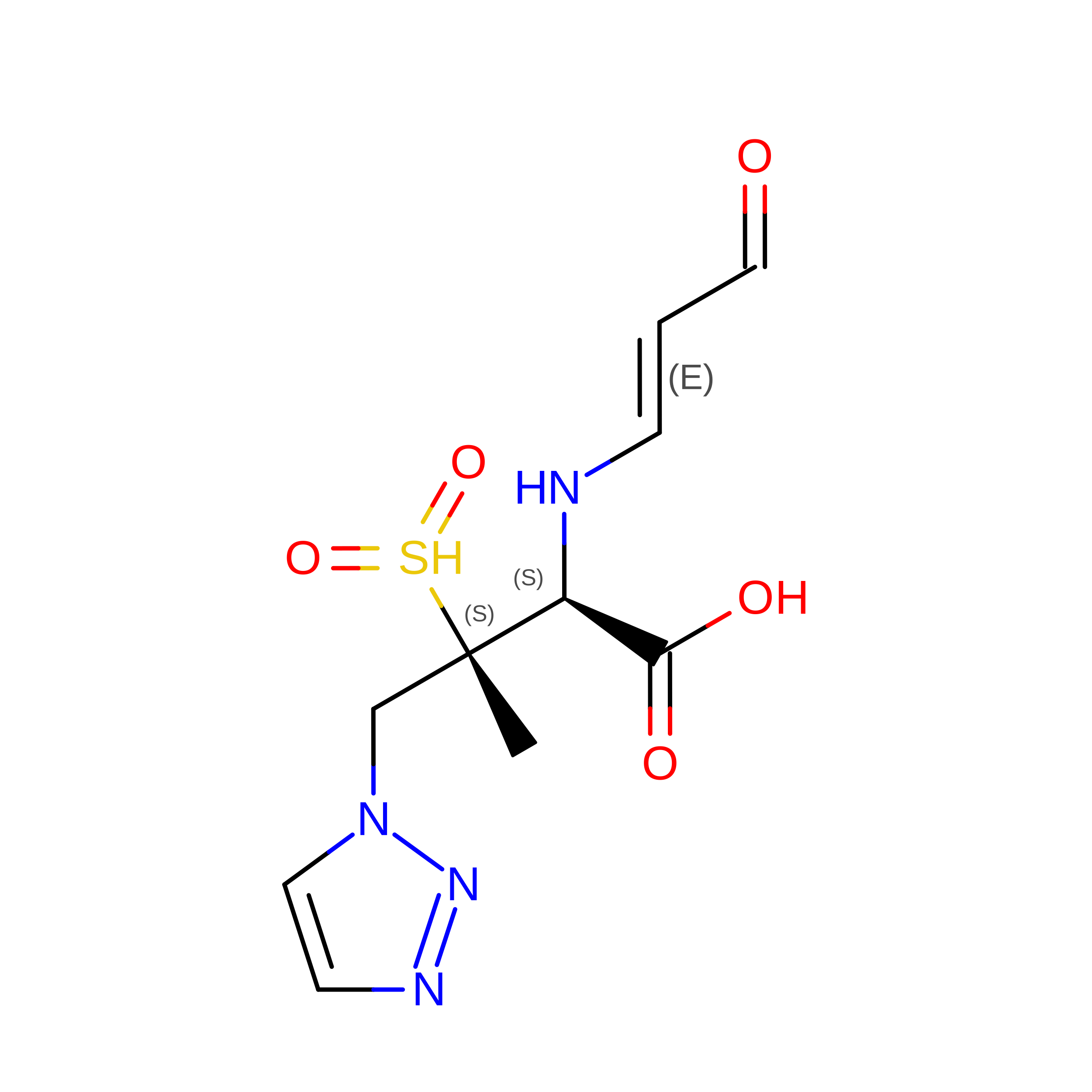
Many pathogenic bacteria develop antibiotic resistance by utilizing beta-lactamases to degrade penicillin-like antibiotics. A commonly prescribed mechanism-based inhibitor of beta-lactamases is tazobactam, which can function either irreversibly or in a transient manner. We have demonstrated previously that the reaction between tazobactam and a deacylation deficient variant of SHV-1 beta-lactamase, E166A, could be followed in single crystals using Raman microscopy [Helfand, M. S., et al. (2003) Biochemistry 42, 13386-13392]. The Raman data show that maximal populations of an enamine-like intermediate occur 20-30 min after "soaking in" has commenced. By flash-freezing crystals in this time frame, we were able to trap the enamine species. The resulting 1.63 A resolution crystal structure revealed tazobactam covalently bound in the trans-enamine intermediate state with close to 100% occupancy in the active site. The Raman data also indicated that tazobactam forms a larger population of enamine than sulbactam or clavulanic acid does and that tazobactam's intermediate is also the most long-lived. The crystal structure provides a rationale for this finding since only tazobactam is able to form favorable intra- and intermolecular interactions in the active site that stabilize this trans-enamine intermediate. These interactions involve both the sulfone and triazolyl groups that distinguish tazobactam from clavulanic acid and sulbactam, respectively. The observed stabilization of the transient intermediate of tazobactam is thought to contribute to tazobactam's superior in vitro and in vivo clinical efficacy. Understanding the structural details of differing inhibitor effectiveness can aid the design of improved mechanism-based beta-lactamase inhibitors.
- Department of Biochemistry, Case Western Reserve University, Cleveland, Ohio 44106-4935, USA.
Organizational Affiliation: