1QY7 | pdb_00001qy7

The structure of the PII protein from the cyanobacteria Synechococcus sp. PCC 7942


Experimental Data Snapshot

  • Method: X-RAY DIFFRACTION
  • Resolution: 2.00 Å
  • R-Value Free: 
    0.227 (Depositor), 0.227 (DCC) 
  • R-Value Work: 
    0.199 (Depositor), 0.199 (DCC) 

Starting Model: experimental
View more details

wwPDB Validation 3D Report Full Report

Validation slider image for 1QY7

This is version 1.4 of the entry. See complete history

Literature

The structures of the PII proteins from the cyanobacteria Synechococcus sp. PCC 7942 and Synechocystis sp. PCC 6803.

Xu, Y.Carr, P.D.Clancy, P.Garcia-Dominguez, M.Forchhammer, K.Florencio, F.Vasudevan, S.G.Tandeau de Marsac, N.Ollis, D.L.

(2003) Acta Crystallogr D Biol Crystallogr 59: 2183-2190

  • DOI: https://doi.org/10.1107/s0907444903019589
  • Primary Citation Related Structures: 
    1QY7, 1UL3

  • PubMed Abstract: 

    The PII proteins from the cyanobacteria Synechococcus sp. PCC 7942 and Synechocystis sp. PCC 6803 have been crystallized and high-resolution structures have been obtained using X-ray crystallography. The core of these new structures is similar to that of the PII proteins from Escherichia coli, although the structures of the T- and C-loops differ. The T-loop of the Synechococcus protein is ordered, but appears to be stabilized by crystal contacts. The same loop in the Synechocystis protein is disordered. The C-terminus of the Synechocystis protein is stabilized by hydrogen bonding to the same region of a crystallographically related molecule. The same terminus in the Synechococcus protein is stabilized by coordination with a metal ion. These observations are consistent with the idea that both the T-loop and the C-terminus of PII proteins are flexible in solution and that this flexibility may be important for receptor recognition. Sequence comparisons are used to identify regions of the sequence unique to the cyanobacteria.


  • Organizational Affiliation
    • Department of Biochemistry and Molecular Biology, James Cook University, Townsville, Queensland 4811, Australia.

Macromolecule Content 

  • Total Structure Weight: 37.93 kDa 
  • Atom Count: 2,775 
  • Modeled Residue Count: 336 
  • Deposited Residue Count: 336 
  • Unique protein chains: 1

Macromolecules

Find similar proteins by:|  3D Structure
Entity ID: 1
MoleculeChains  Sequence LengthOrganismDetailsImage
Nitrogen regulatory protein P-II
A, B, C
112Synechococcus elongatus PCC 7942 = FACHB-805Mutation(s): 1 
Gene Names: GLNB
UniProt
Find proteins for P0A3F4 (Synechococcus elongatus (strain ATCC 33912 / PCC 7942 / FACHB-805))
Explore P0A3F4 
Go to UniProtKB:  P0A3F4
Entity Groups
Sequence Clusters30% Identity50% Identity70% Identity90% Identity95% Identity100% Identity
UniProt GroupP0A3F4
Sequence Annotations
Expand
Reference Sequence

Small Molecules

Ligands 2 Unique
IDChains Name / Formula / InChI Key2D Diagram3D Interactions
SO4

Query on SO4


Download:Ideal Coordinates CCD File
D [auth A]
E [auth A]
G [auth B]
H [auth B]
J [auth C]
D [auth A],
E [auth A],
G [auth B],
H [auth B],
J [auth C],
K [auth C]
SULFATE ION
O4 S
QAOWNCQODCNURD-UHFFFAOYSA-L
NI

Query on NI


Download:Ideal Coordinates CCD File
F [auth A],
I [auth B],
L [auth C]
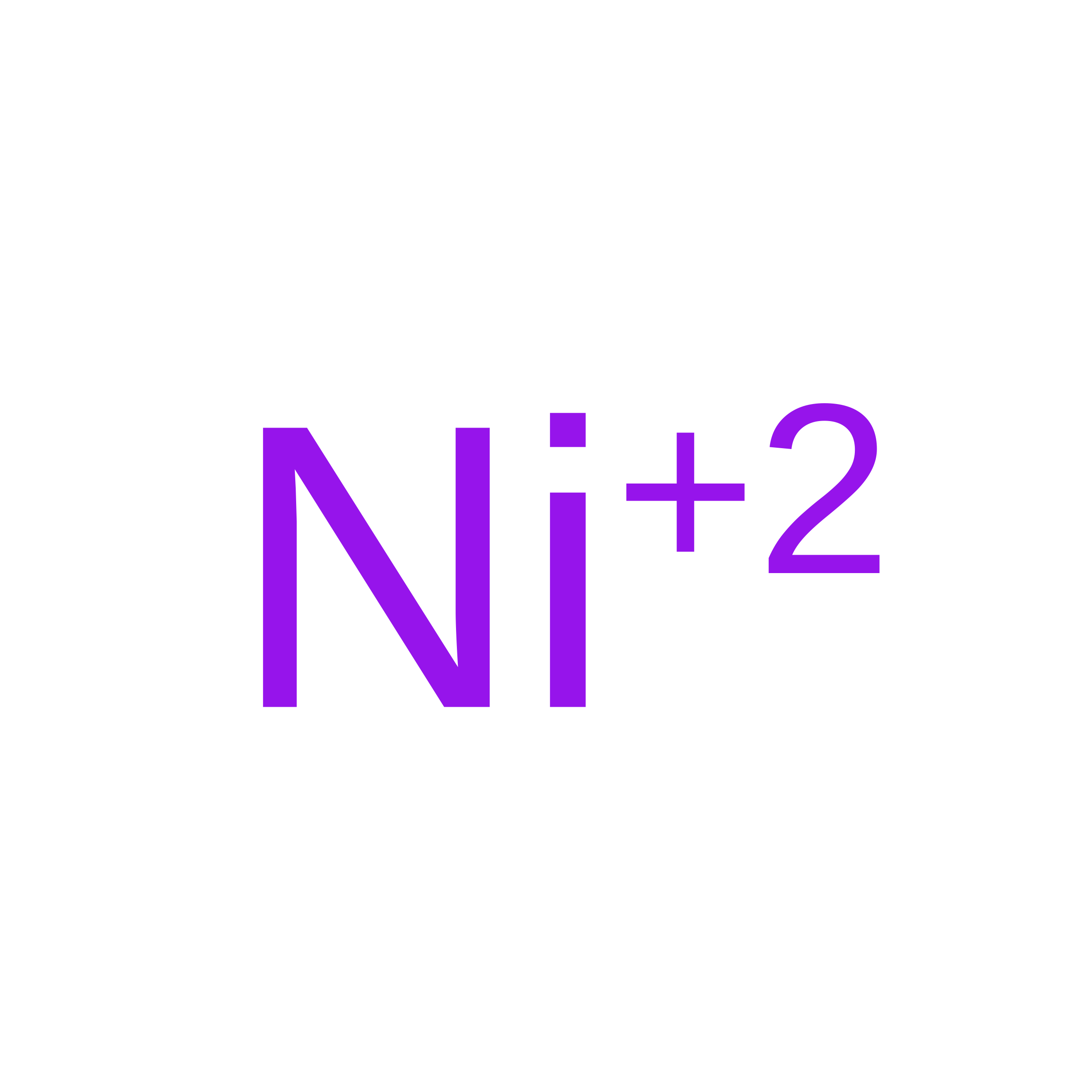
NICKEL (II) ION
Ni
VEQPNABPJHWNSG-UHFFFAOYSA-N

Experimental Data & Validation

Experimental Data

  • Method: X-RAY DIFFRACTION
  • Resolution: 2.00 Å
  • R-Value Free:  0.227 (Depositor), 0.227 (DCC) 
  • R-Value Work:  0.199 (Depositor), 0.199 (DCC) 
Space Group: I 41 2 2
Unit Cell:
Length ( Å )Angle ( ˚ )
a = 109.7α = 90
b = 109.7β = 90
c = 109.68γ = 90
Software Package:
Software NamePurpose
DENZOdata reduction
SCALEPACKdata scaling
MOLREPphasing
CNSrefinement

Structure Validation

View Full Validation Report


Entry History 

Deposition Data

Revision History  (Full details and data files)

  • Version 1.0: 2003-09-23
    Type: Initial release
  • Version 1.1: 2008-04-29
    Changes: Version format compliance
  • Version 1.2: 2011-07-13
    Changes: Source and taxonomy, Version format compliance
  • Version 1.3: 2021-11-10
    Changes: Database references, Derived calculations
  • Version 1.4: 2023-10-25
    Changes: Data collection, Refinement description