1QX0 | pdb_00001qx0

CONJUGATIVE RELAXASE TRWC IN COMPLEX WITH ORIT DNA. METAL-BOUND STRUCTURE


Experimental Data Snapshot

  • Method: X-RAY DIFFRACTION
  • Resolution: 2.26 Å
  • R-Value Free: 
    0.281 (Depositor) 
  • R-Value Work: 
    0.234 (Depositor) 
  • R-Value Observed: 
    0.239 (Depositor) 

Starting Model: experimental
View more details

wwPDB Validation 3D Report Full Report

Validation slider image for 1QX0

This is version 1.5 of the entry. See complete history

Literature

RECOGNITION AND PROCESSING OF THE ORIGIN OF TRANSFER DNA BY CONJUGATIVE RELAXASE TRWC

Guasch, A.Lucas, M.Moncalian, G.Cabezas, M.Prez-Luque, R.Gomis-Rth, F.X.de la Cruz, F.Coll, M.

(2003) Nat Struct Biol 10: 1002-1010

  • DOI: https://doi.org/10.1038/nsb1017
  • Primary Citation Related Structures: 
    1OMH, 1OSB, 1QX0

  • PubMed Abstract: 

    Relaxases are DNA strand transferases that catalyze the initial and final stages of DNA processing during conjugative cell-to-cell DNA transfer. Upon binding to the origin of transfer (oriT) DNA, relaxase TrwC melts the double helix. The three-dimensional structure of the relaxase domain of TrwC in complex with its cognate DNA at oriT shows a fold built on a two-layer alpha/beta sandwich, with a deep narrow cleft that houses the active site. The DNA includes one arm of an extruded cruciform, an essential feature for specific recognition. This arm is firmly embraced by the protein through a beta-ribbon positioned in the DNA major groove and a loop occupying the minor groove. It is followed by a single-stranded DNA segment that enters the active site, after a sharp U-turn forming a hydrophobic cage that traps the N-terminal methionine. Structural analysis combined with site-directed mutagenesis defines the architecture of the active site.


  • Organizational Affiliation
    • Institut de Biologia Molecular de Barcelona, CSIC, Jordi Girona, 18-26, 08034 Barcelona, Spain.

Macromolecule Content 

  • Total Structure Weight: 40.96 kDa 
  • Atom Count: 2,984 
  • Modeled Residue Count: 314 
  • Deposited Residue Count: 318 
  • Unique protein chains: 1
  • Unique nucleic acid chains: 1

Macromolecules


Find similar proteins by:|  3D Structure
Entity ID: 2
MoleculeChains  Sequence LengthOrganismDetailsImage
trwC proteinB [auth A]293Escherichia coliMutation(s): 4 
UniProt
Find proteins for Q47673 (Escherichia coli)
Explore Q47673 
Go to UniProtKB:  Q47673
Entity Groups
Sequence Clusters30% Identity50% Identity70% Identity90% Identity95% Identity100% Identity
UniProt GroupQ47673
Sequence Annotations
Expand
Reference Sequence
Find similar nucleic acids by:  Sequence
Entity ID: 1
MoleculeChains LengthOrganismImage
DNA OLIGONUCLEOTIDEA [auth B]25N/A
Sequence Annotations
Expand
Reference Sequence

Small Molecules

Ligands 2 Unique
IDChains Name / Formula / InChI Key2D Diagram3D Interactions
SO4

Query on SO4


Download:Ideal Coordinates CCD File
C [auth B]SULFATE ION
O4 S
QAOWNCQODCNURD-UHFFFAOYSA-L
ZN

Query on ZN


Download:Ideal Coordinates CCD File
D [auth A]ZINC ION
Zn
PTFCDOFLOPIGGS-UHFFFAOYSA-N
Modified Residues  1 Unique
IDChains TypeFormula2D DiagramParent
MSE
Query on MSE
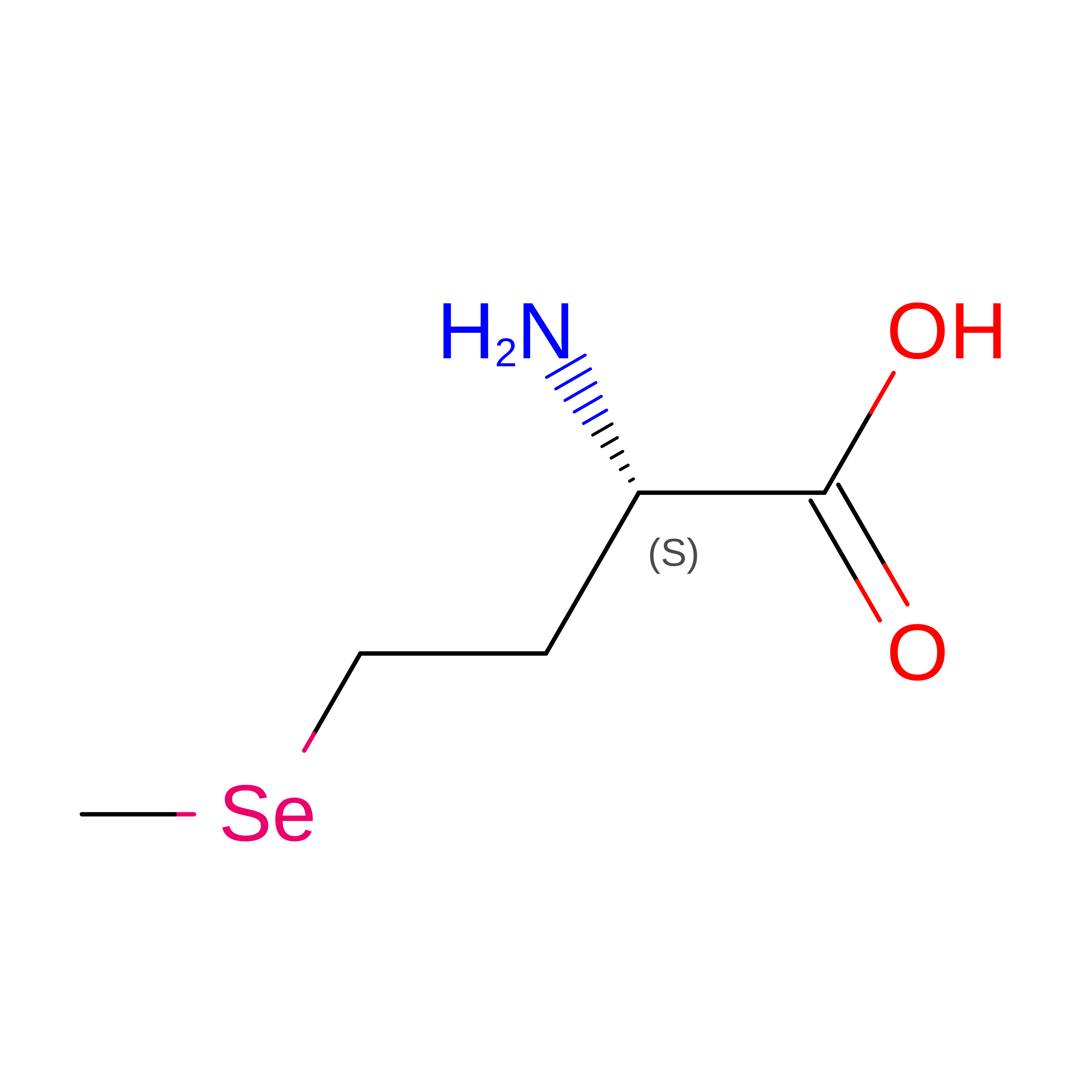
B [auth A]L-PEPTIDE LINKINGC5 H11 N O2 SeMET

Experimental Data & Validation

Experimental Data

  • Method: X-RAY DIFFRACTION
  • Resolution: 2.26 Å
  • R-Value Free:  0.281 (Depositor) 
  • R-Value Work:  0.234 (Depositor) 
  • R-Value Observed: 0.239 (Depositor) 
Space Group: P 61 2 2
Unit Cell:
Length ( Å )Angle ( ˚ )
a = 91.185α = 90
b = 91.185β = 90
c = 205.034γ = 120
Software Package:
Software NamePurpose
REFMACrefinement
MOSFLMdata reduction
CCP4data scaling
CNSphasing

Structure Validation

View Full Validation Report


Entry History 

Deposition Data

Revision History  (Full details and data files)

  • Version 1.0: 2003-11-25
    Type: Initial release
  • Version 1.1: 2008-04-29
    Changes: Version format compliance
  • Version 1.2: 2011-07-13
    Changes: Version format compliance
  • Version 1.3: 2023-08-16
    Changes: Data collection, Database references, Derived calculations, Refinement description
  • Version 1.4: 2023-11-15
    Changes: Data collection
  • Version 1.5: 2024-10-30
    Changes: Structure summary