1QVY | pdb_00001qvy

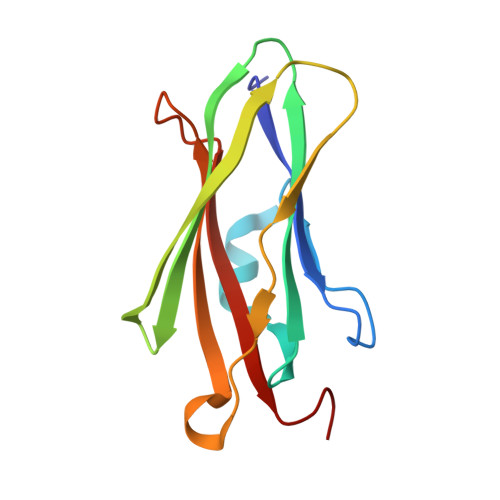
Crystal structure of RhoGDI K(199,200)R double mutant


Experimental Data Snapshot

  • Method: X-RAY DIFFRACTION
  • Resolution: 1.60 Å
  • R-Value Free: 
    0.210 (Depositor), 0.220 (DCC) 
  • R-Value Work: 
    0.172 (Depositor), 0.183 (DCC) 
  • R-Value Observed: 
    0.173 (Depositor) 

Starting Model: experimental
View more details

wwPDB Validation 3D Report Full Report

Validation slider image for 1QVY

This is version 1.4 of the entry. See complete history

Literature

The impact of Lys-->Arg surface mutations on the crystallization of the globular domain of RhoGDI.

Czepas, J.Devedjiev, Y.Krowarsch, D.Derewenda, U.Otlewski, J.Derewenda, Z.S.

(2004) Acta Crystallogr D Biol Crystallogr 60: 275-280

  • DOI: https://doi.org/10.1107/S0907444903026271
  • Primary Citation Related Structures: 
    1QVY

  • PubMed Abstract: 

    The potential of rational surface mutagenesis for enhanced protein crystallization is being probed in an ongoing effort. In previous work, it was hypothesized that residues with high conformational entropy such as Glu and Lys are suitable targets for surface mutagenesis, as they are rarely incorporated in crystal contacts or protein-protein interfaces. Previous experiments using Lys-->Ala, Glu-->Ala and Glu-->Asp mutants confirmed that mutated proteins were more likely to crystallize. In the present paper, the usefulness of Lys-->Arg mutations is studied. Several mutations of the globular domain of human RhoGDI were generated, including the single mutants K105R, K113R, K127R, K138R and K141R, the double mutants K(98,99)R and K(199,200)R and the triple mutants K(98,99,105)R and K(135,138,141)R. It is shown that Lys-->Arg mutants are more likely to crystallize than the wild-type protein, although not as likely as Lys-->Ala mutants. Out of the nine mutants tested, five produced diffracting crystals, including the K(199,200)R double mutant, which crystallized in a new space group and exceeded by approximately 1.0 A the resolution of the diffraction of the wild-type crystal. Major crystal contacts in the new lattice were created by the mutated epitope.


  • Organizational Affiliation
    • Department of Molecular Physiology and Biological Physics, University of Virginia, Charlottesville, VA 22908-0736, USA.

Macromolecule Content 

  • Total Structure Weight: 64.87 kDa 
  • Atom Count: 5,291 
  • Modeled Residue Count: 552 
  • Deposited Residue Count: 556 
  • Unique protein chains: 1

Macromolecules

Find similar proteins by:|  3D Structure
Entity ID: 1
MoleculeChains  Sequence LengthOrganismDetailsImage
Rho GDP-dissociation inhibitor 1
A, B, C, D
139Homo sapiensMutation(s): 2 
UniProt & NIH Common Fund Data Resources
Find proteins for P52565 (Homo sapiens)
Explore P52565 
Go to UniProtKB:  P52565
PHAROS:  P52565
GTEx:  ENSG00000141522 
Entity Groups
Sequence Clusters30% Identity50% Identity70% Identity90% Identity95% Identity100% Identity
UniProt GroupP52565
Sequence Annotations
Expand
Reference Sequence

Experimental Data & Validation

Experimental Data

  • Method: X-RAY DIFFRACTION
  • Resolution: 1.60 Å
  • R-Value Free:  0.210 (Depositor), 0.220 (DCC) 
  • R-Value Work:  0.172 (Depositor), 0.183 (DCC) 
  • R-Value Observed: 0.173 (Depositor) 
Space Group: C 1 2 1
Unit Cell:
Length ( Å )Angle ( ˚ )
a = 148.66α = 90
b = 58.24β = 92.49
c = 75.05γ = 90
Software Package:
Software NamePurpose
HKL-2000data collection
SCALEPACKdata scaling
AMoREphasing
REFMACrefinement
HKL-2000data reduction

Structure Validation

View Full Validation Report


Entry History 

Deposition Data

Revision History  (Full details and data files)

  • Version 1.0: 2004-02-10
    Type: Initial release
  • Version 1.1: 2008-04-29
    Changes: Version format compliance
  • Version 1.2: 2011-07-13
    Changes: Version format compliance
  • Version 1.3: 2021-10-27
    Changes: Database references, Derived calculations
  • Version 1.4: 2023-08-16
    Changes: Data collection, Refinement description