Download Mendeley
C-reactive protein and SAP-like pentraxin are both present in Limulus polyphemus haemolymph: crystal structure of Limulus SAP.
Shrive, A.K., Metcalfe, A.M., Cartwright, J.R., Greenhough, T.J.(1999) J Mol Biol 290: 997-1008
- PubMed: 10438598 Search on PubMed
- DOI: https://doi.org/10.1006/jmbi.1999.2956
- Primary Citation Related Structures:
1QTJ - PubMed Abstract:
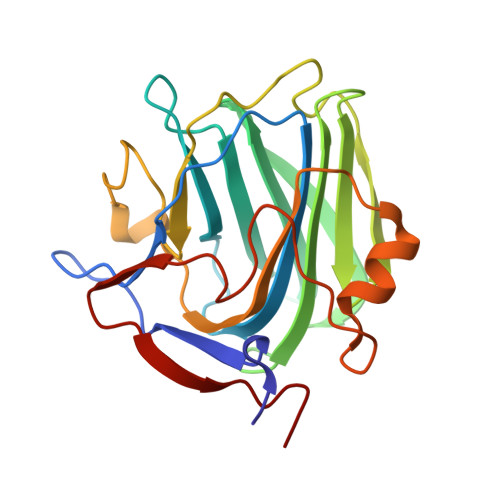
C-reactive protein and serum amyloid P component are members of the pentraxin family of oligomeric serum proteins which has been conserved through evolution. In humans both have pentameric structures and both play complex roles in the immune response, C-reactive protein being the classical acute-phase reactant produced in response to tissue damage and inflammation. An invertebrate SAP-like pentraxin has not previously been identified and it has been postulated that C-reactive protein and serum amyloid P component are products of a gene duplication event within vertebrate evolution. We have isolated serum amyloid P component from the haemolymph of the phylogenetically ancient "living fossil", the horseshoe crab Limulus polyphemus and determined the three-dimensional structure by X-ray crystallography. The structure of the previously undiscovered Limulus serum amyloid P component, the first invertebrate lectin structure to be determined, reveals the pentraxin fold and a novel doubly stacked octameric ring. The crystal structure and the discovery that both prototypic pentraxins are present in Limulus raises the possibility that both were present in the common ancestors of arthropods and chordates over 500 million years ago. The impact of the results on our understanding of the origins and evolution of pentraxins and innate immunity is discussed.
- Structural Biology Research Group, School of Life Sciences, Keele University, Keele, Staffordshire, ST5 5BG, UK.
Organizational Affiliation: