1QNX | pdb_00001qnx

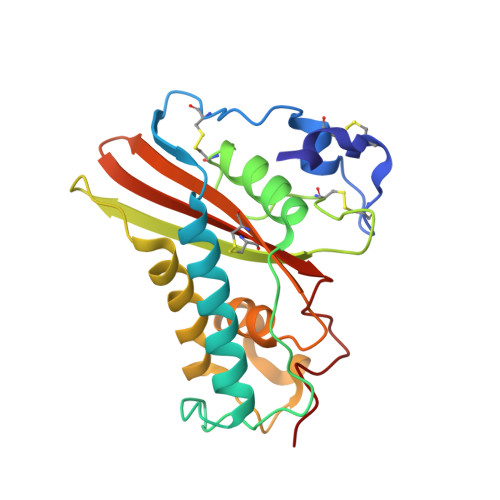
Ves v 5, an allergen from Vespula vulgaris venom


Experimental Data Snapshot

  • Method: X-RAY DIFFRACTION
  • Resolution: 1.90 Å
  • R-Value Free: 
    0.236 (Depositor) 
  • R-Value Work: 
    0.209 (Depositor), 0.215 (DCC) 
  • R-Value Observed: 
    0.209 (Depositor) 

wwPDB Validation 3D Report Full Report

Validation slider image for 1QNX

This is version 1.4 of the entry. See complete history

Literature

Major Venom Allergen of Yellow Jackets, Ves V 5: Structural Characterization of a Pathogenesis-Related Protein Superfamily.

Henriksen, A.King, T.P.Mirza, O.Monsalve, R.I.Meno, K.Ipsen, H.Larsen, J.N.Gajhede, M.Spangfort, M.D.

(2001) Proteins 45: 438

  • DOI: https://doi.org/10.1002/prot.1160
  • Primary Citation Related Structures: 
    1QNX

  • PubMed Abstract: 

    Ves v 5 is one of three major allergens found in yellow-jacket venom: phospholipase A(1) (Ves v 1), hyaluronidase (Ves v 2), and antigen 5 (Ves v 5). Ves v 5 is related by high amino acid sequence identity to pathogenesis-related proteins including proteins from mammals, reptiles, insects, fungi, and plants. The crystal structure of Ves v 5 has been solved and refined to a resolution of 1.9 A. The majority of residues conserved between the pathogenesis-related proteins can be rationalized in terms of hydrogen bonding patterns and hydrophobic interactions defining an alpha-beta-alpha sandwich core structure. A small number of consensus residues are solvent exposed (including two adjacent histidines) and located in an elongated cavity that forms a putative active site. The site has no structural resemblance to previously characterized enzymes. Homologous antigen 5's from a large number of different yellow jackets, hornets, and paper wasps are known and patients show varying extents of cross-reactivity to the related antigen 5's. The structure of Ves v 5 allows a detailed analysis of the epitopes that may participate in antigenic cross-reactivity, findings that are useful for the development of a vaccine for treatment of insect allergy.


  • Organizational Affiliation
    • Protein Structure Group, Department of Chemistry, University of Copenhagen, Copenhagen, Denmark. anette@crc.dk

Macromolecule Content 

  • Total Structure Weight: 23.89 kDa 
  • Atom Count: 1,928 
  • Modeled Residue Count: 209 
  • Deposited Residue Count: 209 
  • Unique protein chains: 1

Macromolecules

Find similar proteins by:|  3D Structure
Entity ID: 1
MoleculeChains  Sequence LengthOrganismDetailsImage
VES V 5209Vespula vulgarisMutation(s): 0 
UniProt
Find proteins for Q05110 (Vespula vulgaris)
Explore Q05110 
Go to UniProtKB:  Q05110
Entity Groups
Sequence Clusters30% Identity50% Identity70% Identity90% Identity95% Identity100% Identity
UniProt GroupQ05110
Sequence Annotations
Expand
Reference Sequence

Small Molecules

Ligands 1 Unique
IDChains Name / Formula / InChI Key2D Diagram3D Interactions
NA

Query on NA


Download:Ideal Coordinates CCD File
B [auth A]SODIUM ION
Na
FKNQFGJONOIPTF-UHFFFAOYSA-N

Experimental Data & Validation

Experimental Data

  • Method: X-RAY DIFFRACTION
  • Resolution: 1.90 Å
  • R-Value Free:  0.236 (Depositor) 
  • R-Value Work:  0.209 (Depositor), 0.215 (DCC) 
  • R-Value Observed: 0.209 (Depositor) 
Space Group: P 21 21 21
Unit Cell:
Length ( Å )Angle ( ˚ )
a = 45.359α = 90
b = 62.179β = 90
c = 82.777γ = 90
Software Package:
Software NamePurpose
DENZOdata reduction
SCALEPACKdata scaling
CNSphasing
SHARPphasing
CNSrefinement

Structure Validation

View Full Validation Report


Entry History 

Deposition Data

Revision History  (Full details and data files)

  • Version 1.0: 2000-10-26
    Type: Initial release
  • Version 1.1: 2011-05-08
    Changes: Version format compliance
  • Version 1.2: 2011-07-13
    Changes: Version format compliance
  • Version 1.3: 2018-01-17
    Changes: Data collection
  • Version 1.4: 2024-11-20
    Changes: Data collection, Database references, Derived calculations, Other, Structure summary