1Q91 | pdb_00001q91

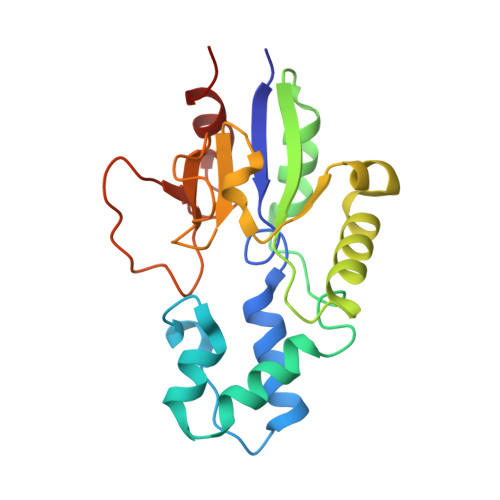
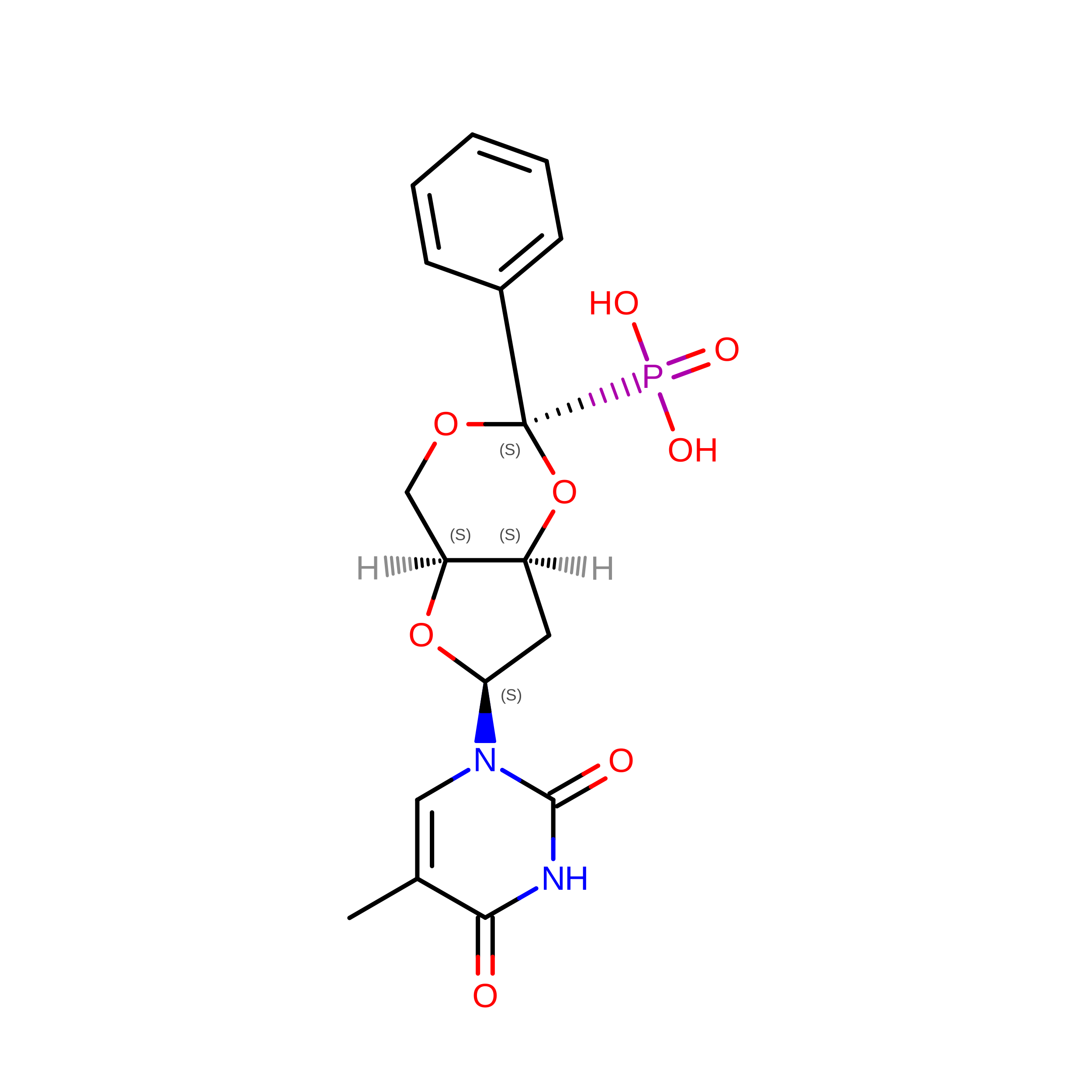
Crystal structure of human mitochondrial deoxyribonucleotidase in complex with the inhibitor DPB-T


Experimental Data Snapshot

  • Method: X-RAY DIFFRACTION
  • Resolution: 1.60 Å
  • R-Value Free: 
    0.206 (Depositor), 0.205 (DCC) 
  • R-Value Work: 
    0.186 (Depositor), 0.186 (DCC) 
  • R-Value Observed: 
    0.186 (Depositor) 

Starting Model: experimental
View more details

wwPDB Validation 3D Report Full Report

Validation slider image for 1Q91

Ligand Structure Quality Assessment 


This is version 1.3 of the entry. See complete history

Literature

Crystal structures of the mitochondrial deoxyribonucleotidase in complex with two specific inhibitors

Rinaldo-Matthis, A.Rampazzo, C.Balzarini, J.Reichard, P.Bianchi, V.Nordlund, P.

(2004) Mol Pharmacol 65: 860-867

  • DOI: https://doi.org/10.1124/mol.65.4.860
  • Primary Citation Related Structures: 
    1Q91, 1Q92

  • PubMed Abstract: 

    Monophosphate nucleotidases are enzymes that dephosphorylate nucleotides to their corresponding nucleosides. They play potentially important roles in controlling the activation of nucleotide-based drugs targeted against viral infections or cancer cells. The human mitochondrial deoxyribonucleotidase (dNT-2) dephosphorylates thymidine and deoxyuridine monophosphates. We describe the high resolution structures of the dNT-2 enzyme in complex with two potent nucleoside phosphonate inhibitors, (S)-1-[2'-deoxy-3',5'-O-(1-phosphono) benzylidene-beta-d-threo-pentofuranosyl]thymine (DPB-T) at 1.6-A resolution and (+/-)-1-trans-(2-phosphonomethoxycyclopentyl)uracil (PMcP-U) at 1.4-A resolution. The mixed competitive inhibitor DPB-T and the competitive inhibitor PMcP-U both bind in the active site of dNT-2 but in distinctly different binding modes, explaining their different kinetics of inhibition. The pyrimidine part of the inhibitors binds with very similar hydrogen bond interactions to the protein but with their phosphonate moieties in different binding sites compared with each other and to the previously determined position of phosphate bound to dNT-2. Together, these phosphate/phosphonate binding sites describe what might constitute a functionally relevant phosphate entrance tunnel to the active site. The structures of the inhibitors in complex with dNT-2, being the first such complexes of any nucleotidase, might provide important information for the design of more specific inhibitors to control the activation of nucleotide-based drugs.


  • Organizational Affiliation
    • Department of Biochemistry and Biophysics, Stockholm University, Stockholm, Sweden.

Macromolecule Content 

  • Total Structure Weight: 23.37 kDa 
  • Atom Count: 1,960 
  • Modeled Residue Count: 194 
  • Deposited Residue Count: 197 
  • Unique protein chains: 1

Macromolecules

Find similar proteins by:|  3D Structure
Entity ID: 1
MoleculeChains  Sequence LengthOrganismDetailsImage
5(3)-deoxyribonucleotidase197Homo sapiensMutation(s): 0 
EC: 3.1.3.5 (PDB Primary Data), 3.1.3 (UniProt)
UniProt & NIH Common Fund Data Resources
Find proteins for Q9NPB1 (Homo sapiens)
Explore Q9NPB1 
Go to UniProtKB:  Q9NPB1
PHAROS:  Q9NPB1
GTEx:  ENSG00000205309 
Entity Groups
Sequence Clusters30% Identity50% Identity70% Identity90% Identity95% Identity100% Identity
UniProt GroupQ9NPB1
Sequence Annotations
Expand
Reference Sequence

Small Molecules

Experimental Data & Validation

Experimental Data

  • Method: X-RAY DIFFRACTION
  • Resolution: 1.60 Å
  • R-Value Free:  0.206 (Depositor), 0.205 (DCC) 
  • R-Value Work:  0.186 (Depositor), 0.186 (DCC) 
  • R-Value Observed: 0.186 (Depositor) 
Space Group: P 43 21 2
Unit Cell:
Length ( Å )Angle ( ˚ )
a = 73.651α = 90
b = 73.651β = 90
c = 106.83γ = 90
Software Package:
Software NamePurpose
CNSrefinement
DENZOdata reduction
SCALEPACKdata scaling
CNSphasing

Structure Validation

View Full Validation Report


Ligand Structure Quality Assessment 


Entry History 

Deposition Data

Revision History  (Full details and data files)

  • Version 1.0: 2004-04-20
    Type: Initial release
  • Version 1.1: 2008-04-29
    Changes: Version format compliance
  • Version 1.2: 2011-07-13
    Changes: Version format compliance
  • Version 1.3: 2023-10-25
    Changes: Data collection, Database references, Derived calculations, Refinement description