1Q2B | pdb_00001q2b

CELLOBIOHYDROLASE CEL7A WITH DISULPHIDE BRIDGE ADDED ACROSS EXO-LOOP BY MUTATIONS D241C AND D249C


Experimental Data Snapshot

  • Method: X-RAY DIFFRACTION
  • Resolution: 1.60 Å
  • R-Value Free: 
    0.223 (Depositor), 0.223 (DCC) 
  • R-Value Work: 
    0.207 (Depositor), 0.207 (DCC) 

wwPDB Validation 3D Report Full Report

Validation slider image for 1Q2B

Ligand Structure Quality Assessment 


This is version 2.3 of the entry. See complete history

Literature

Engineering the exo-loop of Trichoderma reesei cellobiohydrolase, Cel7A. A comparison with Phanerochaete chrysosporium Cel7D.

von Ossowski, I.Stahlberg, J.Koivula, A.Piens, K.Becker, D.Boer, H.Harle, R.Harris, M.Divne, C.Mahdi, S.Zhao, Y.Driguez, H.Claeyssens, M.Sinnott, M.L.Teeri, T.T.

(2003) J Mol Biology 333: 817-829

  • DOI: https://doi.org/10.1016/s0022-2836(03)00881-7
  • Primary Citation Related Structures: 
    1Q2B, 1Q2E

  • PubMed Abstract: 

    The exo-loop of Trichoderma reesei cellobiohydrolase Cel7A forms the roof of the active site tunnel at the catalytic centre. Mutants were designed to study the role of this loop in crystalline cellulose degradation. A hydrogen bond to substrate made by a tyrosine at the tip of the loop was removed by the Y247F mutation. The mobility of the loop was reduced by introducing a new disulphide bridge in the mutant D241C/D249C. The tip of the loop was deleted in mutant Delta(G245-Y252). No major structural disturbances were observed in the mutant enzymes, nor was the thermostability of the enzyme affected by the mutations. The Y247F mutation caused a slight k(cat) reduction on 4-nitrophenyl lactoside, but only a small effect on cellulose hydrolysis. Deletion of the tip of the loop increased both k(cat) and K(M) and gave reduced product inhibition. Increased activity was observed on amorphous cellulose, while only half the original activity remained on crystalline cellulose. Stabilisation of the exo-loop by the disulphide bridge enhanced the activity on both amorphous and crystalline cellulose. The ratio Glc(2)/(Glc(3)+Glc(1)) released from cellulose, which is indicative of processive action, was highest with Tr Cel7A wild-type enzyme and smallest with the deletion mutant on both substrates. Based on these data it seems that the exo-loop of Tr Cel7A has evolved to facilitate processive crystalline cellulose degradation, which does not require significant conformational changes of this loop.


  • Organizational Affiliation
    • VTT Biotechnology, PO Box 1500, FIN-02044 VTT, Espoo, Finland.

Macromolecule Content 

  • Total Structure Weight: 46.38 kDa 
  • Atom Count: 3,593 
  • Modeled Residue Count: 434 
  • Deposited Residue Count: 434 
  • Unique protein chains: 1

Macromolecules

Find similar proteins by:|  3D Structure
Entity ID: 1
MoleculeChains  Sequence LengthOrganismDetailsImage
EXOCELLOBIOHYDROLASE I434Trichoderma reeseiMutation(s): 2 
Gene Names: cbh1
EC: 3.2.1.91
UniProt
Find proteins for P62694 (Hypocrea jecorina)
Explore P62694 
Go to UniProtKB:  P62694
Entity Groups
Sequence Clusters30% Identity50% Identity70% Identity90% Identity95% Identity100% Identity
UniProt GroupP62694
Glycosylation
Glycosylation Sites: 1
Sequence Annotations
Expand
Reference Sequence

Small Molecules

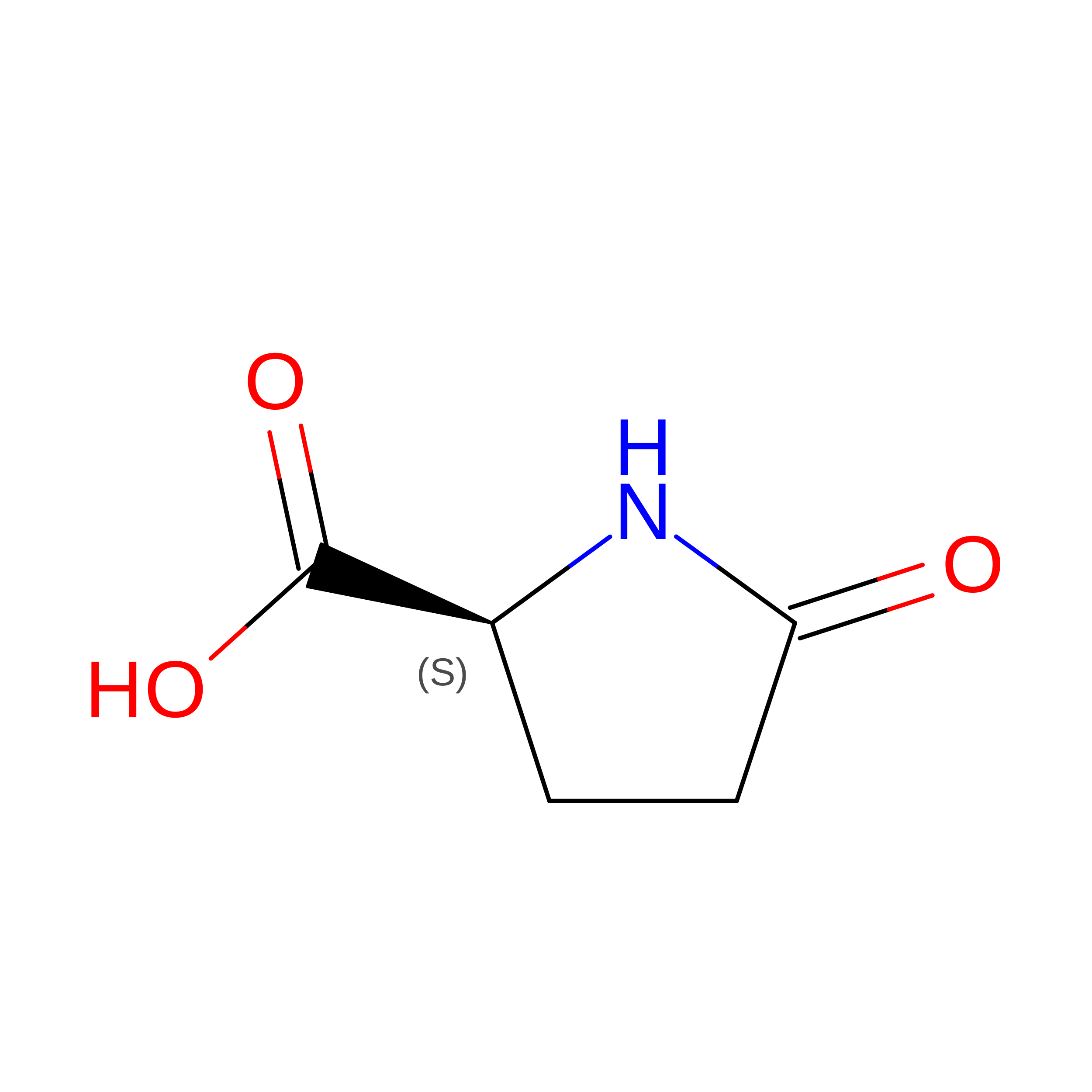
Modified Residues  1 Unique
IDChains TypeFormula2D DiagramParent
PCA
Query on PCA
A
L-PEPTIDE LINKINGC5 H7 N O3GLN

Experimental Data & Validation

Experimental Data

  • Method: X-RAY DIFFRACTION
  • Resolution: 1.60 Å
  • R-Value Free:  0.223 (Depositor), 0.223 (DCC) 
  • R-Value Work:  0.207 (Depositor), 0.207 (DCC) 
Space Group: I 2 2 2
Unit Cell:
Length ( Å )Angle ( ˚ )
a = 83.17α = 90
b = 83.14β = 90
c = 110.04γ = 90
Software Package:
Software NamePurpose
MAR345data collection
SCALEPACKdata scaling
CNSrefinement
CNSphasing

Structure Validation

View Full Validation Report


Ligand Structure Quality Assessment 


Entry History 

Deposition Data

Revision History  (Full details and data files)

  • Version 1.0: 2003-11-25
    Type: Initial release
  • Version 1.1: 2008-04-29
    Changes: Version format compliance
  • Version 1.2: 2011-07-13
    Changes: Non-polymer description, Version format compliance
  • Version 1.3: 2017-10-11
    Changes: Data collection, Refinement description
  • Version 2.0: 2019-12-25
    Changes: Database references, Derived calculations, Polymer sequence
  • Version 2.1: 2020-07-29
    Type: Remediation
    Reason: Carbohydrate remediation
    Changes: Data collection, Derived calculations, Structure summary
  • Version 2.2: 2021-10-27
    Changes: Database references, Structure summary
  • Version 2.3: 2024-11-20
    Changes: Data collection, Structure summary