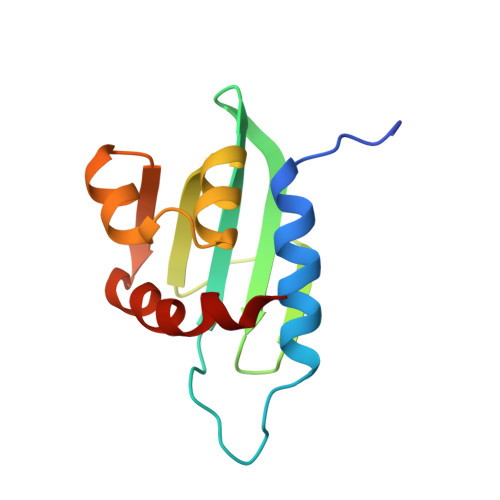
1PZ4 | pdb_00001pz4

The structural determination of an insect (mosquito) Sterol Carrier Protein-2 with a ligand bound C16 Fatty Acid at 1.35 A resolution


Experimental Data Snapshot

  • Method: X-RAY DIFFRACTION
  • Resolution: 1.35 Å
  • R-Value Free: 
    0.226 (Depositor) 
  • R-Value Work: 
    0.187 (Depositor), 0.179 (DCC) 
  • R-Value Observed: 
    0.187 (Depositor) 

wwPDB Validation 3D Report Full Report

Validation slider image for 1PZ4

Ligand Structure Quality Assessment 


This is version 1.3 of the entry. See complete history

Literature

The Structural Determination of an Insect Sterol Carrier Protein-2 with a Ligand-bound C16 Fatty Acid at 1.35A Resolution

Dyer, D.H.Lovell, S.Thoden, J.B.Holden, H.M.Rayment, I.Lan, Q.

(2003) J Biological Chem 278: 39085-39091

  • DOI: https://doi.org/10.1074/jbc.M306214200
  • Primary Citation Related Structures: 
    1PZ4

  • PubMed Abstract: 

    Yellow fever mosquito sterol carrier protein (SCP-2) is known to bind to cholesterol. We report here the three-dimensional structure of the complex of SCP-2 from Aedes aegypti with a C16 fatty acid to 1.35-A resolution. The protein fold is exceedingly similar to the human and rabbit proteins, which consist of a five-stranded beta-sheet that exhibits strand order 3-2-1-4-5 with an accompanying layer of four alpha-helices that cover the beta-sheet. A large cavity exists at the interface of the layer alpha-helices and the beta-sheet, which serves as the fatty acid binding site. The carboxylate moiety of the fatty acid is coordinated by a short loop that connects the first alpha-helix to the first beta-strand, whereas the acyl chain extends deep into the interior of the protein. Interestingly, the orientation of the fatty acid is opposite to the observed orientation for Triton X-100 in the SCP-2-like domain from the peroxisomal multifunctional enzyme (Haapalainen, A. M., van Aalten, D. M., Merilainen, G., Jalonen, J. E., Pirila, P., Wierenga, R. K., Hiltunen, J. K., and Glumoff, T. (2001) J. Mol. Biol. 313, 1127-1138). The present study suggests that the binding pocket in the SCP-2 family of proteins may exhibit conformational flexibility to allow coordination of a variety of lipids.


  • Organizational Affiliation
    • Department of Biochemistry, University of Wisconsin, Madison, Wisconsin 53706, USA.

Macromolecule Content 

  • Total Structure Weight: 13.11 kDa 
  • Atom Count: 996 
  • Modeled Residue Count: 113 
  • Deposited Residue Count: 116 
  • Unique protein chains: 1

Macromolecules

Find similar proteins by:|  3D Structure
Entity ID: 1
MoleculeChains  Sequence LengthOrganismDetailsImage
sterol carrier protein 2116Aedes aegyptiMutation(s): 0 
UniProt
Find proteins for Q86PR3 (Aedes aegypti)
Explore Q86PR3 
Go to UniProtKB:  Q86PR3
Entity Groups
Sequence Clusters30% Identity50% Identity70% Identity90% Identity95% Identity100% Identity
UniProt GroupQ86PR3
Sequence Annotations
Expand
Reference Sequence

Small Molecules

Ligands 1 Unique
IDChains Name / Formula / InChI Key2D Diagram3D Interactions
PLM

Query on PLM


Download:Ideal Coordinates CCD File
B [auth A]PALMITIC ACID
C16 H32 O2
IPCSVZSSVZVIGE-UHFFFAOYSA-N

Experimental Data & Validation

Experimental Data

  • Method: X-RAY DIFFRACTION
  • Resolution: 1.35 Å
  • R-Value Free:  0.226 (Depositor) 
  • R-Value Work:  0.187 (Depositor), 0.179 (DCC) 
  • R-Value Observed: 0.187 (Depositor) 
Space Group: P 21 21 21
Unit Cell:
Length ( Å )Angle ( ˚ )
a = 29.3α = 90
b = 46.1β = 90
c = 70.4γ = 90
Software Package:
Software NamePurpose
smartdata collection
SAINTdata reduction
EPMRphasing
TNTrefinement
SMARTdata reduction
SAINTdata scaling

Structure Validation

View Full Validation Report


Ligand Structure Quality Assessment 


Entry History 

Deposition Data

Revision History  (Full details and data files)

  • Version 1.0: 2003-09-30
    Type: Initial release
  • Version 1.1: 2008-04-29
    Changes: Version format compliance
  • Version 1.2: 2011-07-13
    Changes: Version format compliance
  • Version 1.3: 2024-02-14
    Changes: Data collection, Database references, Derived calculations