1PU8 | pdb_00001pu8

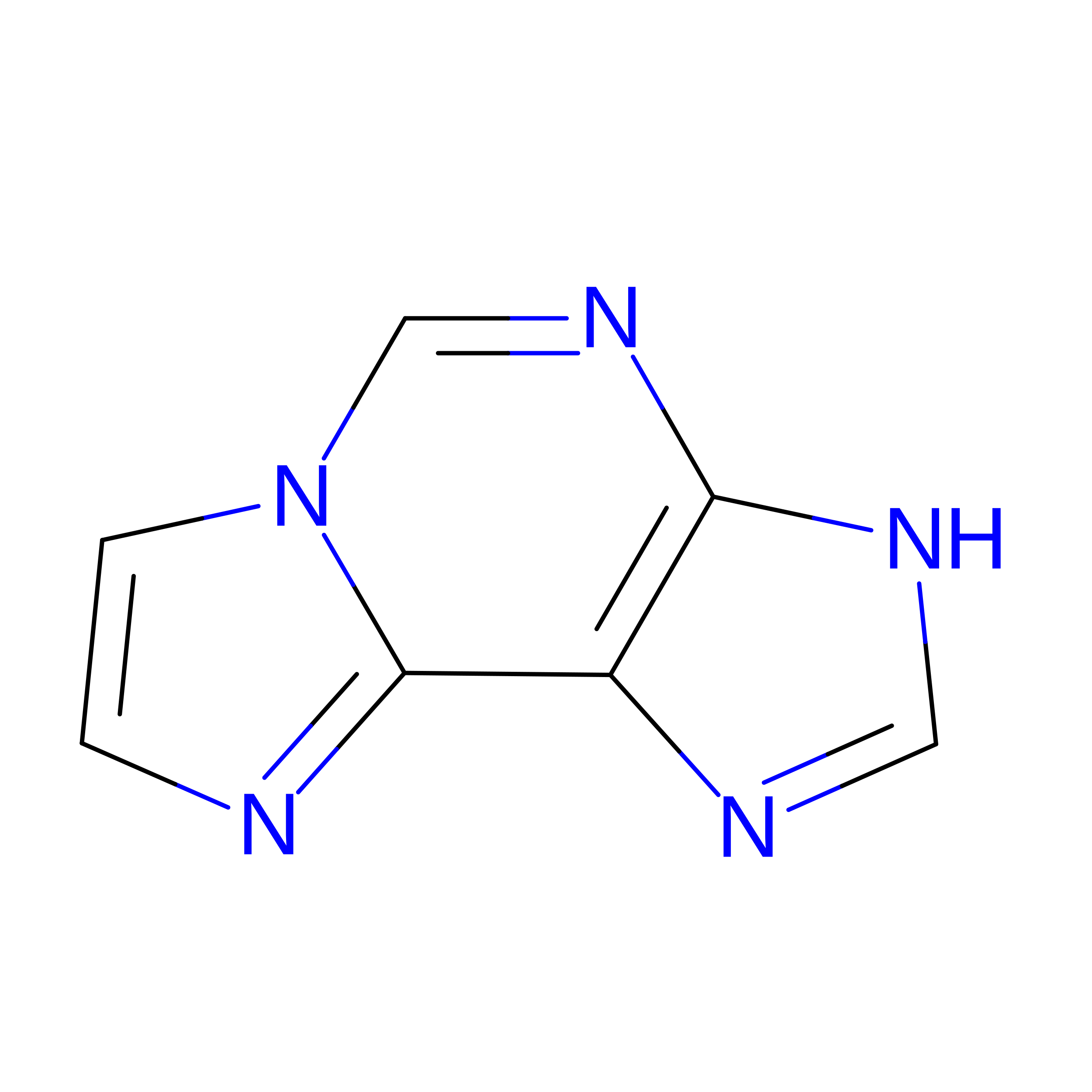
Crystal structure of H.pylori 3-methyladenine DNA glycosylase (MagIII) bound to 1,N6-ethenoadenine


Experimental Data Snapshot

  • Method: X-RAY DIFFRACTION
  • Resolution: 2.13 Å
  • R-Value Free: 
    0.230 (Depositor), 0.225 (DCC) 
  • R-Value Work: 
    0.202 (Depositor) 
  • R-Value Observed: 
    0.204 (Depositor) 

Starting Model: experimental
View more details

wwPDB Validation 3D Report Full Report

Validation slider image for 1PU8

Ligand Structure Quality Assessment 


This is version 1.4 of the entry. See complete history

Literature

Crystal structures of 3-methyladenine DNA glycosylase MagIII and the recognition of alkylated bases

Eichman, B.F.O'Rourke, E.J.Radicella, J.P.Ellenberger, T.

(2003) EMBO J 22: 4898-4909

  • DOI: https://doi.org/10.1093/emboj/cdg505
  • Primary Citation Related Structures: 
    1PU6, 1PU7, 1PU8

  • PubMed Abstract: 

    DNA glycosylases catalyze the excision of chemically modified bases from DNA. Although most glycosylases are specific to a particular base, the 3-methyladenine (m3A) DNA glycosylases include both highly specific enzymes acting on a single modified base, and enzymes with broader specificity for alkylation-damaged DNA. Our structural understanding of these different enzymatic specificities is currently limited to crystal and NMR structures of the unliganded enzymes and complexes with abasic DNA inhibitors. Presented here are high-resolution crystal structures of the m3A DNA glycosylase from Helicobacter pylori (MagIII) in the unliganded form and bound to alkylated bases 3,9-dimethyladenine and 1,N6-ethenoadenine. These are the first structures of a nucleobase bound in the active site of a m3A glycosylase belonging to the helix-hairpin-helix superfamily. MagIII achieves its specificity for positively-charged m3A not by direct interactions with purine or methyl substituent atoms, but rather by stacking the base between two aromatic side chains in a pocket that excludes 7-methylguanine. We report base excision and DNA binding activities of MagIII active site mutants, together with a structural comparison of the HhH glycosylases.


  • Organizational Affiliation
    • Department of Biological Chemistry and Molecular Pharmacology, Harvard Medical School, 240 Longwood Avenue, Boston, MA 02115, USA.

Macromolecule Content 

  • Total Structure Weight: 50.91 kDa 
  • Atom Count: 3,660 
  • Modeled Residue Count: 431 
  • Deposited Residue Count: 436 
  • Unique protein chains: 1

Macromolecules

Find similar proteins by:|  3D Structure
Entity ID: 1
MoleculeChains  Sequence LengthOrganismDetailsImage
3-METHYLADENINE DNA GLYCOSYLASE
A, B
218Helicobacter pyloriMutation(s): 1 
UniProt
Find proteins for O25323 (Helicobacter pylori (strain ATCC 700392 / 26695))
Explore O25323 
Go to UniProtKB:  O25323
Entity Groups
Sequence Clusters30% Identity50% Identity70% Identity90% Identity95% Identity100% Identity
UniProt GroupO25323
Sequence Annotations
Expand
Reference Sequence

Experimental Data & Validation

Experimental Data

  • Method: X-RAY DIFFRACTION
  • Resolution: 2.13 Å
  • R-Value Free:  0.230 (Depositor), 0.225 (DCC) 
  • R-Value Work:  0.202 (Depositor) 
  • R-Value Observed: 0.204 (Depositor) 
Space Group: C 1 2 1
Unit Cell:
Length ( Å )Angle ( ˚ )
a = 146.605α = 90
b = 44.399β = 106.4
c = 81.516γ = 90
Software Package:
Software NamePurpose
REFMACrefinement
DENZOdata reduction
SCALEPACKdata scaling

Structure Validation

View Full Validation Report


Ligand Structure Quality Assessment 


Entry History 

Deposition Data

Revision History  (Full details and data files)

  • Version 1.0: 2003-10-07
    Type: Initial release
  • Version 1.1: 2008-04-29
    Changes: Version format compliance
  • Version 1.2: 2011-07-13
    Changes: Advisory, Refinement description, Version format compliance
  • Version 1.3: 2023-08-16
    Changes: Data collection, Database references, Derived calculations, Refinement description
  • Version 1.4: 2023-11-15
    Changes: Data collection