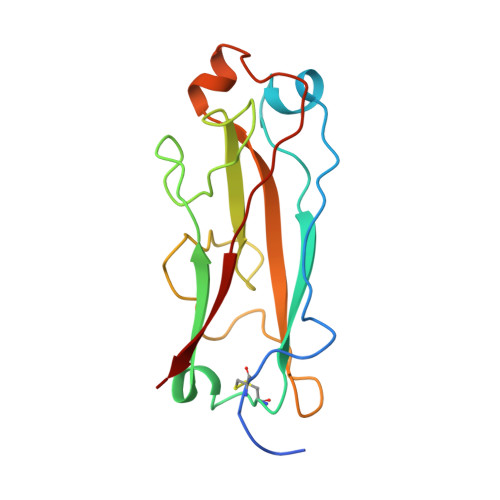
1PDK | pdb_00001pdk

PAPD-PAPK CHAPERONE-PILUS SUBUNIT COMPLEX FROM E.COLI P PILUS


Experimental Data Snapshot

  • Method: X-RAY DIFFRACTION
  • Resolution: 2.40 Å
  • R-Value Free: 
    0.273 (Depositor) 
  • R-Value Work: 
    0.235 (Depositor) 

wwPDB Validation 3D Report Full Report

Validation slider image for 1PDK

This is version 1.4 of the entry. See complete history

Literature

Structural basis of chaperone function and pilus biogenesis.

Sauer, F.G.Futterer, K.Pinkner, J.S.Dodson, K.W.Hultgren, S.J.Waksman, G.

(1999) Science 285: 1058-1061

  • DOI: https://doi.org/10.1126/science.285.5430.1058
  • Primary Citation Related Structures: 
    1PDK

  • PubMed Abstract: 

    Many Gram-negative pathogens assemble architecturally and functionally diverse adhesive pili on their surfaces by the chaperone-usher pathway. Immunoglobulin-like periplasmic chaperones escort pilus subunits to the usher, a large protein complex that facilitates the translocation and assembly of subunits across the outer membrane. The crystal structure of the PapD-PapK chaperone-subunit complex, determined at 2.4 angstrom resolution, reveals that the chaperone functions by donating its G(1) beta strand to complete the immunoglobulin-like fold of the subunit via a mechanism termed donor strand complementation. The structure of the PapD-PapK complex also suggests that during pilus biogenesis, every subunit completes the immunoglobulin-like fold of its neighboring subunit via a mechanism termed donor strand exchange.


  • Organizational Affiliation
    • Department of Molecular Microbiology, Washington University School of Medicine, 660 South Euclid Avenue, St. Louis, MO 63110, USA.

Macromolecule Content 

  • Total Structure Weight: 41.45 kDa 
  • Atom Count: 2,903 
  • Modeled Residue Count: 364 
  • Deposited Residue Count: 375 
  • Unique protein chains: 2

Macromolecules

Find similar proteins by:|  3D Structure
Entity ID: 1
MoleculeChains  Sequence LengthOrganismDetailsImage
PROTEIN (CHAPERONE PROTEIN PAPD)218Escherichia coliMutation(s): 0 
UniProt
Find proteins for P15319 (Escherichia coli)
Explore P15319 
Go to UniProtKB:  P15319
Entity Groups
Sequence Clusters30% Identity50% Identity70% Identity90% Identity95% Identity100% Identity
UniProt GroupP15319
Sequence Annotations
Expand
Reference Sequence
Find similar proteins by:|  3D Structure
Entity ID: 2
MoleculeChains  Sequence LengthOrganismDetailsImage
PROTEIN (PROTEIN PAPK)157Escherichia coliMutation(s): 0 
UniProt
Find proteins for P62532 (Escherichia coli)
Explore P62532 
Go to UniProtKB:  P62532
Entity Groups
Sequence Clusters30% Identity50% Identity70% Identity90% Identity95% Identity100% Identity
UniProt GroupP62532
Sequence Annotations
Expand
Reference Sequence

Experimental Data & Validation

Experimental Data

  • Method: X-RAY DIFFRACTION
  • Resolution: 2.40 Å
  • R-Value Free:  0.273 (Depositor) 
  • R-Value Work:  0.235 (Depositor) 
Space Group: P 21 21 21
Unit Cell:
Length ( Å )Angle ( ˚ )
a = 62.12α = 90
b = 63.69β = 90
c = 92.72γ = 90
Software Package:
Software NamePurpose
DENZOdata reduction
SCALEPACKdata scaling
SHARPphasing
CNSrefinement

Structure Validation

View Full Validation Report


Entry History 

Deposition Data

Revision History  (Full details and data files)

  • Version 1.0: 1999-08-17
    Type: Initial release
  • Version 1.1: 2008-04-26
    Changes: Version format compliance
  • Version 1.2: 2011-07-13
    Changes: Version format compliance
  • Version 1.3: 2023-12-27
    Changes: Data collection, Database references
  • Version 1.4: 2024-10-30
    Changes: Structure summary