1PC5 | pdb_00001pc5

Crystal Structure of the P50G Mutant of Ferredoxin I at 1.8 A Resolution


Experimental Data Snapshot

  • Method: X-RAY DIFFRACTION
  • Resolution: 1.80 Å
  • R-Value Free: 
    0.253 (Depositor) 
  • R-Value Work: 
    0.180 (Depositor) 
  • R-Value Observed: 
    0.183 (Depositor) 

wwPDB Validation 3D Report Full Report

Validation slider image for 1PC5

This is version 1.4 of the entry. See complete history

Literature

Mechanisms of redox-coupled proton transfer in proteins: role of the proximal proline in reactions of the [3Fe-4S] cluster in Azotobacter vinelandii ferredoxin I

Camba, R.Jung, Y.S.Hunsicker-Wang, L.M.Burgess, B.K.Stout, C.D.Hirst, J.Armstrong, F.A.

(2003) Biochemistry 42: 10589-10599

  • DOI: https://doi.org/10.1021/bi035021v
  • Primary Citation Related Structures: 
    1PC4, 1PC5

  • PubMed Abstract: 

    The 7Fe ferredoxin from Azotobacter vinelandii (AvFdI) contains a [3Fe-4S](+/0) cluster that binds a single proton in its reduced level. Although the cluster is buried, and therefore inaccessible to solvent, proton transfer from solvent to the cluster is fast. The kinetics and energetics of the coupled electron-proton transfer reaction at the cluster have been analyzed in detail by protein-film voltammetry, to reveal that proton transfer is mediated by the mobile carboxylate of an adjacent surface residue, aspartate-15, the pK of which is sensitive to the charge on the cluster. This paper examines the role of a nearby proline residue, proline-50, in proton transfer and its coupling to electron transfer. In the P50A and P50G mutants, a water molecule has entered the cluster binding region; it is hydrogen bonded to the backbone amide of residue-50 and to the Asp-15 carboxylate, and it is approximately 4 A from the closest sulfur atom of the cluster. Despite the water molecule linking the cluster more directly to the solvent, proton transfer is not accelerated. A detailed analysis reveals that Asp-15 remains a central part of the mechanism. However, the electrostatic coupling between cluster and carboxylate is almost completely quenched, so that cluster reduction no longer induces such a favorable shift in the carboxylate pK, and protonation of the base no longer induces a significant shift in the pK of the cluster. The electrostatic coupling is crucial for maintaining the efficiency of proton transfer both to and from the cluster, over a range of pH values.


  • Organizational Affiliation
    • Department of Chemistry, Oxford University, South Parks Road, Oxford, OX1 3QR, England.

Macromolecule Content 

  • Total Structure Weight: 12.8 kDa 
  • Atom Count: 944 
  • Modeled Residue Count: 106 
  • Deposited Residue Count: 107 
  • Unique protein chains: 1

Macromolecules

Find similar proteins by:|  3D Structure
Entity ID: 1
MoleculeChains  Sequence LengthOrganismDetailsImage
Ferredoxin I107Azotobacter vinelandiiMutation(s): 1 
UniProt
Find proteins for P00214 (Azotobacter vinelandii)
Explore P00214 
Go to UniProtKB:  P00214
Entity Groups
Sequence Clusters30% Identity50% Identity70% Identity90% Identity95% Identity100% Identity
UniProt GroupP00214
Sequence Annotations
Expand
Reference Sequence

Small Molecules

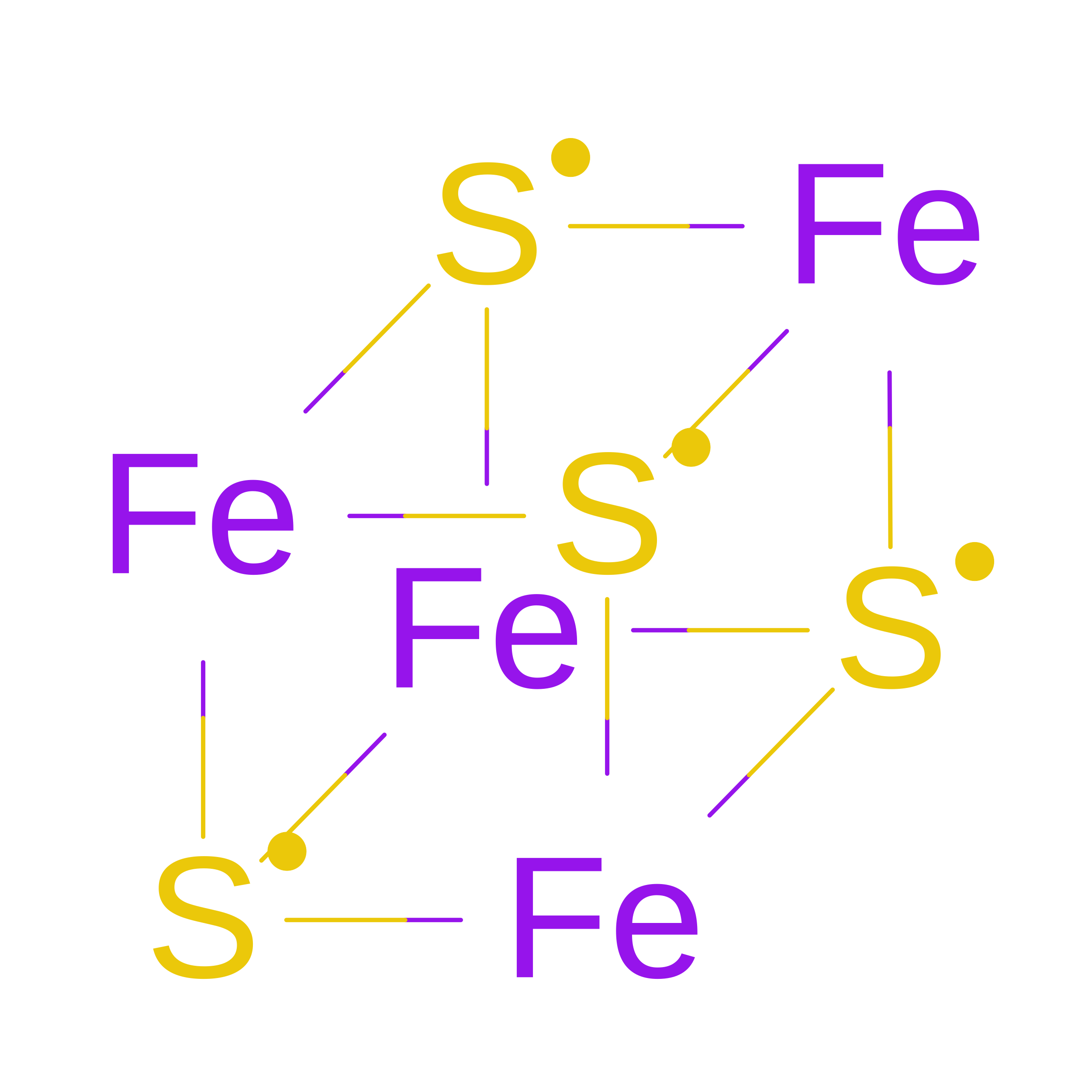
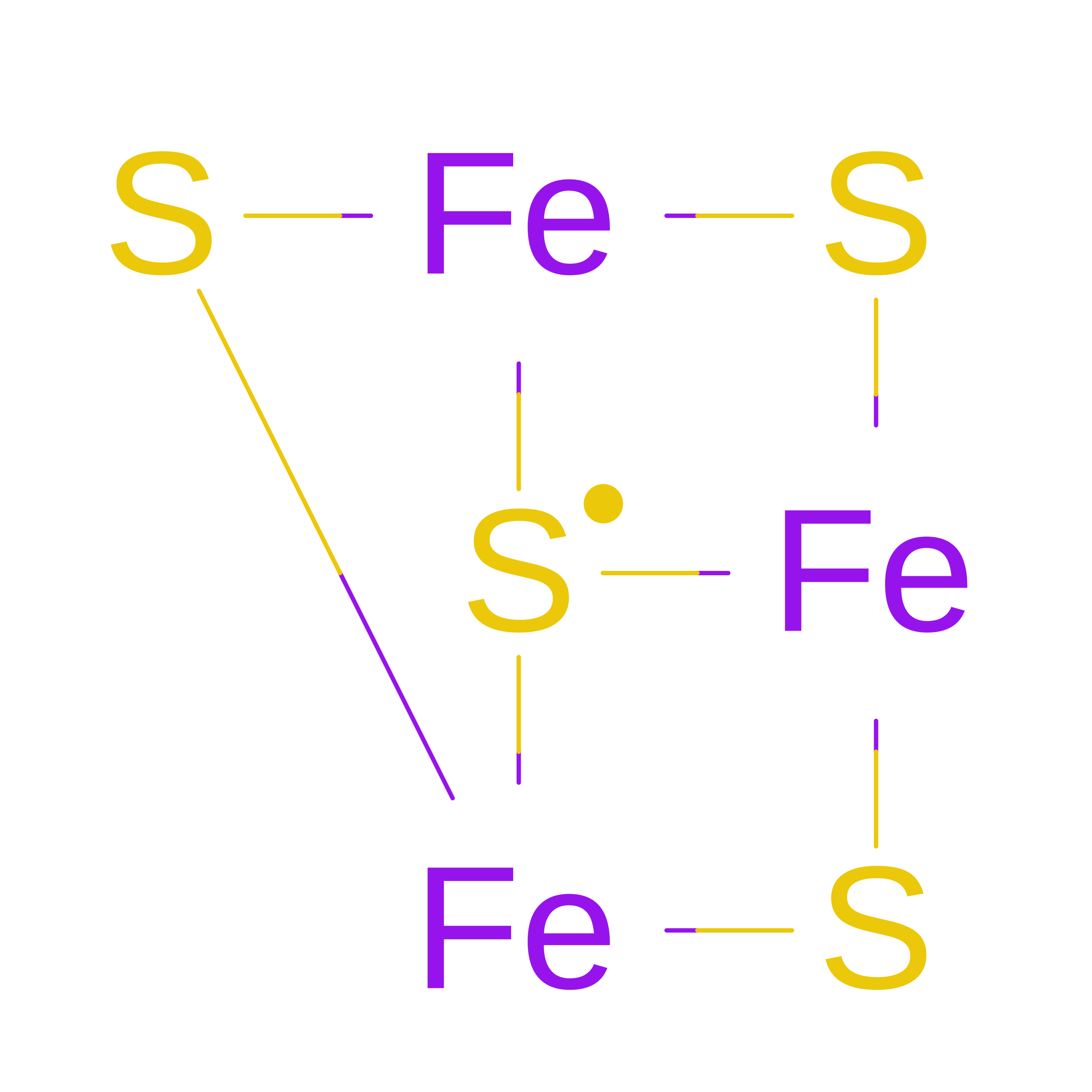
Ligands 2 Unique
IDChains Name / Formula / InChI Key2D Diagram3D Interactions
SF4

Query on SF4


Download:Ideal Coordinates CCD File
B [auth A]IRON/SULFUR CLUSTER
Fe4 S4
LJBDFODJNLIPKO-UHFFFAOYSA-N
F3S

Query on F3S


Download:Ideal Coordinates CCD File
C [auth A]FE3-S4 CLUSTER
Fe3 S4
FCXHZBQOKRZXKS-UHFFFAOYSA-N

Experimental Data & Validation

Experimental Data

  • Method: X-RAY DIFFRACTION
  • Resolution: 1.80 Å
  • R-Value Free:  0.253 (Depositor) 
  • R-Value Work:  0.180 (Depositor) 
  • R-Value Observed: 0.183 (Depositor) 
Space Group: P 41 21 2
Unit Cell:
Length ( Å )Angle ( ˚ )
a = 55.166α = 90
b = 55.166β = 90
c = 91.862γ = 90
Software Package:
Software NamePurpose
SHELXmodel building
SHELXL-97refinement
DENZOdata reduction
SCALEPACKdata scaling
SHELXphasing

Structure Validation

View Full Validation Report


Entry History 

Deposition Data

Revision History  (Full details and data files)

  • Version 1.0: 2003-09-30
    Type: Initial release
  • Version 1.1: 2008-04-29
    Changes: Version format compliance
  • Version 1.2: 2011-07-13
    Changes: Version format compliance
  • Version 1.3: 2021-10-27
    Changes: Database references, Derived calculations
  • Version 1.4: 2024-02-14
    Changes: Data collection