1P9U | pdb_00001p9u

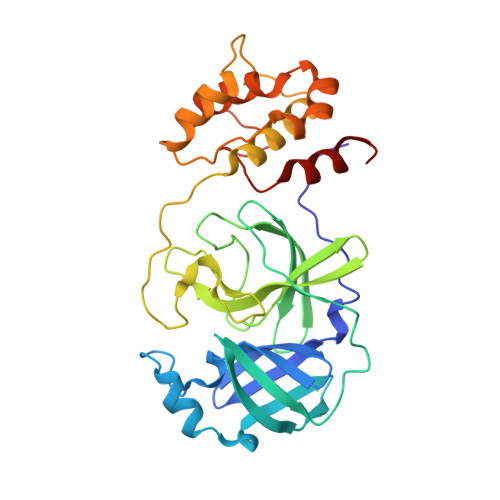
Coronavirus Main Proteinase (3CLpro) Structure: Basis for Design of anti-SARS Drugs


Experimental Data Snapshot

  • Method: X-RAY DIFFRACTION
  • Resolution: 2.37 Å
  • R-Value Free: 
    0.234 (Depositor) 
  • R-Value Work: 
    0.191 (Depositor) 
  • R-Value Observed: 
    0.200 (Depositor) 

wwPDB Validation 3D Report Full Report

Validation slider image for 1P9U

This is version 1.5 of the entry. See complete history

Literature

Coronavirus Main Proteinase (3CLpro) Structure: Basis for Design of anti-SARS Drugs

Anand, K.Ziebuhr, J.Wadhwani, P.Mesters, J.R.Hilgenfeld, R.

(2003) Science 300: 1763-1767

  • DOI: https://doi.org/10.1126/science.1085658
  • Primary Citation Related Structures: 
    1P9S, 1P9U

  • PubMed Abstract: 

    A novel coronavirus has been identified as the causative agent of severe acute respiratory syndrome (SARS). The viral main proteinase (Mpro, also called 3CLpro), which controls the activities of the coronavirus replication complex, is an attractive target for therapy. We determined crystal structures for human coronavirus (strain 229E) Mpro and for an inhibitor complex of porcine coronavirus [transmissible gastroenteritis virus (TGEV)] Mpro, and we constructed a homology model for SARS coronavirus (SARS-CoV) Mpro. The structures reveal a remarkable degree of conservation of the substrate-binding sites, which is further supported by recombinant SARS-CoV Mpro-mediated cleavage of a TGEV Mpro substrate. Molecular modeling suggests that available rhinovirus 3Cpro inhibitors may be modified to make them useful for treating SARS.


  • Organizational Affiliation
    • Institute of Biochemistry, University of Lübeck, D-23538 Lübeck, Germany.

Macromolecule Content 

  • Total Structure Weight: 203.21 kDa 
  • Atom Count: 14,981 
  • Modeled Residue Count: 1,813 
  • Deposited Residue Count: 1,828 
  • Unique protein chains: 2

Macromolecules

Find similar proteins by:|  3D Structure
Entity ID: 1
MoleculeChains  Sequence LengthOrganismDetailsImage
putative coronavirus nsp2 (3CL-PRO)
A, B, C, D, E
A, B, C, D, E, F
302Transmissible gastroenteritis virusMutation(s): 0 
Gene Names: ORF1a
UniProt
Find proteins for P0C6Y5 (Porcine transmissible gastroenteritis coronavirus (strain Purdue))
Explore P0C6Y5 
Go to UniProtKB:  P0C6Y5
Entity Groups
Sequence Clusters30% Identity50% Identity70% Identity90% Identity95% Identity100% Identity
UniProt GroupP0C6Y5
Sequence Annotations
Expand
Reference Sequence
Find similar proteins by:  Sequence   |   3D Structure  
Entity ID: 2
MoleculeChains  Sequence LengthOrganismDetailsImage
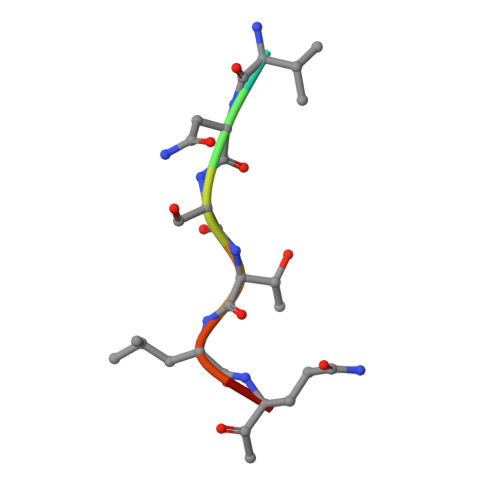
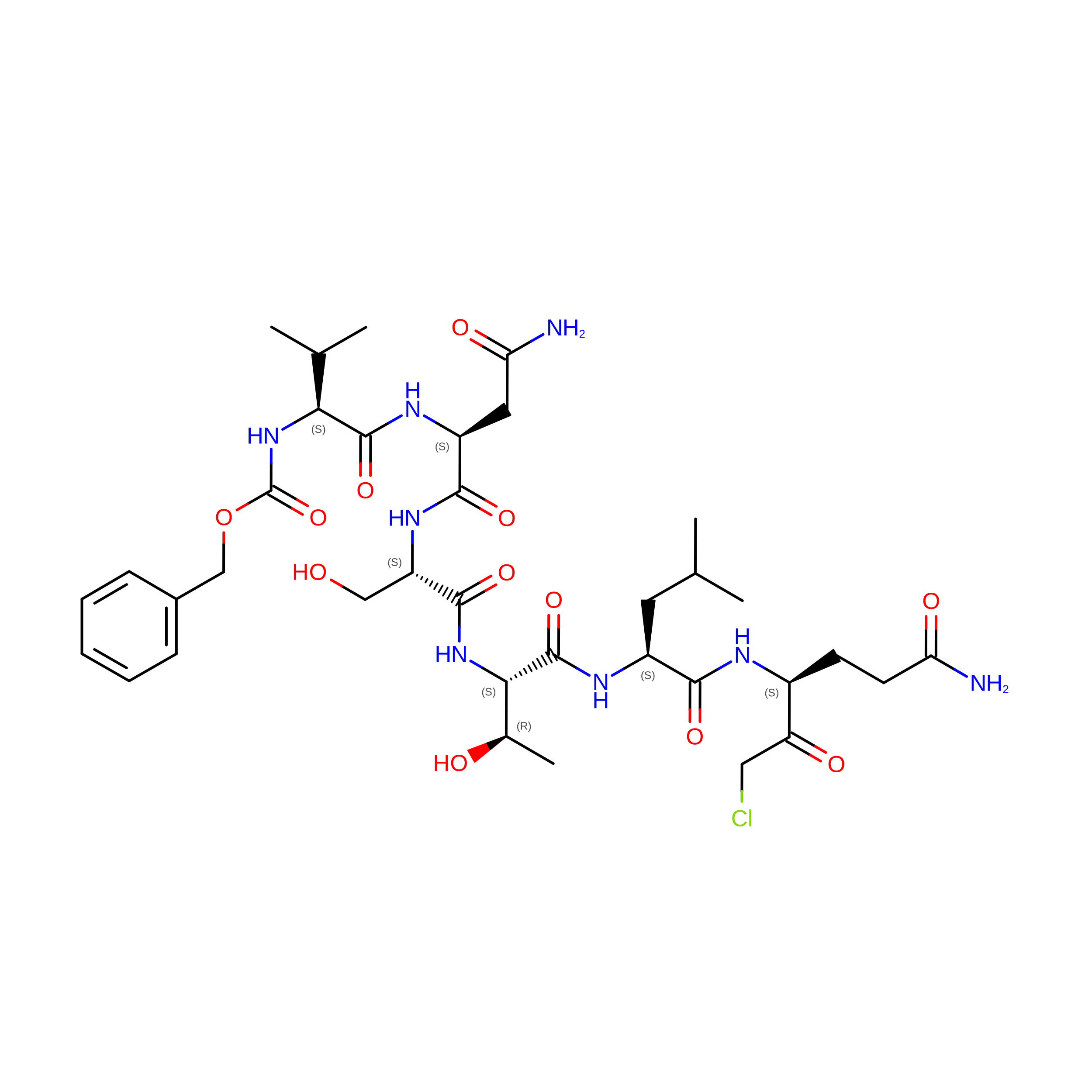
PHQ-VNSTLQ-CHLOROMETHYLKETONE INHIBITOR
G, H
8N/AMutation(s): 0 

Small Molecules

Ligands 2 Unique
IDChains Name / Formula / InChI Key2D Diagram3D Interactions
MRD

Query on MRD


Download:Ideal Coordinates CCD File
AA [auth D],
GA [auth E],
N [auth A],
U [auth C]
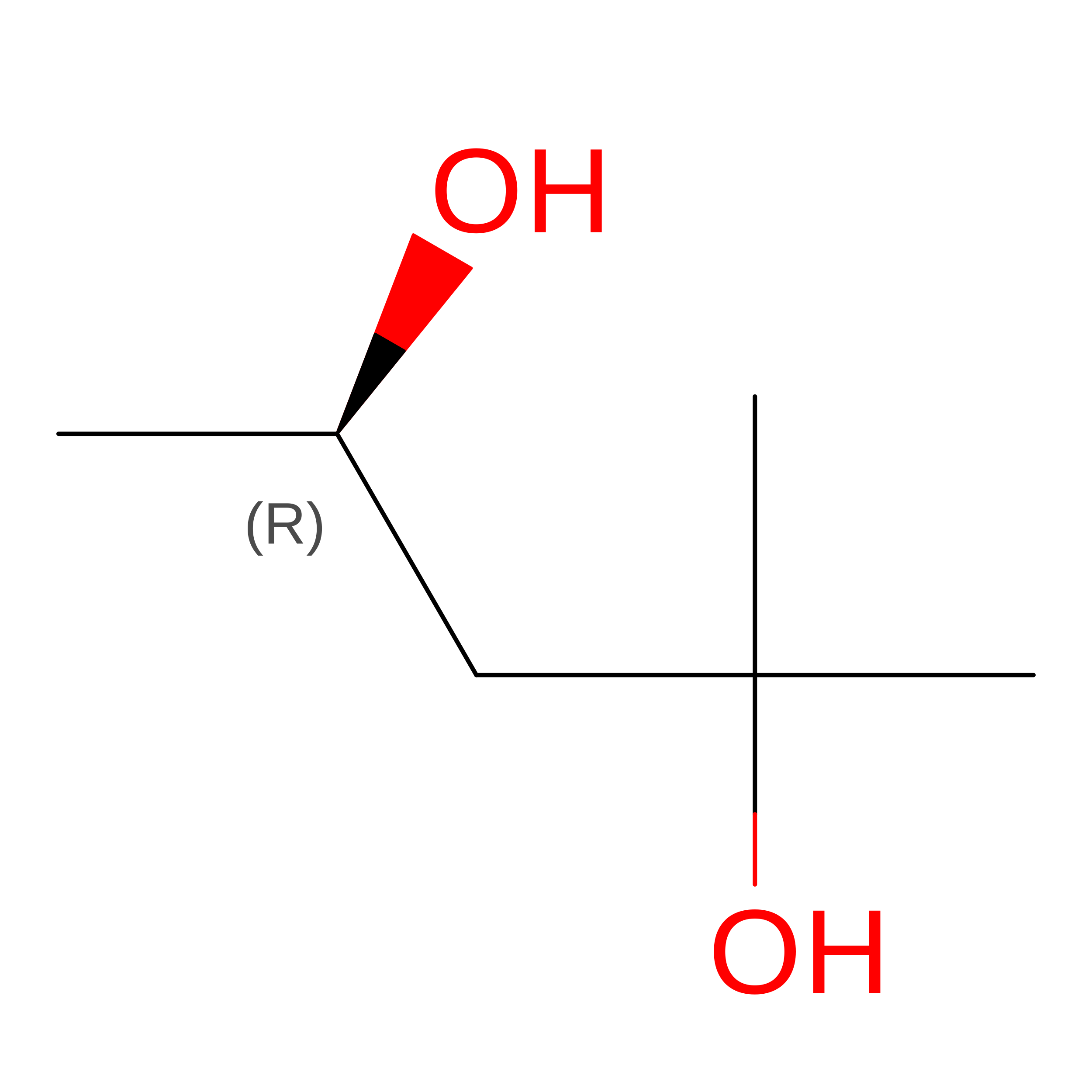
(4R)-2-METHYLPENTANE-2,4-DIOL
C6 H14 O2
SVTBMSDMJJWYQN-RXMQYKEDSA-N
SO4

Query on SO4


Download:Ideal Coordinates CCD File
BA [auth E]
CA [auth E]
DA [auth E]
EA [auth E]
FA [auth E]
BA [auth E],
CA [auth E],
DA [auth E],
EA [auth E],
FA [auth E],
HA [auth F],
I [auth A],
IA [auth F],
J [auth A],
JA [auth F],
K [auth A],
L [auth A],
M [auth A],
O [auth B],
P [auth B],
Q [auth C],
R [auth C],
S [auth C],
T [auth C],
V [auth D],
W [auth D],
X [auth D],
Y [auth D],
Z [auth D]
SULFATE ION
O4 S
QAOWNCQODCNURD-UHFFFAOYSA-L

Biologically Interesting Molecules (External Reference) 

1 Unique

Experimental Data & Validation

Experimental Data

  • Method: X-RAY DIFFRACTION
  • Resolution: 2.37 Å
  • R-Value Free:  0.234 (Depositor) 
  • R-Value Work:  0.191 (Depositor) 
  • R-Value Observed: 0.200 (Depositor) 
Space Group: P 1 21 1
Unit Cell:
Length ( Å )Angle ( ˚ )
a = 72.39α = 90
b = 158.55β = 94.4
c = 88.2γ = 90
Software Package:
Software NamePurpose
CNSrefinement
MAR345data collection
SCALEPACKdata scaling
CNSphasing

Structure Validation

View Full Validation Report


Entry History 

Deposition Data

Revision History  (Full details and data files)

  • Version 1.0: 2003-05-20
    Type: Initial release
  • Version 1.1: 2008-04-29
    Changes: Version format compliance
  • Version 1.2: 2011-07-13
    Changes: Atomic model, Database references, Derived calculations, Non-polymer description, Structure summary, Version format compliance
  • Version 1.3: 2012-12-12
    Changes: Other
  • Version 1.4: 2017-10-11
    Changes: Refinement description
  • Version 1.5: 2024-10-30
    Changes: Data collection, Database references, Derived calculations, Structure summary