1OPR | pdb_00001opr

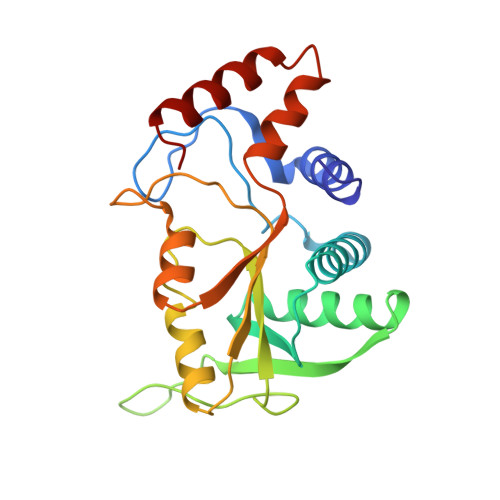
THE CRYSTAL STRUCTURE OF THE OROTATE PHOSPHORIBOSYLTRANSFERASE COMPLEXED WITH OROTATE AND ALPHA-D-5-PHOSPHORIBOSYL-1-PYROPHOSPHATE


Experimental Data Snapshot

  • Method: X-RAY DIFFRACTION
  • Resolution: 2.30 Å
  • R-Value Work: 
    0.187 (Depositor) 

wwPDB Validation 3D Report Full Report

Validation slider image for 1OPR

This is version 1.6 of the entry. See complete history

Literature

The crystal structure of the orotate phosphoribosyltransferase complexed with orotate and alpha-D-5-phosphoribosyl-1-pyrophosphate.

Scapin, G.Ozturk, D.H.Grubmeyer, C.Sacchettini, J.C.

(1995) Biochemistry 34: 10744-10754

  • DOI: https://doi.org/10.1021/bi00034a006
  • Primary Citation Related Structures: 
    1OPR

  • PubMed Abstract: 

    The three-dimensional structure of Salmonella typhimurium orotate phosphoribosyltransferase (OPRTase) in complex with the ribose 5-phosphate donor alpha-D-5--phosphoribosyl-1-pyrophosphate (PRPP) and the nitrogenous base orotic acid has been solved and refined with X-ray diffraction data extending to 2.3 A resolution to a crystallographic R-factor of 18.7%. The complex was generated by carrying out catalysis in the crystal. Comparison of this structure with the previously reported structure of the orotidine 5'-monophosphate (OMP) complex [Scapin, G., Grubmeyer, C., and Sacchettini, J. C. (1994) Biochemistry 33, 1287-1294] revealed that the enzyme backbone undergoes only small movements. The most significant differences occur near the active site, at Ala71-Gly74, with the largest difference involving the side chains of Lys73, Val127-Ala133, the 5'-phosphate binding loop, and a long, solvent-exposed loop at the dimer interface. The position of the ribose moiety is, on the other hand, very different in the OMP and PRPP.orotate complexes, with its anomeric carbon moving approximately 7 A across the binding cavity. In the PRPP.orotate complex the highly conserved acidic side chain of Asp124 interacts with the ribose of PRPP, whereas there are no interactions of this aspartate with the substrate in the OMP complex.


  • Organizational Affiliation
    • Department of Biochemistry, Albert Einstein College of Medicine, Bronx, New York 10461, USA.

Macromolecule Content 

  • Total Structure Weight: 24.16 kDa 
  • Atom Count: 1,740 
  • Modeled Residue Count: 213 
  • Deposited Residue Count: 213 
  • Unique protein chains: 1

Macromolecules

Find similar proteins by:|  3D Structure
Entity ID: 1
MoleculeChains  Sequence LengthOrganismDetailsImage
OROTATE PHOSPHORIBOSYLTRANSFERASE213Salmonella enterica subsp. enterica serovar TyphimuriumMutation(s): 0 
EC: 2.4.2.10
UniProt
Find proteins for P08870 (Salmonella typhimurium (strain LT2 / SGSC1412 / ATCC 700720))
Explore P08870 
Go to UniProtKB:  P08870
Entity Groups
Sequence Clusters30% Identity50% Identity70% Identity90% Identity95% Identity100% Identity
UniProt GroupP08870
Sequence Annotations
Expand
Reference Sequence

Small Molecules

Ligands 3 Unique
IDChains Name / Formula / InChI Key2D Diagram3D Interactions
PRP

Query on PRP


Download:Ideal Coordinates CCD File
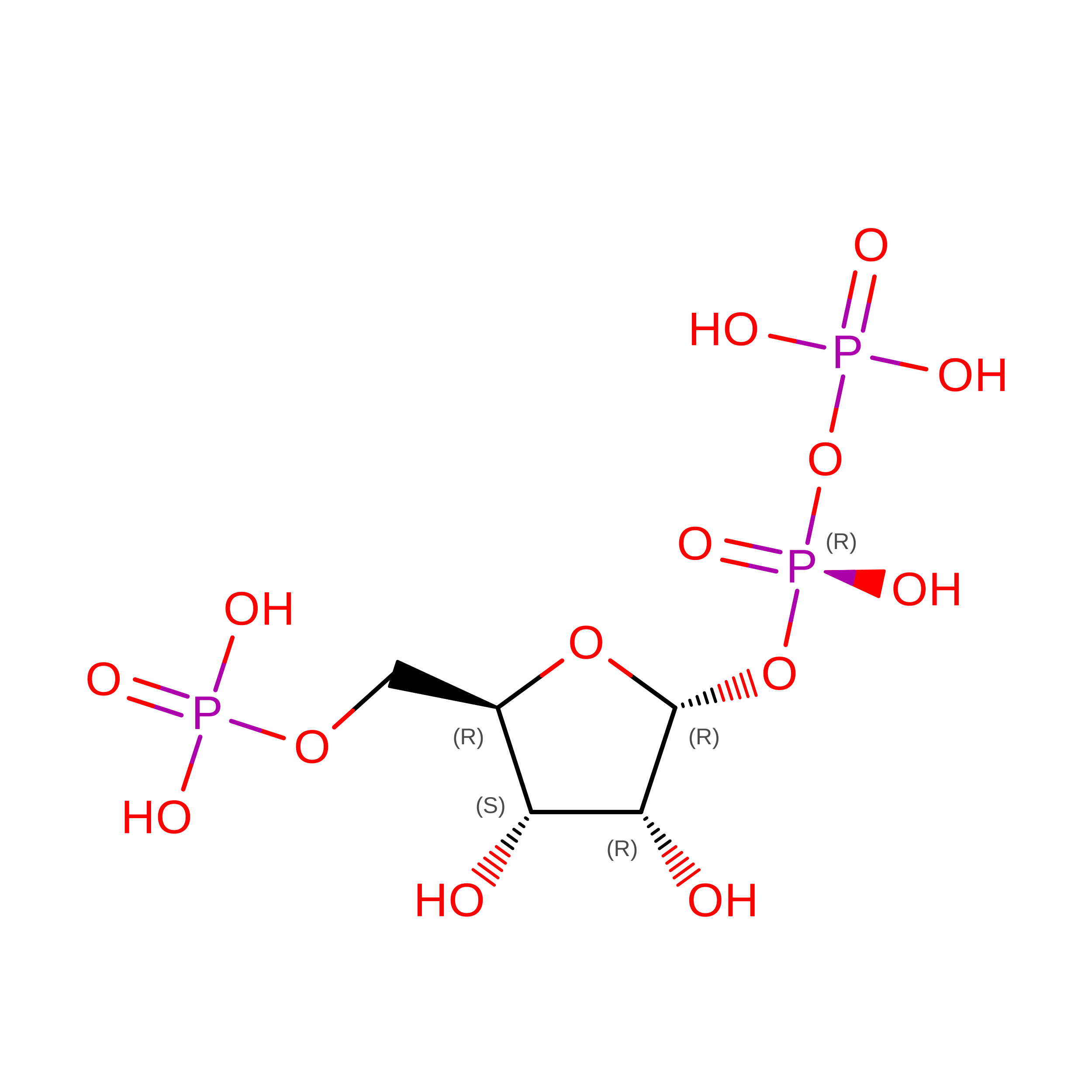
D [auth A]1-O-pyrophosphono-5-O-phosphono-alpha-D-ribofuranose
C5 H13 O14 P3
PQGCEDQWHSBAJP-TXICZTDVSA-N
ORO

Query on ORO


Download:Ideal Coordinates CCD File
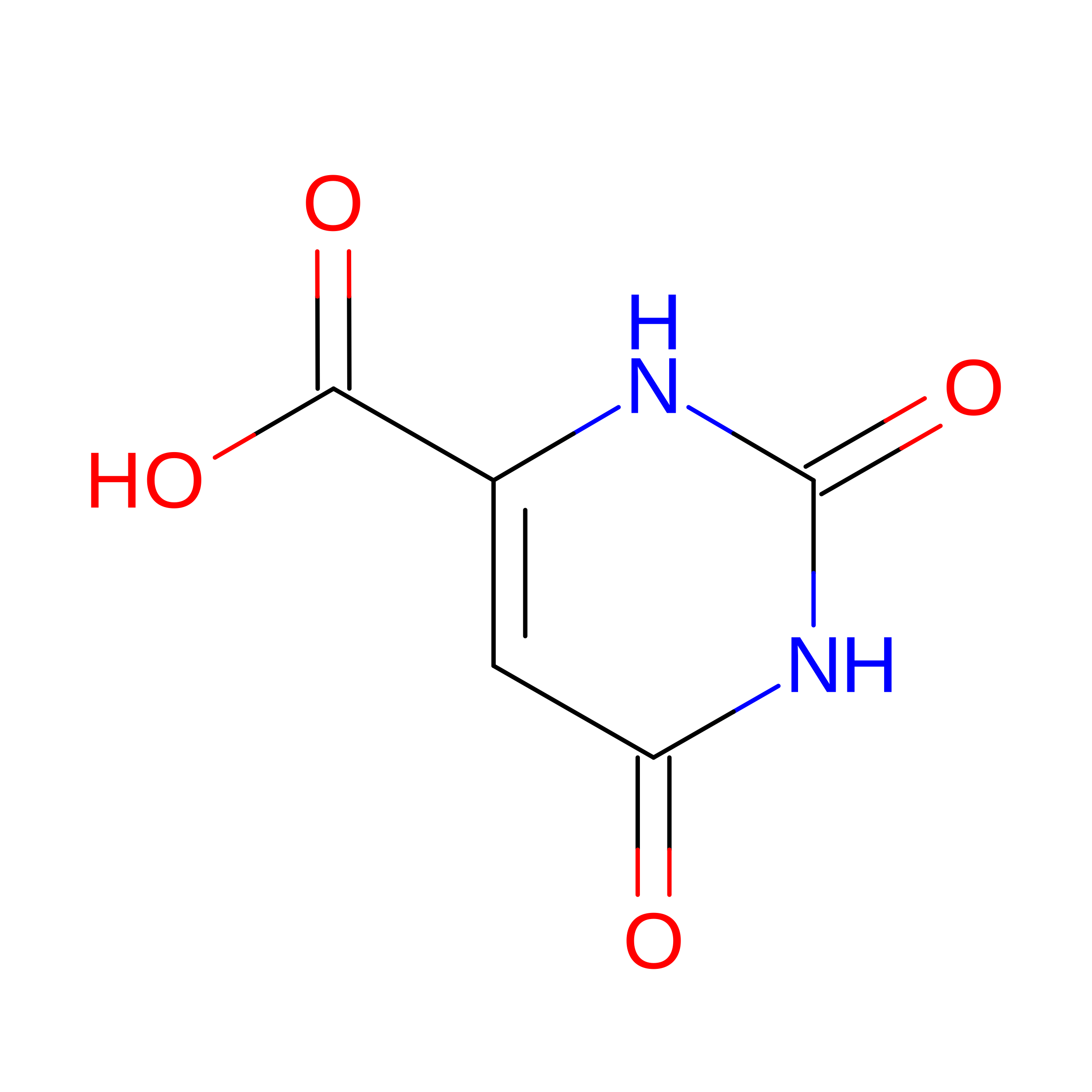
C [auth A]OROTIC ACID
C5 H4 N2 O4
PXQPEWDEAKTCGB-UHFFFAOYSA-N
MG

Query on MG


Download:Ideal Coordinates CCD File
B [auth A]MAGNESIUM ION
Mg
JLVVSXFLKOJNIY-UHFFFAOYSA-N

Experimental Data & Validation

Experimental Data

  • Method: X-RAY DIFFRACTION
  • Resolution: 2.30 Å
  • R-Value Work:  0.187 (Depositor) 
Space Group: P 41 21 2
Unit Cell:
Length ( Å )Angle ( ˚ )
a = 47.3α = 90
b = 47.3β = 90
c = 216.6γ = 90
Software Package:
Software NamePurpose
X-PLORmodel building
TNTrefinement
X-PLORrefinement
X-PLORphasing

Structure Validation

View Full Validation Report


Entry History 

Deposition Data

Revision History  (Full details and data files)

  • Version 1.0: 1996-01-06
    Type: Initial release
  • Version 1.1: 2008-03-24
    Changes: Version format compliance
  • Version 1.2: 2011-07-13
    Changes: Derived calculations, Version format compliance
  • Version 1.3: 2019-07-17
    Changes: Data collection, Other, Refinement description
  • Version 1.4: 2019-08-14
    Changes: Data collection, Refinement description
  • Version 1.5: 2020-07-29
    Type: Remediation
    Reason: Carbohydrate remediation
    Changes: Data collection, Derived calculations, Structure summary
  • Version 1.6: 2024-02-14
    Changes: Data collection, Database references, Structure summary