1OB9 | pdb_00001ob9

Holliday Junction Resolving Enzyme


Experimental Data Snapshot

  • Method: X-RAY DIFFRACTION
  • Resolution: 2.00 Å
  • R-Value Free: 
    0.240 (Depositor), 0.257 (DCC) 
  • R-Value Work: 
    0.200 (Depositor) 

Starting Model: experimental
View more details

wwPDB Validation 3D Report Full Report

Validation slider image for 1OB9

This is version 1.6 of the entry. See complete history

Literature

Substrate Recognition and Catalysis by the Holliday Junction Resolving Enzyme Hje.

Middleton, C.L.Parker, J.L.Richard, D.J.White, M.F.Bond, C.S.

(2004) Nucleic Acids Res 32: 5442

  • DOI: https://doi.org/10.1093/nar/gkh869
  • Primary Citation Related Structures: 
    1OB8, 1OB9

  • PubMed Abstract: 

    Two archaeal Holliday junction resolving enzymes, Holliday junction cleavage (Hjc) and Holliday junction endonuclease (Hje), have been characterized. Both are members of a nuclease superfamily that includes the type II restriction enzymes, although their DNA cleaving activity is highly specific for four-way junction structure and not nucleic acid sequence. Despite 28% sequence identity, Hje and Hjc cleave junctions with distinct cutting patterns--they cut different strands of a four-way junction, at different distances from the junction centre. We report the high-resolution crystal structure of Hje from Sulfolobus solfataricus. The structure provides a basis to explain the differences in substrate specificity of Hje and Hjc, which result from changes in dimer organization, and suggests a viral origin for the Hje gene. Structural and biochemical data support the modelling of an Hje:DNA junction complex, highlighting a flexible loop that interacts intimately with the junction centre. A highly conserved serine residue on this loop is shown to be essential for the enzyme's activity, suggesting a novel variation of the nuclease active site. The loop may act as a conformational switch, ensuring that the active site is completed only on binding a four-way junction, thus explaining the exquisite specificity of these enzymes.


  • Organizational Affiliation
    • Division of Biological Chemistry and Molecular Microbiology, School of Life Sciences, University of Dundee, Dundee, DD1 5EH, UK.

Macromolecule Content 

  • Total Structure Weight: 15.86 kDa 
  • Atom Count: 1,182 
  • Modeled Residue Count: 124 
  • Deposited Residue Count: 135 
  • Unique protein chains: 1

Macromolecules

Find similar proteins by:|  3D Structure
Entity ID: 1
MoleculeChains  Sequence LengthOrganismDetailsImage
HOLLIDAY JUNCTION RESOLVASE135Saccharolobus solfataricusMutation(s): 0 
EC: 3.1.21.10
UniProt
Find proteins for Q97YX6 (Saccharolobus solfataricus (strain ATCC 35092 / DSM 1617 / JCM 11322 / P2))
Explore Q97YX6 
Go to UniProtKB:  Q97YX6
Entity Groups
Sequence Clusters30% Identity50% Identity70% Identity90% Identity95% Identity100% Identity
UniProt GroupQ97YX6
Sequence Annotations
Expand
Reference Sequence

Small Molecules

Ligands 2 Unique
IDChains Name / Formula / InChI Key2D Diagram3D Interactions
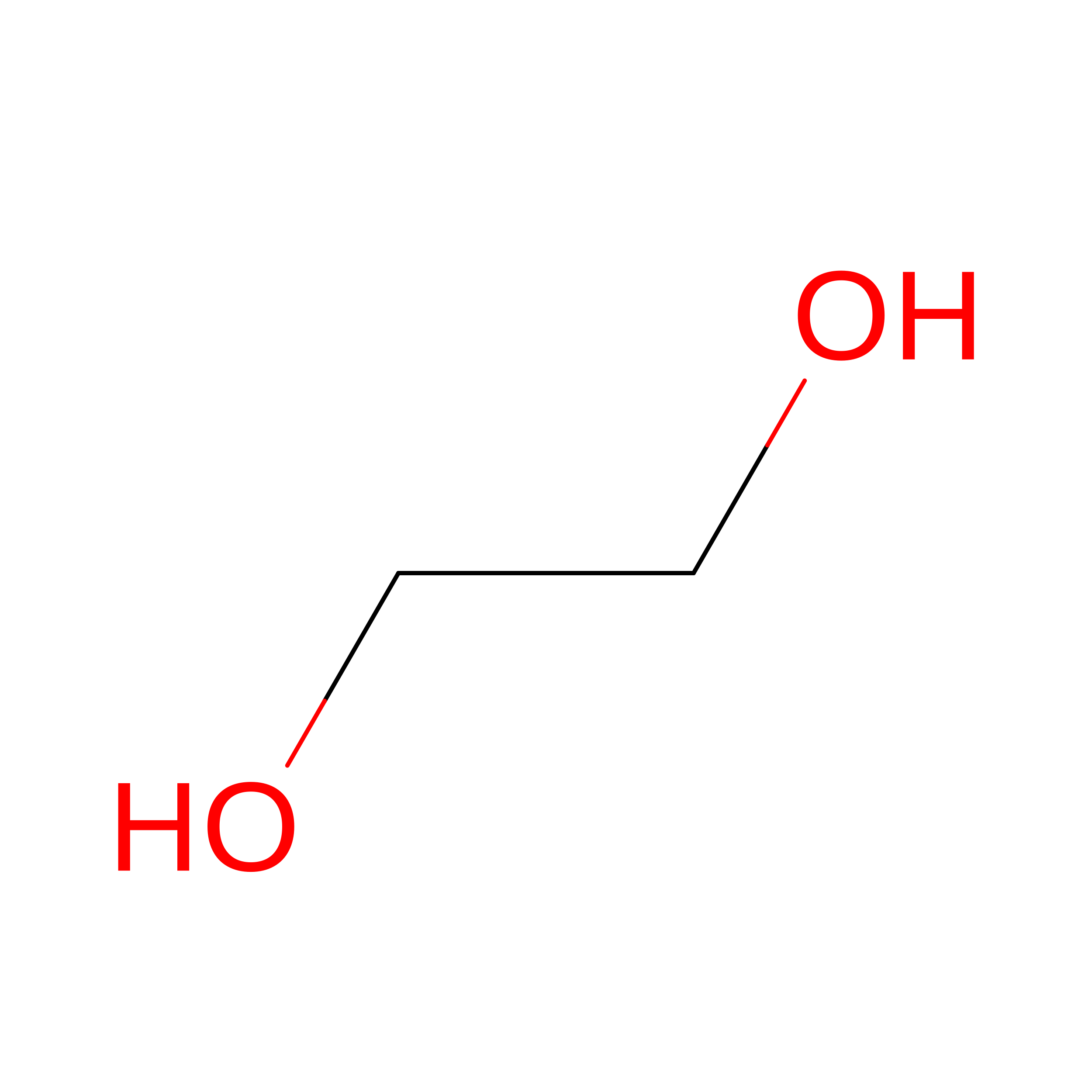
EDO

Query on EDO


Download:Ideal Coordinates CCD File
B [auth A]1,2-ETHANEDIOL
C2 H6 O2
LYCAIKOWRPUZTN-UHFFFAOYSA-N
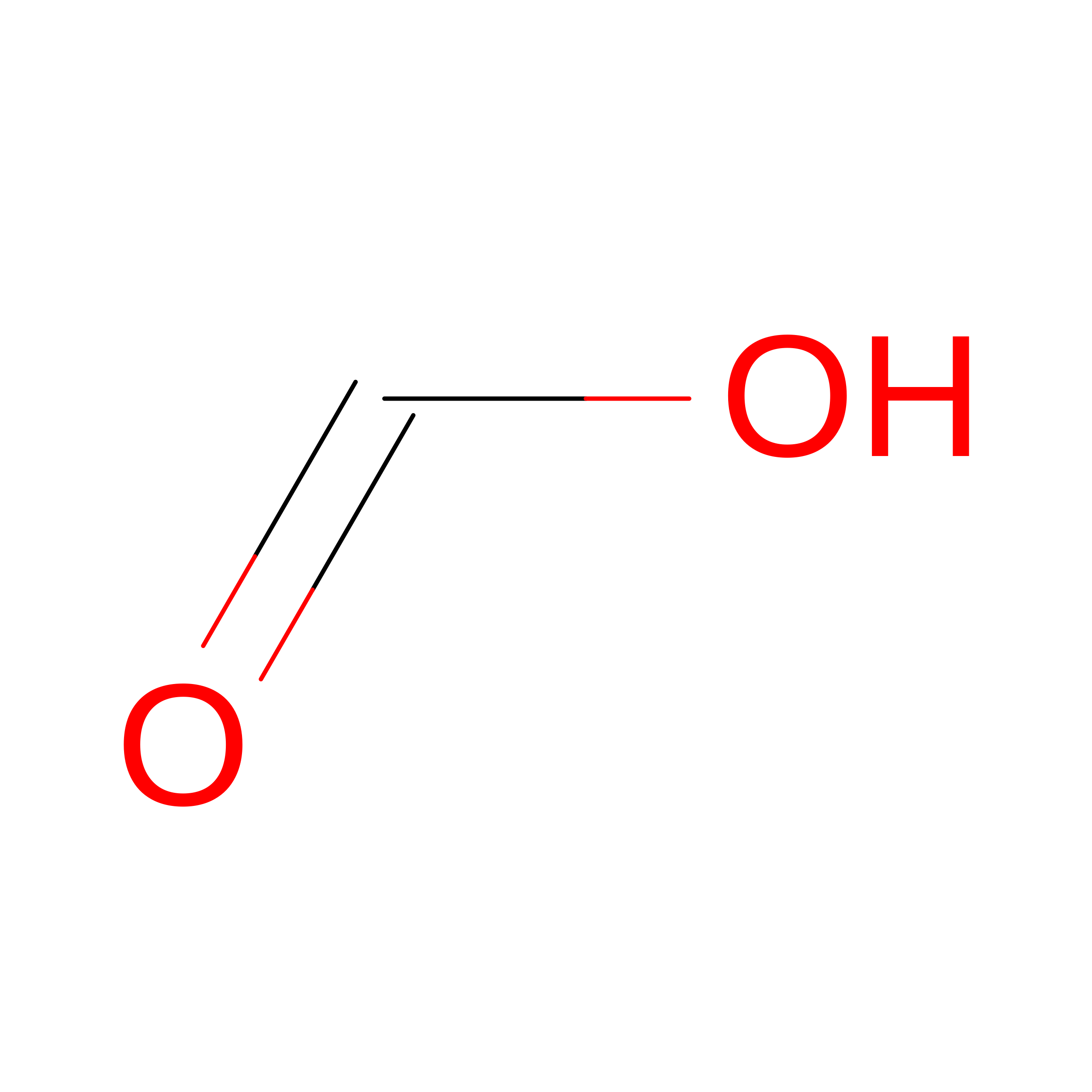
FMT

Query on FMT


Download:Ideal Coordinates CCD File
C [auth A]
D [auth A]
E [auth A]
F [auth A]
G [auth A]
C [auth A],
D [auth A],
E [auth A],
F [auth A],
G [auth A],
H [auth A],
I [auth A]
FORMIC ACID
C H2 O2
BDAGIHXWWSANSR-UHFFFAOYSA-N

Experimental Data & Validation

Experimental Data

  • Method: X-RAY DIFFRACTION
  • Resolution: 2.00 Å
  • R-Value Free:  0.240 (Depositor), 0.257 (DCC) 
  • R-Value Work:  0.200 (Depositor) 
Space Group: I 41
Unit Cell:
Length ( Å )Angle ( ˚ )
a = 76.57α = 90
b = 76.57β = 90
c = 88.944γ = 90
Software Package:
Software NamePurpose
REFMACrefinement
DENZOdata reduction
SCALEPACKdata scaling
MOLREPphasing

Structure Validation

View Full Validation Report


Entry History 

Deposition Data

Revision History  (Full details and data files)

  • Version 1.0: 2004-10-15
    Type: Initial release
  • Version 1.1: 2011-05-08
    Changes: Version format compliance
  • Version 1.2: 2011-07-13
    Changes: Version format compliance
  • Version 1.3: 2017-07-05
    Changes: Data collection
  • Version 1.4: 2018-01-31
    Changes: Source and taxonomy
  • Version 1.5: 2019-03-06
    Changes: Data collection, Experimental preparation
  • Version 1.6: 2023-12-13
    Changes: Data collection, Database references, Other, Refinement description