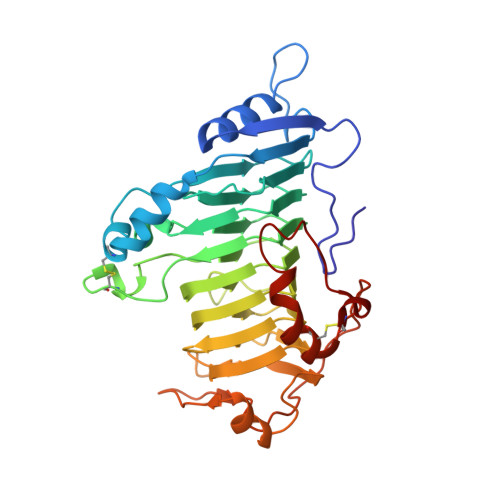
1O8K | pdb_00001o8k

Pectate Lyase C from Erwinia Chrysanthemi at pH 4.5 with 20mM CA2+


Experimental Data Snapshot

  • Method: X-RAY DIFFRACTION
  • Resolution: 2.20 Å
  • R-Value Free: 
    0.208 (Depositor) 
  • R-Value Work: 
    0.181 (Depositor), 0.246 (DCC) 
  • R-Value Observed: 
    0.181 (Depositor) 

Starting Model: experimental
View more details

wwPDB Validation 3D Report Full Report

Validation slider image for 1O8K

This is version 2.2 of the entry. See complete history

Literature

Characterization and Implications of Ca2+ Binding to Pectate Lyase C

Herron, S.R.Scavetta, R.Garrett, M.Legner, M.Jurnak, F.A.

(2003) J Biological Chem 278: 12271-12277

  • DOI: https://doi.org/10.1074/jbc.M209306200
  • Primary Citation Related Structures: 
    1O88, 1O8D, 1O8E, 1O8F, 1O8G, 1O8H, 1O8I, 1O8J, 1O8K, 1O8L, 1O8M

  • PubMed Abstract: 

    Ca(2+) is essential for in vitro activity of Erwinia chrysanthemi pectate lyase C (PelC). Crystallographic analyses of 11 PelC-Ca(2+) complexes, formed at pH 4.5, 9.5, and 11.2 under varying Ca(2+) concentrations, have been solved and refined at a resolution of 2.2 A. The Ca(2+) site represents a new motif for Ca(2+), consisting primarily of beta-turns and beta-strands. The principal differences between PelC and the PelC-Ca(2+) structures at all pH values are the side-chain conformations of Asp-129 and Glu-166 as well as the occupancies of four water molecules. According to calculations of pK(a) values, the presence of Ca(2+) and associated structural changes lower the pK(a) of Arg-218, the amino acid responsible for proton abstraction during catalysis. The Ca(2+) affinity for PelC is weak, as the K(d) was estimated to be 0.132 (+/-0.004) mm at pH 9.5, 1.09 (+/-0.29) mm at pH 11.2, and 5.84 (+/-0.41) mm at pH 4.5 from x-ray diffraction studies and 0.133 (+/-0.045) mm at pH 9.5 from intrinsic tryptophan fluorescence measurements. Given the pH dependence of Ca(2+) affinity, PelC activity at pH 4.5 has been reexamined. At saturating Ca(2+) concentrations, PelC activity increases 10-fold at pH 4.5 but is less than 1% of maximal activity at pH 9.5. Taken together, the studies suggest that the primary Ca(2+) ion in PelC has multiple functions.


  • Organizational Affiliation
    • Department of Physiology and Biophysics, University of California, Irvine, California 92697-4560, USA.

Macromolecule Content 

  • Total Structure Weight: 37.77 kDa 
  • Atom Count: 2,831 
  • Modeled Residue Count: 353 
  • Deposited Residue Count: 353 
  • Unique protein chains: 1

Macromolecules

Find similar proteins by:|  3D Structure
Entity ID: 1
MoleculeChains  Sequence LengthOrganismDetailsImage
PECTATE LYASE C353Dickeya chrysanthemiMutation(s): 0 
EC: 4.2.2.2
UniProt
Find proteins for P11073 (Dickeya chrysanthemi)
Explore P11073 
Go to UniProtKB:  P11073
Entity Groups
Sequence Clusters30% Identity50% Identity70% Identity90% Identity95% Identity100% Identity
UniProt GroupP11073
Sequence Annotations
Expand
Reference Sequence

Small Molecules

Ligands 1 Unique
IDChains Name / Formula / InChI Key2D Diagram3D Interactions
CA

Query on CA


Download:Ideal Coordinates CCD File
B [auth A]CALCIUM ION
Ca
BHPQYMZQTOCNFJ-UHFFFAOYSA-N

Experimental Data & Validation

Experimental Data

  • Method: X-RAY DIFFRACTION
  • Resolution: 2.20 Å
  • R-Value Free:  0.208 (Depositor) 
  • R-Value Work:  0.181 (Depositor), 0.246 (DCC) 
  • R-Value Observed: 0.181 (Depositor) 
Space Group: P 21 21 21
Unit Cell:
Length ( Å )Angle ( ˚ )
a = 71.91α = 90
b = 80.99β = 90
c = 95.84γ = 90
Software Package:
Software NamePurpose
X-PLORrefinement
SDMSdata reduction
SDMSdata scaling
X-PLORphasing

Structure Validation

View Full Validation Report


Entry History 

Deposition Data

Revision History  (Full details and data files)

  • Version 1.0: 2003-01-30
    Type: Initial release
  • Version 1.1: 2011-05-08
    Changes: Version format compliance
  • Version 1.2: 2011-07-13
    Changes: Version format compliance
  • Version 2.0: 2018-06-13
    Changes: Atomic model, Data collection, Database references, Structure summary
  • Version 2.1: 2023-12-13
    Changes: Data collection, Database references, Derived calculations, Other, Refinement description
  • Version 2.2: 2024-11-20
    Changes: Structure summary