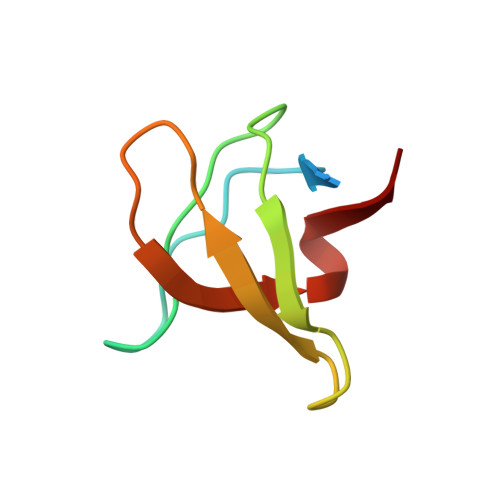
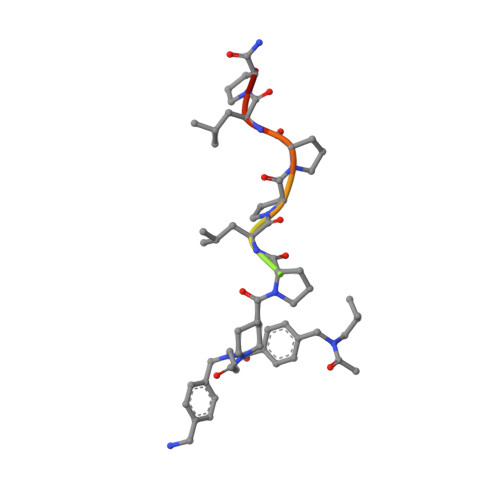
1NLO | pdb_00001nlo

STRUCTURE OF SIGNAL TRANSDUCTION PROTEIN, NMR, MINIMIZED AVERAGE STRUCTURE


Experimental Data Snapshot

  • Method: SOLUTION NMR
  • Conformers Submitted: 
  • Selection Criteria: MINIMIZED AVERAGE 

wwPDB Validation 3D Report Full Report

Validation slider image for 1NLO

This is version 2.1 of the entry. See complete history

Literature

Molecular basis for the binding of SH3 ligands with non-peptide elements identified by combinatorial synthesis.

Feng, S.Kapoor, T.M.Shirai, F.Combs, A.P.Schreiber, S.L.

(1996) Chem Biol 3: 661-670

  • DOI: https://doi.org/10.1016/s1074-5521(96)90134-9
  • Primary Citation Related Structures: 
    1NLO, 1NLP

  • PubMed Abstract: 

    Protein-structure-based combinatorial chemistry has recently been used to discover several ligands containing non-peptide binding elements to the Src SH3 domain. The encoded library used has the form Cap-M1-M2-M3-PLPPLP, in which the Cap and Mi's are composed of a diverse set of organic monomers. The PLPPLP portion provided a structural bias directing the non-peptide fragment Cap-M1-M2-M3 to the SH3 specificity pocket. Fifteen ligands were selected from > 1.1 million distinct compounds. The structural basis for selection was unknown. The solution structures of the Src SH3 domain complexed with two ligands containing non-peptide elements selected from the library were determined by multidimensional NMR spectroscopy. The non-peptide moieties of the ligands interact with the specificity pocket of Src SH3 domain differently from peptides complexed with SH3 domains. Structural information about the ligands was used to design various homologs, whose affinities for the SH3 domain were measured. The results provide a structural basis for understanding the selection of a few optimal ligands from a large library. The cycle of protein-structure-based combinatorial chemistry followed by structure determination of the few highest affinity ligands provides a powerful new tool for the field of molecular recognition.


  • Organizational Affiliation
    • Howard Hughes Medical Institute, Department of Chemistry and Chemical Biology, Harvard University, MA 02138, USA.

Macromolecule Content 

  • Total Structure Weight: 8.25 kDa 
  • Atom Count: 536 
  • Modeled Residue Count: 67 
  • Deposited Residue Count: 75 
  • Unique protein chains: 2

Macromolecules

Find similar proteins by:|  3D Structure
Entity ID: 1
MoleculeChains  Sequence LengthOrganismDetailsImage
C-SRCA [auth C]64Gallus gallusMutation(s): 0 
Gene Names: CHICKEN
EC: 2.7.1.112 (PDB Primary Data), 2.7.10.2 (UniProt)
UniProt
Find proteins for P00523 (Gallus gallus)
Explore P00523 
Go to UniProtKB:  P00523
Entity Groups
Sequence Clusters30% Identity50% Identity70% Identity90% Identity95% Identity100% Identity
UniProt GroupP00523
Sequence Annotations
Expand
Reference Sequence
Find similar proteins by:  Sequence   |   3D Structure  
Entity ID: 2
MoleculeChains  Sequence LengthOrganismDetailsImage
NL1 (MN7-MN2-MN1-PLPPLP)B [auth N]11N/AMutation(s): 0 

Experimental Data & Validation

Experimental Data

  • Method: SOLUTION NMR
  • Conformers Submitted: 
  • Selection Criteria: MINIMIZED AVERAGE 

Structure Validation

View Full Validation Report


Entry History 

Deposition Data

Revision History  (Full details and data files)

  • Version 1.0: 1997-01-27
    Type: Initial release
  • Version 1.1: 2008-03-24
    Changes: Version format compliance
  • Version 1.2: 2011-07-13
    Changes: Version format compliance
  • Version 1.3: 2022-02-23
    Changes: Database references, Derived calculations, Other
  • Version 2.0: 2023-11-15
    Changes: Atomic model, Data collection, Derived calculations
  • Version 2.1: 2024-10-23
    Changes: Structure summary