1N9N | pdb_00001n9n

Crystal structure of the Phot-LOV1 domain from Chlamydomonas reinhardtii in illuminated state. Data set of a single crystal.


Experimental Data Snapshot

  • Method: X-RAY DIFFRACTION
  • Resolution: 2.30 Å
  • R-Value Free: 
    0.265 (Depositor), 0.254 (DCC) 
  • R-Value Work: 
    0.212 (Depositor), 0.209 (DCC) 
  • R-Value Observed: 
    0.215 (Depositor) 

Starting Model: experimental
View more details

wwPDB Validation 3D Report Full Report

Validation slider image for 1N9N

Ligand Structure Quality Assessment 


This is version 1.5 of the entry. See complete history

Literature

Crystal structures and molecular mechanism of a light-induced signaling switch: The Phot-LOV1 domain from Chlamydomonas reinhardtii.

Fedorov, R.Schlichting, I.Hartmann, E.Domratcheva, T.Fuhrmann, M.Hegemann, P.

(2003) Biophys J 84: 2474-2482

  • DOI: https://doi.org/10.1016/S0006-3495(03)75052-8
  • Primary Citation Related Structures: 
    1N9L, 1N9N, 1N9O

  • PubMed Abstract: 

    Phot proteins (phototropins and homologs) are blue-light photoreceptors that control mechanical processes like phototropism, chloroplast relocation, or guard-cell opening in plants. Phot receptors consist of two flavin mononucleotide (FMN)-binding light, oxygen, or voltage (LOV) domains and a C-terminal serine/threonine kinase domain. We determined crystal structures of the LOV1 domain of Phot1 from the green alga Chlamydomonas reinhardtii in the dark and illuminated state to 1.9 A and 2.8 A resolution, respectively. The structure resembles that of LOV2 from Adiantum (Crosson, S. and K. Moffat. 2001. PROC: Natl. Acad. Sci. USA. 98:2995-3000). In the resting dark state of LOV1, the reactive Cys-57 is present in two conformations. Blue-light absorption causes formation of a proposed active signaling state that is characterized by a covalent bond between the flavin C4a and the thiol of Cys-57. There are differences around the FMN chromophore but no large overall conformational changes. Quantum chemical calculations based on the crystal structures revealed the electronic distribution in the active site during the photocycle. The results suggest trajectories for electrons, protons, and the active site cysteine and offer an interpretation of the reaction mechanism.


  • Organizational Affiliation
    • Max Planck Institut für Molekulare Physiologie, Abteilung Biophysikalische Chemie, 44227 Dortmund, Germany.

Macromolecule Content 

  • Total Structure Weight: 12.45 kDa 
  • Atom Count: 979 
  • Modeled Residue Count: 108 
  • Deposited Residue Count: 109 
  • Unique protein chains: 1

Macromolecules

Find similar proteins by:|  3D Structure
Entity ID: 1
MoleculeChains  Sequence LengthOrganismDetailsImage
putative blue light receptor109Chlamydomonas reinhardtiiMutation(s): 0 
EC: 2.7.11.1
UniProt
Find proteins for Q8LPD9 (Chlamydomonas reinhardtii)
Explore Q8LPD9 
Go to UniProtKB:  Q8LPD9
Entity Groups
Sequence Clusters30% Identity50% Identity70% Identity90% Identity95% Identity100% Identity
UniProt GroupQ8LPD9
Sequence Annotations
Expand
Reference Sequence

Small Molecules

Ligands 1 Unique
IDChains Name / Formula / InChI Key2D Diagram3D Interactions
FMN

Query on FMN


Download:Ideal Coordinates CCD File
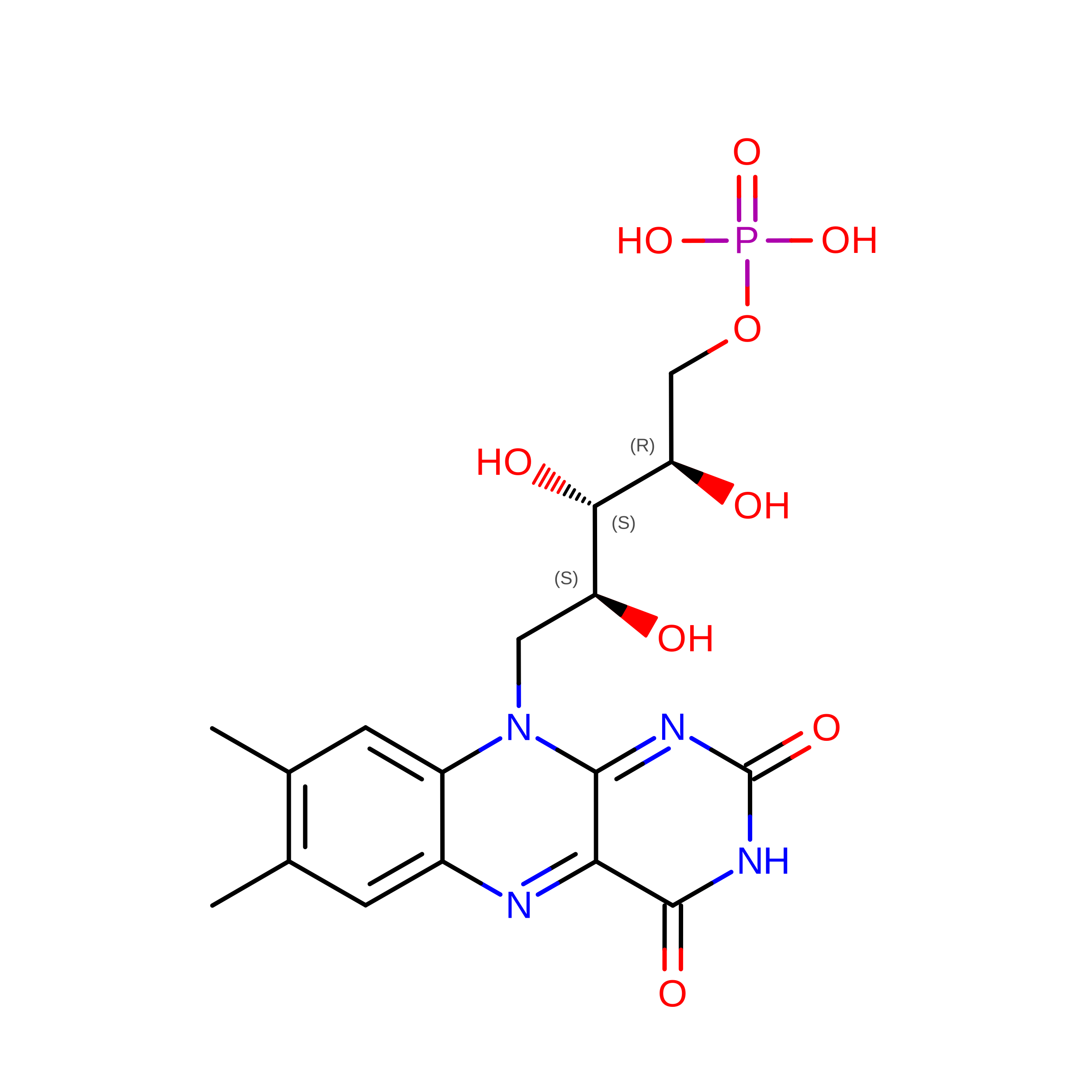
B [auth A]FLAVIN MONONUCLEOTIDE
C17 H21 N4 O9 P
FVTCRASFADXXNN-SCRDCRAPSA-N

Experimental Data & Validation

Experimental Data

  • Method: X-RAY DIFFRACTION
  • Resolution: 2.30 Å
  • R-Value Free:  0.265 (Depositor), 0.254 (DCC) 
  • R-Value Work:  0.212 (Depositor), 0.209 (DCC) 
  • R-Value Observed: 0.215 (Depositor) 
Space Group: P 65 2 2
Unit Cell:
Length ( Å )Angle ( ˚ )
a = 120.9α = 90
b = 120.9β = 90
c = 46γ = 120
Software Package:
Software NamePurpose
ProDCdata collection
XDSdata reduction
AMoREphasing
CNSrefinement
XDSdata scaling

Structure Validation

View Full Validation Report


Ligand Structure Quality Assessment 


Entry History 

Deposition Data

Revision History  (Full details and data files)

  • Version 1.0: 2003-06-17
    Type: Initial release
  • Version 1.1: 2008-04-28
    Changes: Version format compliance
  • Version 1.2: 2011-07-13
    Changes: Version format compliance
  • Version 1.3: 2017-10-11
    Changes: Refinement description
  • Version 1.4: 2019-11-06
    Changes: Data collection, Database references
  • Version 1.5: 2023-10-25
    Changes: Data collection, Database references, Derived calculations, Refinement description