1MWM | pdb_00001mwm

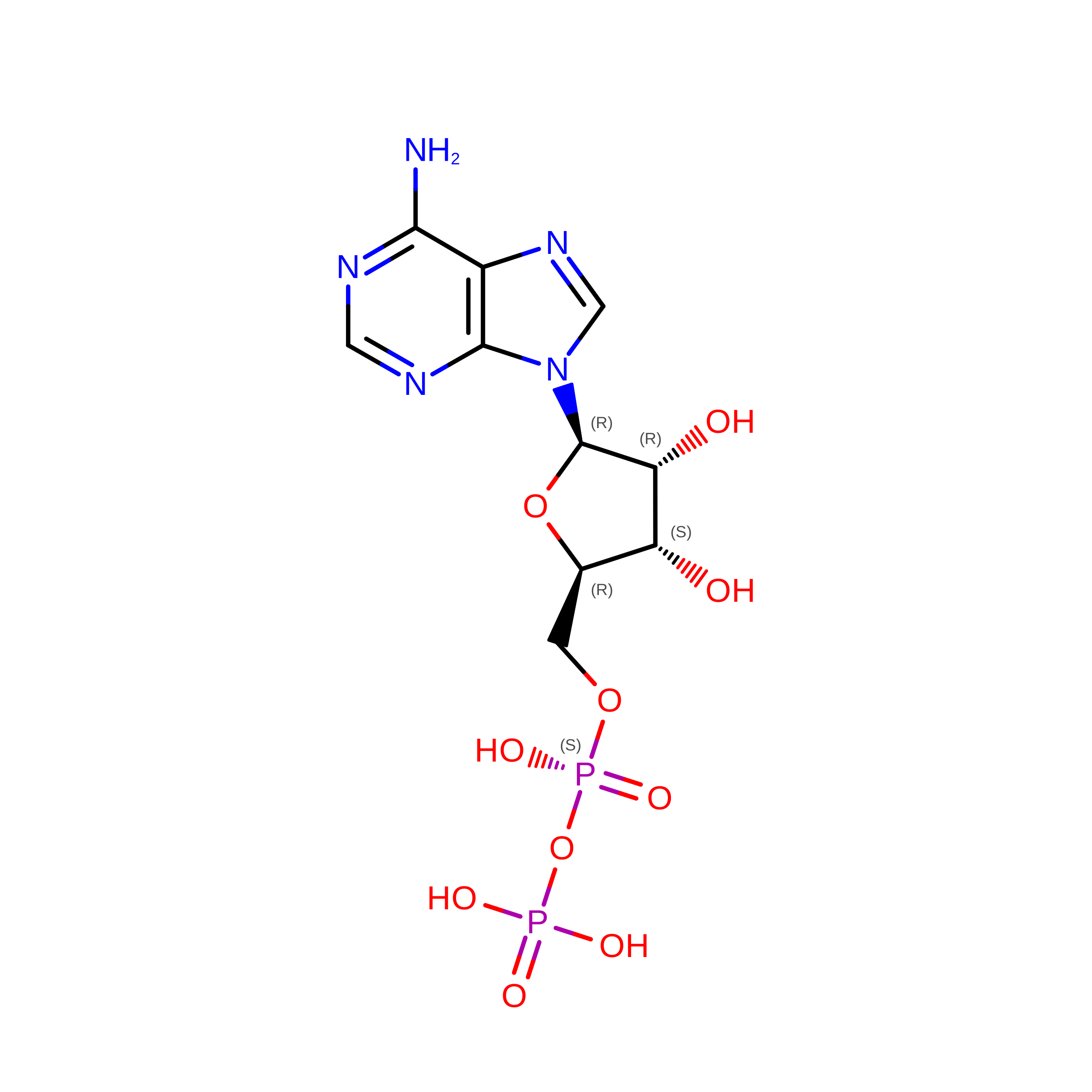
ParM from plasmid R1 ADP form


Experimental Data Snapshot

  • Method: X-RAY DIFFRACTION
  • Resolution: 2.00 Å
  • R-Value Free: 
    0.252 (Depositor), 0.248 (DCC) 
  • R-Value Work: 
    0.221 (Depositor), 0.217 (DCC) 
  • R-Value Observed: 
    0.222 (Depositor) 

Starting Model: experimental
View more details

wwPDB Validation 3D Report Full Report

Validation slider image for 1MWM

Ligand Structure Quality Assessment 


This is version 1.5 of the entry. See complete history

Literature

F-actin-like filaments formed by plasmid segregation protein ParM

Van den Ent, F.Moller-Jensen, J.Amos, L.A.Gerdes, K.Lowe, J.

(2002) EMBO J 21: 6935-6943

  • DOI: https://doi.org/10.1093/emboj/cdf672
  • Primary Citation Related Structures: 
    1MWK, 1MWM

  • PubMed Abstract: 

    It was the general belief that DNA partitioning in prokaryotes is independent of a cytoskeletal structure, which in eukaryotic cells is indispensable for DNA segregation. Recently, however, immunofluorescence microscopy revealed highly dynamic, filamentous structures along the longitudinal axis of Escherichia coli formed by ParM, a plasmid-encoded protein required for accurate segregation of low-copy-number plasmid R1. We show here that ParM polymerizes into double helical protofilaments with a longitudinal repeat similar to filamentous actin (F-actin) and MreB filaments that maintain the cell shape of non-spherical bacteria. The crystal structure of ParM with and without ADP demonstrates that it is a member of the actin family of proteins and shows a domain movement of 25 degrees upon nucleotide binding. Furthermore, the crystal structure of ParM reveals major differences in the protofilament interface compared with F-actin, despite the similar arrangement of the subunits within the filaments. Thus, there is now evidence for cytoskeletal structures, formed by actin-like filaments that are involved in plasmid partitioning in E.coli.


  • Organizational Affiliation
    • MRC Laboratory of Molecular Biology, Hills Road, Cambridge CB2 2QH, UK.

Macromolecule Content 

  • Total Structure Weight: 72.51 kDa 
  • Atom Count: 5,382 
  • Modeled Residue Count: 632 
  • Deposited Residue Count: 640 
  • Unique protein chains: 1

Macromolecules

Find similar proteins by:|  3D Structure
Entity ID: 1
MoleculeChains  Sequence LengthOrganismDetailsImage
ParM
A, B
320Escherichia coliMutation(s): 0 
UniProt
Find proteins for P11904 (Escherichia coli)
Explore P11904 
Go to UniProtKB:  P11904
Entity Groups
Sequence Clusters30% Identity50% Identity70% Identity90% Identity95% Identity100% Identity
UniProt GroupP11904
Sequence Annotations
Expand
Reference Sequence

Experimental Data & Validation

Experimental Data

  • Method: X-RAY DIFFRACTION
  • Resolution: 2.00 Å
  • R-Value Free:  0.252 (Depositor), 0.248 (DCC) 
  • R-Value Work:  0.221 (Depositor), 0.217 (DCC) 
  • R-Value Observed: 0.222 (Depositor) 
Space Group: P 41
Unit Cell:
Length ( Å )Angle ( ˚ )
a = 64.71α = 90
b = 64.71β = 90
c = 199.71γ = 90
Software Package:
Software NamePurpose
MOSFLMdata reduction
TRUNCATEdata reduction
CNSrefinement
CCP4data scaling
CNSphasing

Structure Validation

View Full Validation Report


Ligand Structure Quality Assessment 


Entry History 

Deposition Data

Revision History  (Full details and data files)

  • Version 1.0: 2003-01-28
    Type: Initial release
  • Version 1.1: 2008-04-28
    Changes: Version format compliance
  • Version 1.2: 2011-07-13
    Changes: Version format compliance
  • Version 1.3: 2018-02-14
    Changes: Experimental preparation
  • Version 1.4: 2024-03-13
    Changes: Data collection, Database references, Derived calculations
  • Version 1.5: 2024-04-03
    Changes: Refinement description