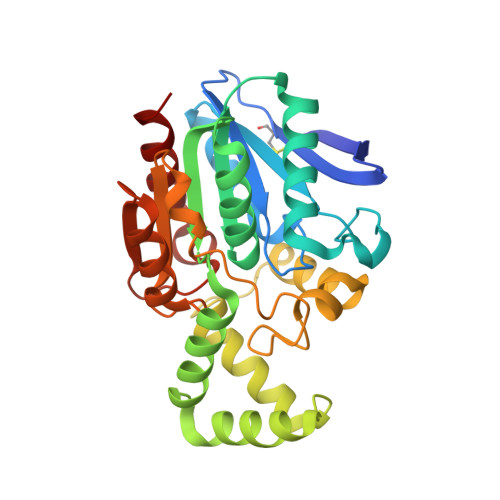
1MTZ | pdb_00001mtz

Crystal Structure of the Tricorn Interacting Factor F1


Experimental Data Snapshot

  • Method: X-RAY DIFFRACTION
  • Resolution: 1.80 Å
  • R-Value Free: 
    0.236 (Depositor) 
  • R-Value Work: 
    0.199 (Depositor), 0.206 (DCC) 
  • R-Value Observed: 
    0.236 (Depositor) 

Starting Model: experimental
View more details

wwPDB Validation 3D Report Full Report

Validation slider image for 1MTZ

This is version 1.3 of the entry. See complete history

Literature

Structures of the tricorn-interacting aminopeptidase F1 with different ligands explain its catalytic mechanism

Goettig, P.Groll, M.Kim, J.-S.Huber, R.Brandstetter, H.

(2002) EMBO J 21: 5343-5352

  • DOI: https://doi.org/10.1093/emboj/cdf552
  • Primary Citation Related Structures: 
    1MT3, 1MTZ, 1MU0

  • PubMed Abstract: 

    F1 is a 33.5 kDa serine peptidase of the alpha/beta-hydrolase family from the archaeon Thermoplasma acidophilum. Subsequent to proteasomal protein degradation, tricorn generates small peptides, which are cleaved by F1 to yield single amino acids. We have solved the crystal structure of F1 with multiwavelength anomalous dispersion (MAD) phasing at 1.8 A resolution. In addition to the conserved catalytic domain, the structure reveals a chiefly alpha-helical domain capping the catalytic triad. Thus, the active site is accessible only through a narrow opening from the protein surface. Two structures with molecules bound to the active serine, including the inhibitor phenylalanyl chloromethylketone, elucidate the N-terminal recognition of substrates and the catalytic activation switch mechanism of F1. The cap domain mainly confers the specificity for hydrophobic side chains by a novel cavity system, which, analogously to the tricorn protease, guides substrates to the buried active site and products away from it. Finally, the structure of F1 suggests a possible functional complex with tricorn that allows efficient processive degradation to free amino acids for cellular recycling.


  • Organizational Affiliation
    • Max-Planck-Institut für Biochemie, Abteilung Strukturforschung, Am Klopferspitz 18a, D-82152 Martinsried, Germany. goettig@biochem.mpg.de

Macromolecule Content 

  • Total Structure Weight: 33.53 kDa 
  • Atom Count: 2,507 
  • Modeled Residue Count: 290 
  • Deposited Residue Count: 293 
  • Unique protein chains: 1

Macromolecules

Find similar proteins by:|  3D Structure
Entity ID: 1
MoleculeChains  Sequence LengthOrganismDetailsImage
Proline iminopeptidase293Thermoplasma acidophilumMutation(s): 0 
Gene Names: TA0830
EC: 3.4.11.5
UniProt
Find proteins for P96084 (Thermoplasma acidophilum (strain ATCC 25905 / DSM 1728 / JCM 9062 / NBRC 15155 / AMRC-C165))
Explore P96084 
Go to UniProtKB:  P96084
Entity Groups
Sequence Clusters30% Identity50% Identity70% Identity90% Identity95% Identity100% Identity
UniProt GroupP96084
Sequence Annotations
Expand
Reference Sequence

Experimental Data & Validation

Experimental Data

  • Method: X-RAY DIFFRACTION
  • Resolution: 1.80 Å
  • R-Value Free:  0.236 (Depositor) 
  • R-Value Work:  0.199 (Depositor), 0.206 (DCC) 
  • R-Value Observed: 0.236 (Depositor) 
Space Group: P 21 21 21
Unit Cell:
Length ( Å )Angle ( ˚ )
a = 54.961α = 90
b = 57.095β = 90
c = 82.274γ = 90
Software Package:
Software NamePurpose
DENZOdata reduction
SCALAdata scaling
CNSrefinement
CCP4data scaling
CNSphasing

Structure Validation

View Full Validation Report


Entry History 

Deposition Data

Revision History  (Full details and data files)

  • Version 1.0: 2002-11-06
    Type: Initial release
  • Version 1.1: 2008-04-28
    Changes: Version format compliance
  • Version 1.2: 2011-07-13
    Changes: Version format compliance
  • Version 1.3: 2024-10-16
    Changes: Data collection, Database references, Refinement description, Structure summary