1MOO | pdb_00001moo

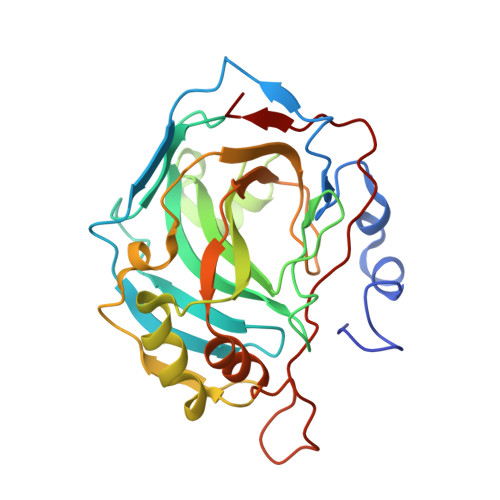
Site Specific Mutant (H64A) of Human Carbonic Anhydrase II at high resolution


Experimental Data Snapshot

  • Method: X-RAY DIFFRACTION
  • Resolution: 1.05 Å
  • R-Value Free: 
    0.177 (Depositor), 0.191 (DCC) 
  • R-Value Work: 
    0.157 (Depositor), 0.156 (DCC) 
  • R-Value Observed: 
    0.158 (Depositor) 

wwPDB Validation 3D Report Full Report

Validation slider image for 1MOO

This is version 1.5 of the entry. See complete history

Literature

The refined atomic structure of carbonic anhydrase II at 1.05 A resolution: implications of chemical rescue of proton transfer.

Duda, D.Govindasamy, L.Agbandje-McKenna, M.Tu, C.Silverman, D.N.McKenna, R.

(2003) Acta Crystallogr D Biol Crystallogr 59: 93-104

  • DOI: https://doi.org/10.1107/s0907444902019455
  • Primary Citation Related Structures: 
    1MOO

  • PubMed Abstract: 

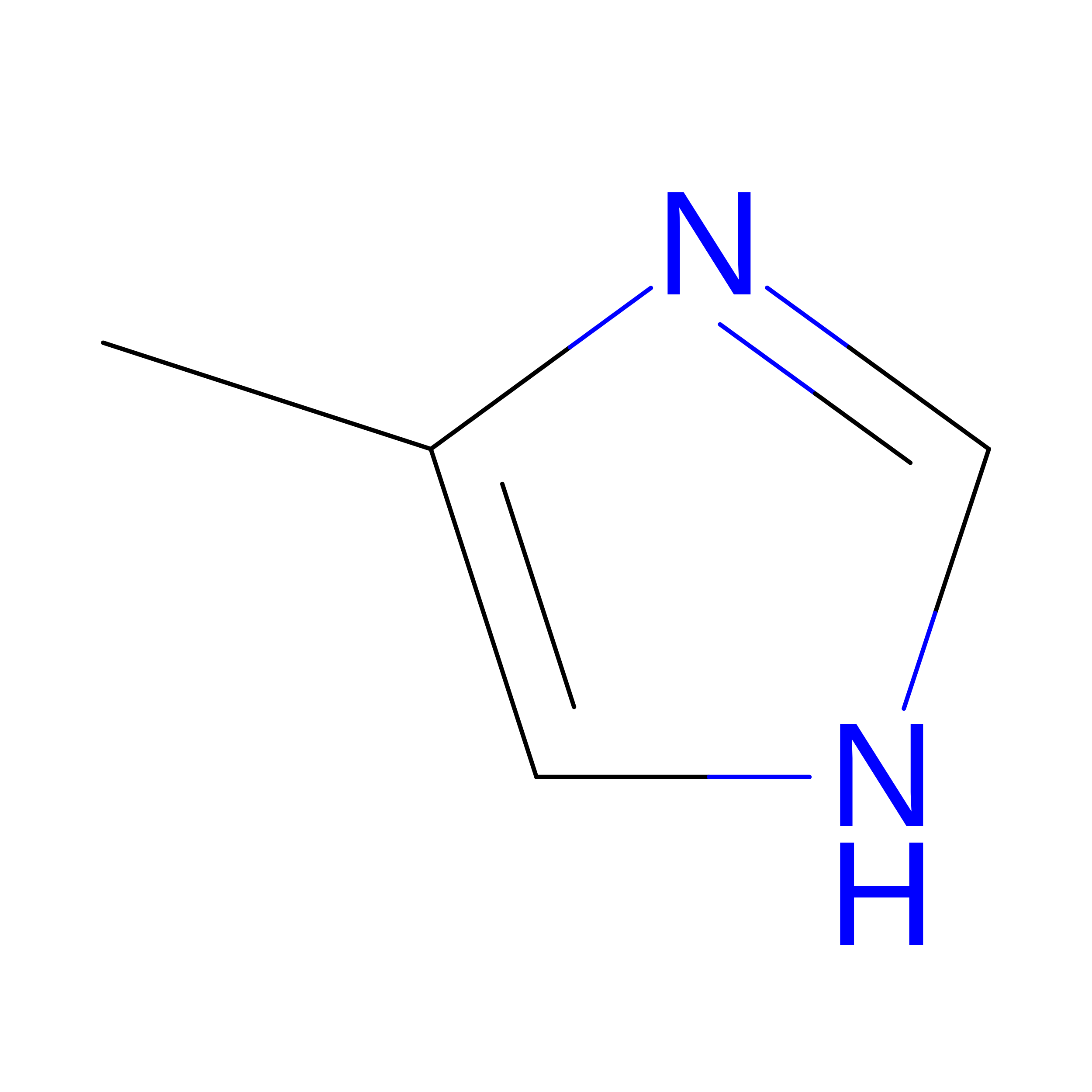
    Using synchrotron radiation and a CCD detector, X-ray data have been collected at 100 K for the His64Ala mutant of human carbonic anhydrase II complexed with 4-methylimidazole (4-MI) to a maximal 1.05 A resolution, allowing full anisotropic least-squares refinement. The refined model has a conventional R factor of 15.7% for all reflections. The C(alpha) coordinates of the model presented here have an r.m.s. deviation of 0.10 A relative to the previously determined structure at 1.6 A resolution. Several amino-acid residues (six of the 255 observed) have been identified with multiple rotamer side-chain conformations. C, N and O atoms can be differentiated with selective electron-density map contouring. The estimated standard deviations for all main-chain non-H atom bond lengths and angles are 0.013 and 0.030 A, respectively, based on unrestrained full-matrix least-squares refinement. This structure gives detailed information about the tetrahedrally arranged zinc ion coordinated by three histidine N atoms (His94 N(epsilon 2), His96 N(epsilon2) and His119 N(delta1)) and a water/hydroxide, the multiple binding sites of the proton chemical rescue molecule 4-MI and the solvent networks linking the zinc-bound water/hydroxide and 4-MI molecules. This structure presents the highest resolution structure of a carbonic anhydrase isozyme so far determined and adds to the understanding of proton-transfer processes.


  • Organizational Affiliation
    • Department of Biochemistry and Molecular Biology, University of Florida, Gainesville, FL 32610, USA.

Macromolecule Content 

  • Total Structure Weight: 29.65 kDa 
  • Atom Count: 2,377 
  • Modeled Residue Count: 256 
  • Deposited Residue Count: 260 
  • Unique protein chains: 1

Macromolecules

Find similar proteins by:|  3D Structure
Entity ID: 1
MoleculeChains  Sequence LengthOrganismDetailsImage
Carbonic Anhydrase II260Homo sapiensMutation(s): 1 
EC: 4.2.1.1 (PDB Primary Data), 4.2.1.69 (UniProt)
UniProt & NIH Common Fund Data Resources
Find proteins for P00918 (Homo sapiens)
Explore P00918 
Go to UniProtKB:  P00918
PHAROS:  P00918
GTEx:  ENSG00000104267 
Entity Groups
Sequence Clusters30% Identity50% Identity70% Identity90% Identity95% Identity100% Identity
UniProt GroupP00918
Sequence Annotations
Expand
Reference Sequence

Experimental Data & Validation

Experimental Data

  • Method: X-RAY DIFFRACTION
  • Resolution: 1.05 Å
  • R-Value Free:  0.177 (Depositor), 0.191 (DCC) 
  • R-Value Work:  0.157 (Depositor), 0.156 (DCC) 
  • R-Value Observed: 0.158 (Depositor) 
Space Group: P 1 21 1
Unit Cell:
Length ( Å )Angle ( ˚ )
a = 42.188α = 90
b = 41.435β = 104.26
c = 72.041γ = 90
Software Package:
Software NamePurpose
DENZOdata reduction
SCALEPACKdata scaling
CNSrefinement
CNSphasing

Structure Validation

View Full Validation Report


Entry History 

Deposition Data

Revision History  (Full details and data files)

  • Version 1.0: 2002-09-18
    Type: Initial release
  • Version 1.1: 2008-04-28
    Changes: Version format compliance
  • Version 1.2: 2011-07-13
    Changes: Version format compliance
  • Version 1.3: 2018-04-04
    Changes: Data collection
  • Version 1.4: 2021-10-27
    Changes: Database references, Derived calculations
  • Version 1.5: 2024-02-14
    Changes: Data collection