1MM8 | pdb_00001mm8

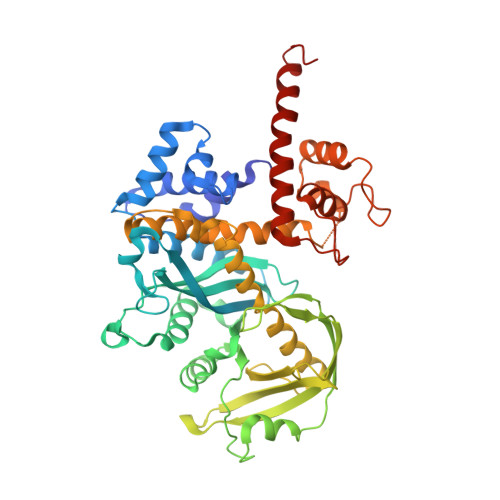
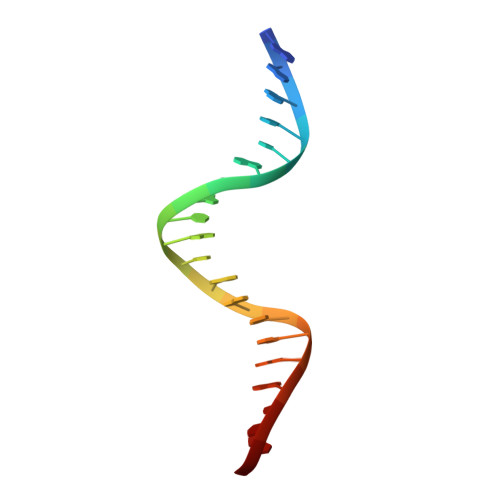
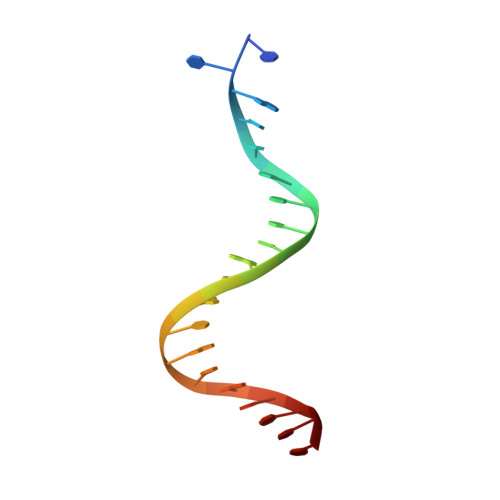
Crystal structure of Tn5 Transposase complexed with ME DNA


Experimental Data Snapshot

  • Method: X-RAY DIFFRACTION
  • Resolution: 2.80 Å
  • R-Value Free: 
    0.271 (Depositor) 
  • R-Value Work: 
    0.217 (Depositor) 

wwPDB Validation 3D Report Full Report

Validation slider image for 1MM8

This is version 1.4 of the entry. See complete history

Literature

Evidence for "unseen" Transposase--DNA contacts

Steiniger-White, M.Bhasin, A.Lovell, S.Rayment, I.Reznikoff, W.S.

(2002) J Mol Biology 322: 971-982

  • DOI: https://doi.org/10.1016/s0022-2836(02)00877-x
  • Primary Citation Related Structures: 
    1MM8

  • PubMed Abstract: 

    In this study, evidence of novel, important interactions between a hyperactive Tn5 transposon recognition end sequence and hyperactive Tn5 transposase (Tnp) are presented. A hyperactive Tn5 end sequence, the mosaic end (ME), was isolated previously. The ME and a wild-type end sequence, the outside end (OE), differ at only three positions, yet transposition on the ME is tenfold higher than on the OE in vivo. Also, transposition on the ME is much more efficient than transposition on the OE in vitro. Here, we show that the decreased activity observed for the OE is caused by a defect in paired ends complex (PEC) formation resulting from the orientation of the A-T base-pair at position 4 of this end. Efficient PEC formation requires an interaction between the C5-methyl group (C5-Me) on the non-transferred strand thymine base at position 4 (T4) and Tnp. PEC formation on nicked substrates is much less affected by the orientation of the A-T base-pair at position 4, indicating that the C5-Me group is important only for steps preceding nicking. A recently determined co-crystal structure of Tn5 Tnp with the ME is discussed and a model explaining possible roles for the base-pair at position 4 is explored.


  • Organizational Affiliation
    • Department of Biochemistry, University of Wisconsin-Madison, Madison, WI 53706, USA.

Macromolecule Content 

  • Total Structure Weight: 66.22 kDa 
  • Atom Count: 4,633 
  • Modeled Residue Count: 495 
  • Deposited Residue Count: 521 
  • Unique protein chains: 1
  • Unique nucleic acid chains: 2

Macromolecules


Find similar proteins by:|  3D Structure
Entity ID: 3
MoleculeChains  Sequence LengthOrganismDetailsImage
Tn5 TransposaseC [auth A]481Escherichia coliMutation(s): 4 
Gene Names: Tn5 Transposases
EC: 3.1
UniProt
Find proteins for Q46731 (Escherichia coli)
Explore Q46731 
Go to UniProtKB:  Q46731
Entity Groups
Sequence Clusters30% Identity50% Identity70% Identity90% Identity95% Identity100% Identity
UniProt GroupQ46731
Sequence Annotations
Expand
Reference Sequence
Find similar nucleic acids by:  Sequence
Entity ID: 1
MoleculeChains LengthOrganismImage
ME DNA transferred strandA [auth B]20N/A
Sequence Annotations
Expand
Reference Sequence
Find similar nucleic acids by:  Sequence
Entity ID: 2
MoleculeChains LengthOrganismImage
ME DNA non-transferred strandB [auth C]20N/A
Sequence Annotations
Expand
Reference Sequence

Small Molecules

Experimental Data & Validation

Experimental Data

  • Method: X-RAY DIFFRACTION
  • Resolution: 2.80 Å
  • R-Value Free:  0.271 (Depositor) 
  • R-Value Work:  0.217 (Depositor) 
Space Group: P 65 2 2
Unit Cell:
Length ( Å )Angle ( ˚ )
a = 112.5α = 90
b = 112.5β = 90
c = 233.5γ = 120
Software Package:
Software NamePurpose
HKL-2000data collection
SCALEPACKdata scaling
EPMRphasing
CNSrefinement
HKL-2000data reduction

Structure Validation

View Full Validation Report


Entry History 

Deposition Data

Revision History  (Full details and data files)

  • Version 1.0: 2002-12-13
    Type: Initial release
  • Version 1.1: 2008-04-28
    Changes: Version format compliance
  • Version 1.2: 2011-07-13
    Changes: Version format compliance
  • Version 1.3: 2021-10-27
    Changes: Database references, Derived calculations
  • Version 1.4: 2024-02-14
    Changes: Data collection