1MEI | pdb_00001mei

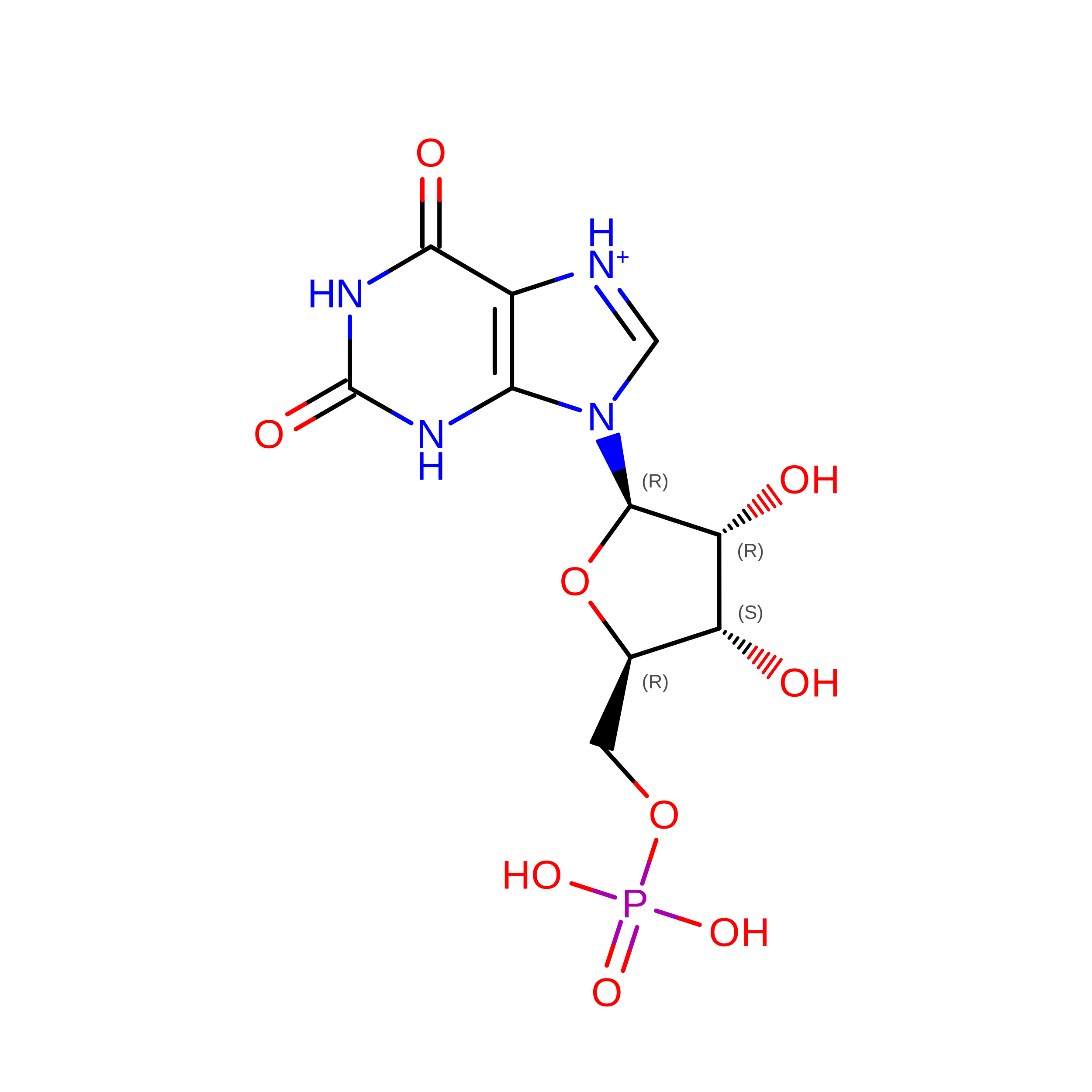
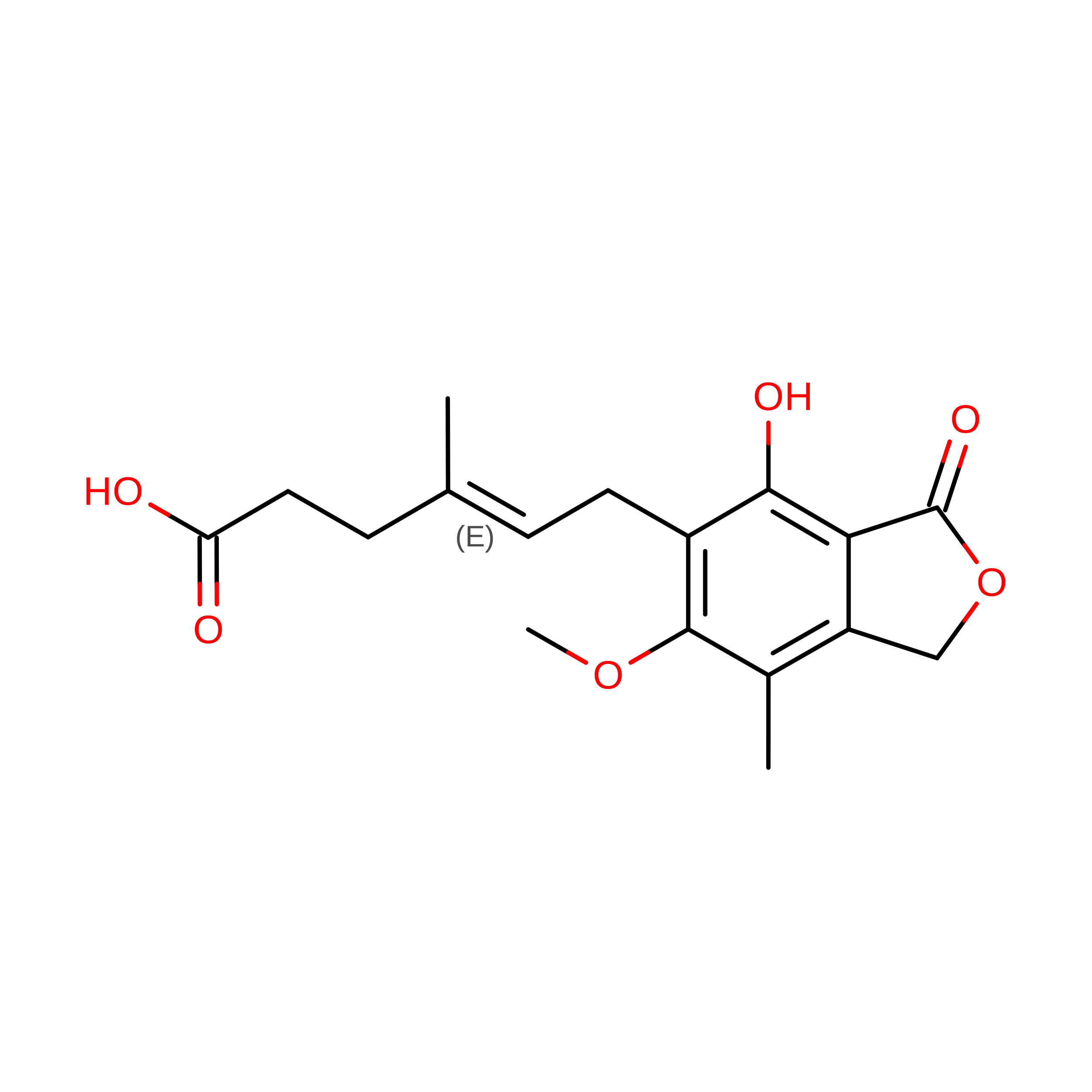
Inosine Monophosphate Dehydrogenase (IMPDH) From Tritrichomonas Foetus with XMP and mycophenolic acid bound


Experimental Data Snapshot

  • Method: X-RAY DIFFRACTION
  • Resolution: 2.20 Å
  • R-Value Free: 
    0.257 (Depositor) 
  • R-Value Work: 
    0.227 (Depositor), 0.228 (DCC) 

Starting Model: experimental
View more details

wwPDB Validation 3D Report Full Report

Validation slider image for 1MEI

Ligand Structure Quality Assessment 


This is version 2.0 of the entry. See complete history

Literature

Crystal Structures of Tritrichomonas foetus Inosine Monophosphate Dehydrogenase in Complex with Substrate, Cofactor and Analogs: A Structural Basis for the Random-in Ordered-out Kinetic Mechanism

Prosise, G.L.Luecke, H.

(2003) J Mol Biology 326: 517-527

  • DOI: https://doi.org/10.1016/s0022-2836(02)01383-9
  • Primary Citation Related Structures: 
    1ME9, 1MEH, 1MEI, 1MEW

  • PubMed Abstract: 

    The enzyme inosine monophosphate dehydrogenase (IMPDH) is responsible for the rate-limiting step in guanine nucleotide biosynthesis. Because it is up-regulated in rapidly proliferating cells, human type II IMPDH is actively targeted for immunosuppressive, anticancer, and antiviral chemotherapy. The enzyme employs a random-in ordered-out kinetic mechanism where substrate or cofactor can bind first but product is only released after the cofactor leaves. Due to structural and kinetic differences between mammalian and microbial enzymes, most drugs that are successful in the inhibition of mammalian IMPDH are far less effective against the microbial forms of the enzyme. It is possible that with greater knowledge of the structural mechanism of the microbial enzymes, an effective and selective inhibitor of microbial IMPDH will be developed for use as a drug against multi-drug resistant bacteria and protists. The high-resolution crystal structures of four different complexes of IMPDH from the protozoan parasite Tritrichomonas foetus have been solved: with its substrate IMP, IMP and the inhibitor mycophenolic acid (MPA), the product XMP with MPA, and XMP with the cofactor NAD(+). In addition, a potassium ion has been located at the dimer interface. A structural model for the kinetic mechanism is proposed.


  • Organizational Affiliation
    • Department of Molecular Biology and Biochemistry University of California, Irvine, CA 92697-3900 USA.

Macromolecule Content 

  • Total Structure Weight: 56.26 kDa 
  • Atom Count: 2,918 
  • Modeled Residue Count: 351 
  • Deposited Residue Count: 503 
  • Unique protein chains: 1

Macromolecules

Find similar proteins by:|  3D Structure
Entity ID: 1
MoleculeChains  Sequence LengthOrganismDetailsImage
INOSINE-5'-MONOPHOSPHATE DEHYDROGENASE503Tritrichomonas suisMutation(s): 0 
Gene Names: IMPDH
EC: 1.1.1.205
UniProt
Find proteins for P50097 (Tritrichomonas foetus)
Explore P50097 
Go to UniProtKB:  P50097
Entity Groups
Sequence Clusters30% Identity50% Identity70% Identity90% Identity95% Identity100% Identity
UniProt GroupP50097
Sequence Annotations
Expand
Reference Sequence

Experimental Data & Validation

Experimental Data

  • Method: X-RAY DIFFRACTION
  • Resolution: 2.20 Å
  • R-Value Free:  0.257 (Depositor) 
  • R-Value Work:  0.227 (Depositor), 0.228 (DCC) 
Space Group: P 4 3 2
Unit Cell:
Length ( Å )Angle ( ˚ )
a = 155.07α = 90
b = 155.07β = 90
c = 155.07γ = 90
Software Package:
Software NamePurpose
DENZOdata reduction
SCALEPACKdata scaling
CNSrefinement
CNSphasing

Structure Validation

View Full Validation Report


Ligand Structure Quality Assessment 


Entry History 

Deposition Data

Revision History  (Full details and data files)

  • Version 1.0: 2003-08-12
    Type: Initial release
  • Version 1.1: 2008-04-28
    Changes: Version format compliance
  • Version 1.2: 2011-07-13
    Changes: Version format compliance
  • Version 2.0: 2024-11-13
    Changes: Atomic model, Data collection, Database references, Derived calculations, Refinement description, Structure summary