Download Mendeley
Possible role of region 152-156 in the structural duality of a peptide fragment from sheep prion protein
Megy, S., Bertho, G., Kozin, S.A., Debey, P., Hoa, G.H., Girault, J.-P.(2004) Protein Sci 13: 3151-3160
- PubMed: 15537751 Search on PubMedSearch on PubMed Central
- DOI: https://doi.org/10.1110/ps.04745004
- Primary Citation Related Structures:
1M25 - PubMed Abstract:
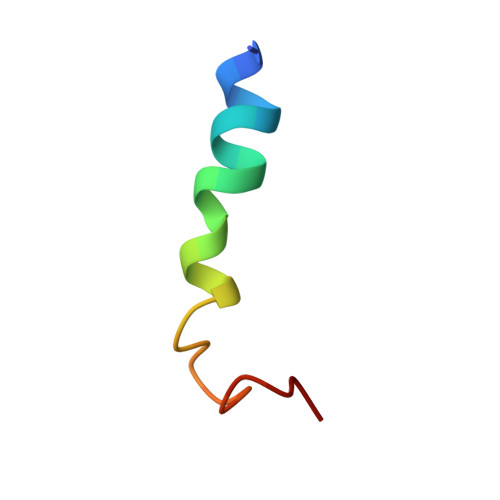
The conformational conversion of the nonpathogenic "cellular" prion isoform into a pathogenic "scrapie" protease-resistant isoform is a fundamental event in the onset of transmissible spongiform encephalopathies (TSE). During this pathogenic conversion, helix H1 and its two flanking loops of the normal prion protein are thought to undergo a conformational transition into a beta-like structure. A peptide spanning helix H1 and beta-strand S2 (residues 142-166 in human numbering) was studied by circular dichroism and nuclear magnetic resonance spectroscopies. This peptide in aqueous solution, in contrast to many prion fragments studied earlier (1) is highly soluble and (2) does not aggregate until the millimolar concentration range, and (3) exhibits an intrinsic propensity to a beta-hairpin-like conformation at neutral pH. We found that this peptide can also fold into a helix H1 conformation when dissolved in a TFE/PB mixture. The structures of the peptide calculated by MD showed solvent-dependent internal stabilizing forces of the structures and evidenced a higher mobility of the residues following the end of helix H1. These data suggest that the molecular rearrangement of this peptide in region 152-156, particularly in position 155, could be associated with the pathogenic conversion of the prion protein.
- Université René Descartes-Paris V, Laboratoire de Chimie et Biochimie Pharmacologiques et Toxicologiques (Unité Mixte de Recherche 8601 Centre National de Recherche Scientifique), 75270 Paris 06, France.
Organizational Affiliation: