1LYB | pdb_00001lyb

CRYSTAL STRUCTURES OF NATIVE AND INHIBITED FORMS OF HUMAN CATHEPSIN D: IMPLICATIONS FOR LYSOSOMAL TARGETING AND DRUG DESIGN


Experimental Data Snapshot

  • Method: X-RAY DIFFRACTION
  • Resolution: 2.50 Å
  • R-Value Work: 
    0.179 (Depositor) 
  • R-Value Observed: 
    0.179 (Depositor) 

wwPDB Validation 3D Report Full Report

Validation slider image for 1LYB

This is version 3.1 of the entry. See complete history

Literature

Crystal structures of native and inhibited forms of human cathepsin D: implications for lysosomal targeting and drug design.

Baldwin, E.T.Bhat, T.N.Gulnik, S.Hosur, M.V.Sowder 2nd., R.C.Cachau, R.E.Collins, J.Silva, A.M.Erickson, J.W.

(1993) Proc Natl Acad Sci U S A 90: 6796-6800

  • DOI: https://doi.org/10.1073/pnas.90.14.6796
  • Primary Citation Related Structures: 
    1LYA, 1LYB

  • PubMed Abstract: 

    Cathepsin D (EC 3.4.23.5) is a lysosomal protease suspected to play important roles in protein catabolism, antigen processing, degenerative diseases, and breast cancer progression. Determination of the crystal structures of cathepsin D and a complex with pepstatin at 2.5 A resolution provides insights into inhibitor binding and lysosomal targeting for this two-chain, N-glycosylated aspartic protease. Comparison with the structures of a complex of pepstatin bound to rhizopuspepsin and with a human renin-inhibitor complex revealed differences in subsite structures and inhibitor-enzyme interactions that are consistent with affinity differences and structure-activity relationships and suggest strategies for fine-tuning the specificity of cathepsin D inhibitors. Mutagenesis studies have identified a phosphotransferase recognition region that is required for oligosaccharide phosphorylation but is 32 A distant from the N-domain glycosylation site at Asn-70. Electron density for the crystal structure of cathepsin D indicated the presence of an N-linked oligosaccharide that extends from Asn-70 toward Lys-203, which is a key component of the phosphotransferase recognition region, and thus provides a structural explanation for how the phosphotransferase can recognize apparently distant sites on the protein surface.


  • Organizational Affiliation
    • Structural Biochemistry Program, Program Resources Inc./DynCorp, National Cancer Institute-Frederick Cancer Research and Development Center, MD 21702.

Macromolecule Content 

  • Total Structure Weight: 77.23 kDa 
  • Atom Count: 5,454 
  • Modeled Residue Count: 688 
  • Deposited Residue Count: 688 
  • Unique protein chains: 3

Macromolecules

Find similar proteins by:|  3D Structure
Entity ID: 1
MoleculeChains  Sequence LengthOrganismDetailsImage
CATHEPSIN DA,
D [auth C]
97Homo sapiensMutation(s): 0 
EC: 3.4.23.5
Membrane Entity: Yes 
UniProt & NIH Common Fund Data Resources
Find proteins for P07339 (Homo sapiens)
Explore P07339 
Go to UniProtKB:  P07339
PHAROS:  P07339
GTEx:  ENSG00000117984 
Entity Groups
Sequence Clusters30% Identity50% Identity70% Identity90% Identity95% Identity100% Identity
UniProt GroupP07339
Glycosylation
Glycosylation Sites: 1Go to GlyGen: P07339-1
Sequence Annotations
Expand
Reference Sequence
Find similar proteins by:|  3D Structure
Entity ID: 2
MoleculeChains  Sequence LengthOrganismDetailsImage
CATHEPSIN DB,
E [auth D]
241Homo sapiensMutation(s): 0 
EC: 3.4.23.5
Membrane Entity: Yes 
UniProt & NIH Common Fund Data Resources
Find proteins for P07339 (Homo sapiens)
Explore P07339 
Go to UniProtKB:  P07339
PHAROS:  P07339
GTEx:  ENSG00000117984 
Entity Groups
Sequence Clusters30% Identity50% Identity70% Identity90% Identity95% Identity100% Identity
UniProt GroupP07339
Glycosylation
Glycosylation Sites: 1Go to GlyGen: P07339-1
Sequence Annotations
Expand
Reference Sequence
Find similar proteins by:  Sequence   |   3D Structure  
Entity ID: 3
MoleculeChains  Sequence LengthOrganismDetailsImage
PEPSTATINC [auth I],
F [auth J]
6Streptomyces argenteolus subsp. toyonakensisMutation(s): 0 

Oligosaccharides

Help  
Entity ID: 4
MoleculeChains Length2D Diagram GlycosylationD Interactions
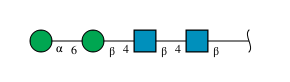
alpha-D-mannopyranose-(1-6)-beta-D-mannopyranose-(1-4)-2-acetamido-2-deoxy-beta-D-glucopyranose-(1-4)-2-acetamido-2-deoxy-beta-D-glucopyranoseG [auth E],
H [auth F]
4N-Glycosylation
Glycosylation Resources
GlyTouCan: G22573RC
GlyCosmos: G22573RC
GlyGen: G22573RC

Small Molecules

Ligands 1 Unique
IDChains Name / Formula / InChI Key2D Diagram3D Interactions
NAG

Query on NAG


Download:Ideal Coordinates CCD File
I [auth B],
J [auth D]
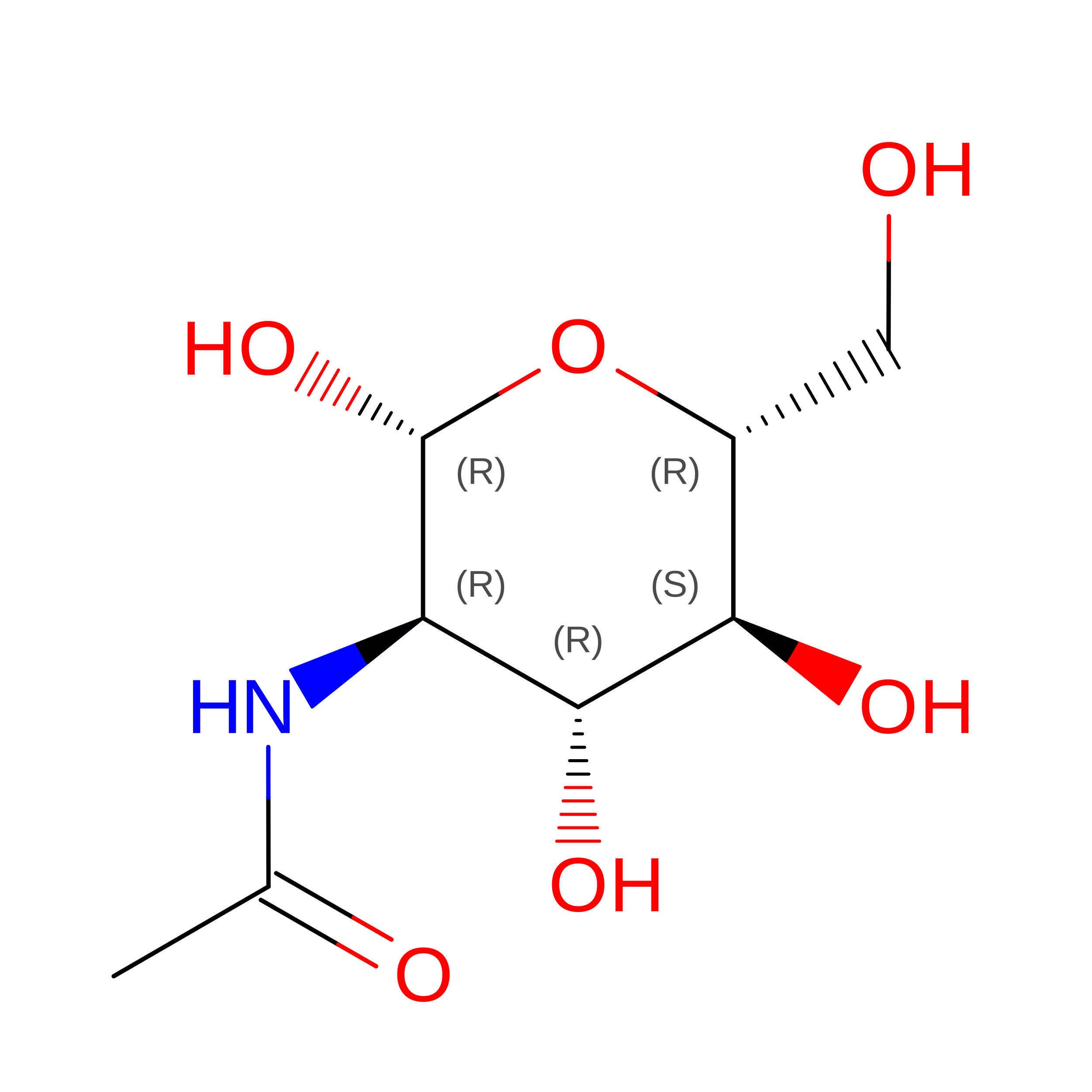
2-acetamido-2-deoxy-beta-D-glucopyranose
C8 H15 N O6
OVRNDRQMDRJTHS-FMDGEEDCSA-N

Biologically Interesting Molecules (External Reference) 

1 Unique
Entity ID: 3
IDChains NameType/Class2D Diagram3D Interactions
PRD_000557
Query on PRD_000557
C [auth I],
F [auth J]
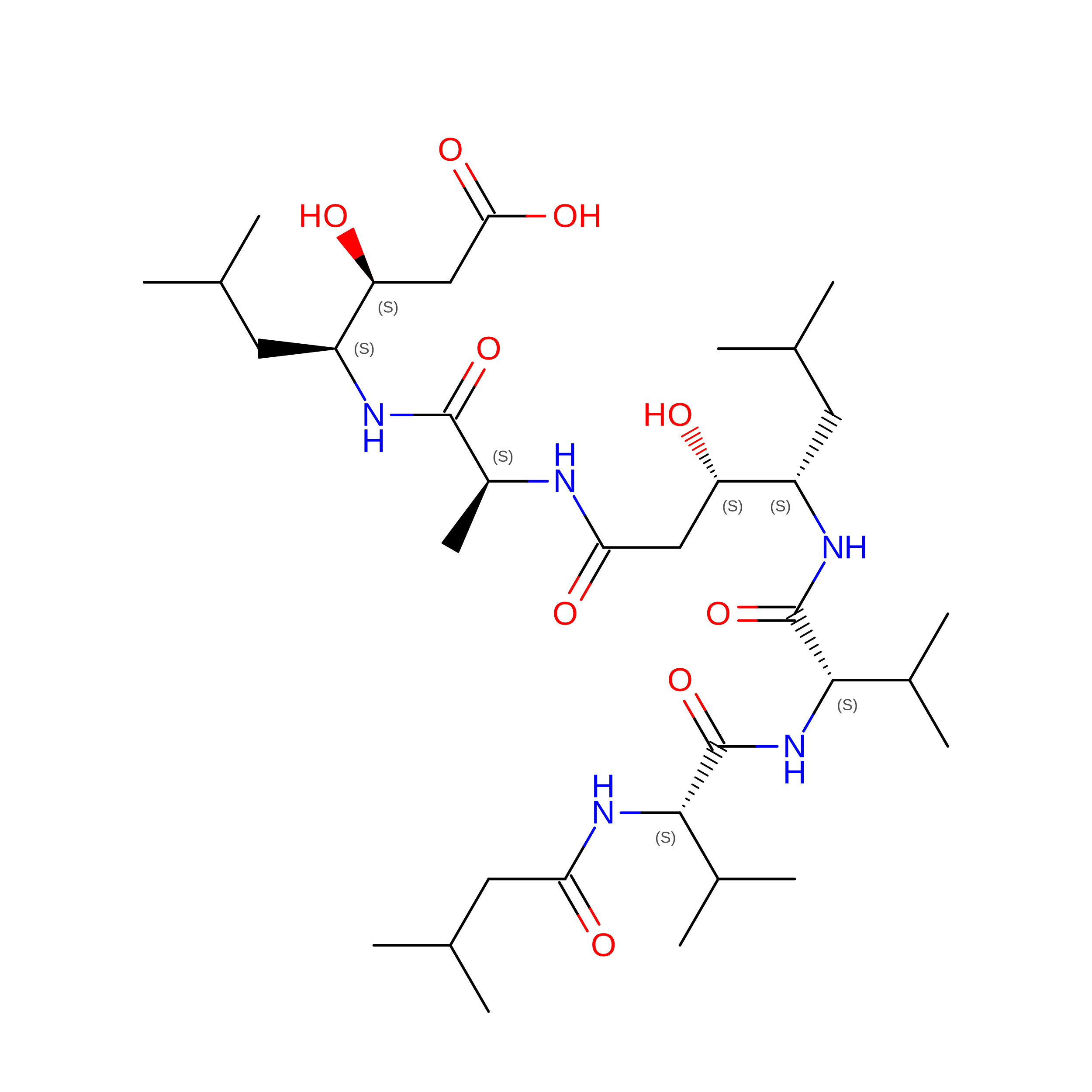
PepstatinOligopeptide / Enzyme inhibitor

Experimental Data & Validation

Experimental Data

  • Method: X-RAY DIFFRACTION
  • Resolution: 2.50 Å
  • R-Value Work:  0.179 (Depositor) 
  • R-Value Observed: 0.179 (Depositor) 
Space Group: P 65
Unit Cell:
Length ( Å )Angle ( ˚ )
a = 125.9α = 90
b = 125.9β = 90
c = 104.1γ = 120
Software Package:
Software NamePurpose
X-PLORmodel building
X-PLORrefinement
X-PLORphasing

Structure Validation

View Full Validation Report


Entry History 

Deposition Data

Revision History  (Full details and data files)

  • Version 1.0: 1994-01-31
    Type: Initial release
  • Version 1.1: 2008-03-03
    Changes: Version format compliance
  • Version 1.2: 2011-07-13
    Changes: Atomic model, Database references, Derived calculations, Non-polymer description, Structure summary, Version format compliance
  • Version 1.3: 2013-02-27
    Changes: Other
  • Version 1.4: 2017-11-29
    Changes: Derived calculations, Other
  • Version 2.0: 2020-07-29
    Type: Remediation
    Reason: Carbohydrate remediation
    Changes: Atomic model, Data collection, Derived calculations, Structure summary
  • Version 3.0: 2023-11-15
    Changes: Atomic model, Data collection, Database references, Structure summary
  • Version 3.1: 2024-10-23
    Changes: Structure summary