1LUC | pdb_00001luc

BACTERIAL LUCIFERASE


Experimental Data Snapshot

  • Method: X-RAY DIFFRACTION
  • Resolution: 1.50 Å

wwPDB Validation 3D Report Full Report

Validation slider image for 1LUC

This is version 1.3 of the entry. See complete history

Literature

The 1.5-A resolution crystal structure of bacterial luciferase in low salt conditions.

Fisher, A.J.Thompson, T.B.Thoden, J.B.Baldwin, T.O.Rayment, I.

(1996) J Biological Chem 271: 21956-21968

  • DOI: https://doi.org/10.1074/jbc.271.36.21956
  • Primary Citation Related Structures: 
    1LUC

  • PubMed Abstract: 

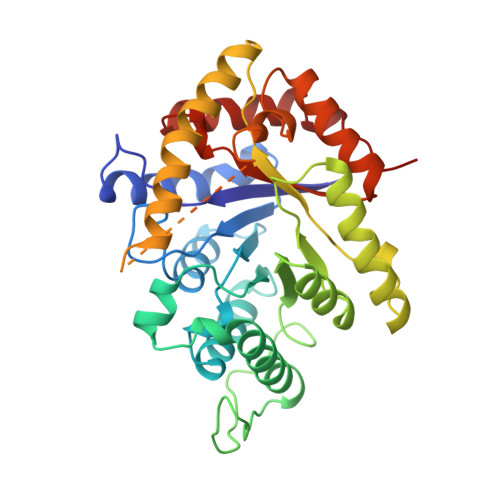
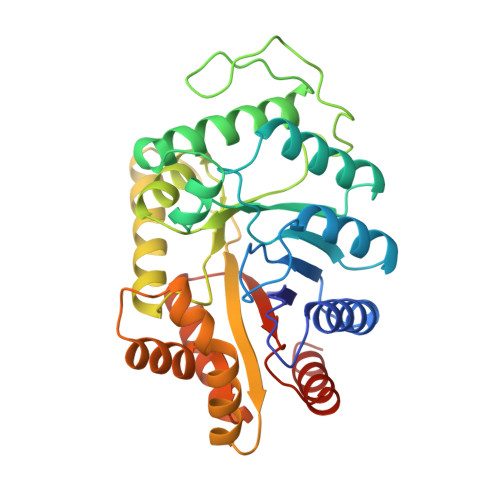
    Bacterial luciferase is a flavin monooxygenase that catalyzes the oxidation of a long-chain aldehyde and releases energy in the form of visible light. A new crystal form of luciferase cloned from Vibrio harveyi has been grown under low-salt concentrations, which diffract x-rays beyond 1.5-A resolution. The x-ray structure of bacterial luciferase has been refined to a conventional R-factor of 18.2% for all recorded synchrotron data between 30.0 and 1.50-A resolution. Bacterial luciferase is an alpha-beta heterodimer, and the individual subunits fold into a single domain (beta/alpha)8 barrel. The high resolution structure reveals a non-prolyl cis peptide bond that forms between Ala74 and Ala75 in the alpha subunit near the putative active site. This cis peptide bond may have functional significance for creating a cavity at the active site. Bacterial luciferase employs reduced flavin as a substrate rather than a cofactor. The structure presented was determined in the absence of substrates. A comparison of the structural similarities between luciferase and a nonfluorescent flavoprotein, which is expressed in the lux operon of one genus of bioluminescent bacteria, suggests that the two proteins originated from a common ancestor. However, the flavin binding sites of the nonfluorescent protein are likely not representative of the flavin binding site on luciferase. The structure presented here will furnish a detailed molecular model for all bacterial luciferases.


  • Organizational Affiliation
    • Institute for Enzyme Research and Department of Biochemistry, University of Wisconsin, Madison, Wisconsin 53705, USA.

Macromolecule Content 

  • Total Structure Weight: 76.97 kDa 
  • Atom Count: 5,754 
  • Modeled Residue Count: 646 
  • Deposited Residue Count: 679 
  • Unique protein chains: 2

Macromolecules

Find similar proteins by:|  3D Structure
Entity ID: 1
MoleculeChains  Sequence LengthOrganismDetailsImage
BACTERIAL LUCIFERASE355Vibrio harveyiMutation(s): 0 
EC: 1.14.14.3
UniProt
Find proteins for P07740 (Vibrio harveyi)
Explore P07740 
Go to UniProtKB:  P07740
Entity Groups
Sequence Clusters30% Identity50% Identity70% Identity90% Identity95% Identity100% Identity
UniProt GroupP07740
Sequence Annotations
Expand
Reference Sequence
Find similar proteins by:|  3D Structure
Entity ID: 2
MoleculeChains  Sequence LengthOrganismDetailsImage
BACTERIAL LUCIFERASE324Vibrio harveyiMutation(s): 0 
EC: 1.14.14.3
UniProt
Find proteins for P07739 (Vibrio harveyi)
Explore P07739 
Go to UniProtKB:  P07739
Entity Groups
Sequence Clusters30% Identity50% Identity70% Identity90% Identity95% Identity100% Identity
UniProt GroupP07739
Sequence Annotations
Expand
Reference Sequence

Experimental Data & Validation

Experimental Data

  • Method: X-RAY DIFFRACTION
  • Resolution: 1.50 Å
Space Group: C 1 2 1
Unit Cell:
Length ( Å )Angle ( ˚ )
a = 150.5α = 90
b = 59β = 93.86
c = 76.5γ = 90
Software Package:
Software NamePurpose
TNTrefinement
DENZOdata reduction
SCALEPACKdata scaling

Structure Validation

View Full Validation Report


Entry History 

Deposition Data

Revision History  (Full details and data files)

  • Version 1.0: 1996-12-07
    Type: Initial release
  • Version 1.1: 2008-03-24
    Changes: Version format compliance
  • Version 1.2: 2011-07-13
    Changes: Version format compliance
  • Version 1.3: 2024-02-14
    Changes: Data collection, Database references, Derived calculations, Other