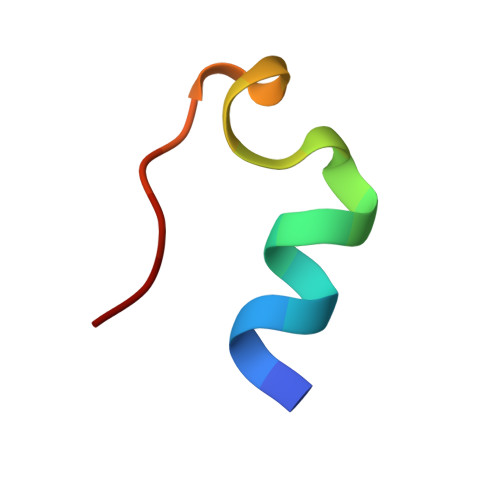
1L2Y | pdb_00001l2y

NMR Structure of Trp-Cage Miniprotein Construct TC5b


Experimental Data Snapshot

  • Method: SOLUTION NMR
  • Conformers Calculated: 50 
  • Conformers Submitted: 38 
  • Selection Criteria: structures with acceptable covalent geometry, structures with the least restraint violations 

wwPDB Validation 3D Report Full Report

Validation slider image for 1L2Y

This is version 1.5 of the entry. See complete history

Literature

Designing a 20-residue protein.

Neidigh, J.W.Fesinmeyer, R.M.Andersen, N.H.

(2002) Nat Struct Biol 9: 425-430

  • DOI: https://doi.org/10.1038/nsb798
  • Primary Citation Related Structures: 
    1L2Y

  • PubMed Abstract: 

    Truncation and mutation of a poorly folded 39-residue peptide has produced 20-residue constructs that are >95% folded in water at physiological pH. These constructs optimize a novel fold, designated as the 'Trp-cage' motif, and are significantly more stable than any other miniprotein reported to date. Folding is cooperative and hydrophobically driven by the encapsulation of a Trp side chain in a sheath of Pro rings. As the smallest protein-like construct, Trp-cage miniproteins should provide a testing ground for both experimental studies and computational simulations of protein folding and unfolding pathways. Pro Trp interactions may be a particularly effective strategy for the a priori design of self-folding peptides.


  • Organizational Affiliation
    • Department of Chemistry, University of Washington, Seattle, Washington 98195, USA.

Macromolecule Content 

  • Total Structure Weight: 2.17 kDa 
  • Atom Count: 154 
  • Modeled Residue Count: 20 
  • Deposited Residue Count: 20 
  • Unique protein chains: 1

Macromolecules

Find similar proteins by:  Sequence   |   3D Structure  
Entity ID: 1
MoleculeChains  Sequence LengthOrganismDetailsImage
TC5b20N/AMutation(s): 0 

Experimental Data & Validation

Experimental Data

  • Method: SOLUTION NMR
  • Conformers Calculated: 50 
  • Conformers Submitted: 38 
  • Selection Criteria: structures with acceptable covalent geometry, structures with the least restraint violations 

Structure Validation

View Full Validation Report


Entry History 

Deposition Data

Revision History  (Full details and data files)

  • Version 1.0: 2002-05-29
    Type: Initial release
  • Version 1.1: 2008-04-28
    Changes: Version format compliance
  • Version 1.2: 2011-07-13
    Changes: Version format compliance
  • Version 1.3: 2020-02-05
    Changes: Data collection, Database references, Derived calculations, Other
  • Version 1.4: 2023-06-14
    Changes: Database references, Other
  • Version 1.5: 2024-05-08
    Changes: Data collection, Database references