1KT1 | pdb_00001kt1

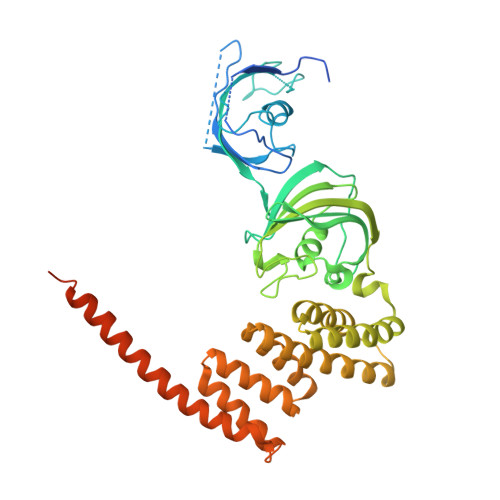
Structure of the Large FKBP-like Protein, FKBP51, Involved in Steroid Receptor Complexes


Experimental Data Snapshot

  • Method: X-RAY DIFFRACTION
  • Resolution: 2.80 Å
  • R-Value Free: 
    0.314 (Depositor), 0.315 (DCC) 
  • R-Value Work: 
    0.255 (Depositor), 0.254 (DCC) 

wwPDB Validation 3D Report Full Report

Validation slider image for 1KT1

This is version 1.3 of the entry. See complete history

Literature

STRUCTURE OF THE LARGE FK506-BINDING PROTEIN FKBP51, AN HSP90-BINDING PROTEIN AND A COMPONENT OF STEROID RECEPTOR COMPLEXES

Sinars, C.R.Cheung-Flynn, J.Rimerman, R.A.Scammell, J.G.Smith, D.F.Clardy, J.C.

(2003) Proc Natl Acad Sci U S A 100: 868-873

  • DOI: https://doi.org/10.1073/pnas.0231020100
  • Primary Citation Related Structures: 
    1KT0, 1KT1

  • PubMed Abstract: 

    The ability to bind immunosuppressive drugs such as cyclosporin and FK506 defines the immunophilin family of proteins, and the FK506-binding proteins form the FKBP subfamily of immunophilins. Some FKBPs, notably FKBP12 (the 12-kDa FK506-binding protein), have defined roles in regulating ion channels or cell signaling, and well established structures. Other FKBPs, especially the larger ones, participate in important biological processes, but their exact roles and the structural bases for these roles are poorly defined. FKBP51 (the 51-kDa FKBP) associates with heat shock protein 90 (Hsp90) and appears in functionally mature steroid receptor complexes. In New World monkeys, FKBP51 has been implicated in cortisol resistance. We report here the x-ray structures of human FKBP51, to 2.7 A, and squirrel monkey FKBP51, to 2.8 A, by using multiwavelength anomalous dispersion phasing. FKBP51 is composed of three domains: two consecutive FKBP domains and a three-unit repeat of the TPR (tetratricopeptide repeat) domain. This structure of a multi-FKBP domain protein clarifies the arrangement of these domains and their possible interactions with other proteins. The two FKBP domains differ by an insertion in the second that affects the formation of the progesterone receptor complex.


  • Organizational Affiliation
    • Department of Chemistry and Chemical Biology, Cornell University, Ithaca, NY 14853-1301, USA.

Macromolecule Content 

  • Total Structure Weight: 51.44 kDa 
  • Atom Count: 3,012 
  • Modeled Residue Count: 374 
  • Deposited Residue Count: 457 
  • Unique protein chains: 1

Macromolecules

Find similar proteins by:|  3D Structure
Entity ID: 1
MoleculeChains  Sequence LengthOrganismDetailsImage
FK506-binding protein FKBP51457Saimiri boliviensisMutation(s): 0 
EC: 5.2.1.8
UniProt
Find proteins for Q9XSH5 (Saimiri boliviensis boliviensis)
Explore Q9XSH5 
Go to UniProtKB:  Q9XSH5
Entity Groups
Sequence Clusters30% Identity50% Identity70% Identity90% Identity95% Identity100% Identity
UniProt GroupQ9XSH5
Sequence Annotations
Expand
Reference Sequence

Experimental Data & Validation

Experimental Data

  • Method: X-RAY DIFFRACTION
  • Resolution: 2.80 Å
  • R-Value Free:  0.314 (Depositor), 0.315 (DCC) 
  • R-Value Work:  0.255 (Depositor), 0.254 (DCC) 
Space Group: P 32 2 1
Unit Cell:
Length ( Å )Angle ( ˚ )
a = 91.035α = 90
b = 91.035β = 90
c = 132.648γ = 120
Software Package:
Software NamePurpose
MOSFLMdata reduction
SCALAdata scaling
SHARPphasing
CNSrefinement
CCP4data scaling

Structure Validation

View Full Validation Report


Entry History 

Deposition Data

Revision History  (Full details and data files)

  • Version 1.0: 2003-02-04
    Type: Initial release
  • Version 1.1: 2008-04-27
    Changes: Version format compliance
  • Version 1.2: 2011-07-13
    Changes: Version format compliance
  • Version 1.3: 2024-02-14
    Changes: Data collection, Database references, Derived calculations