1KRJ | pdb_00001krj

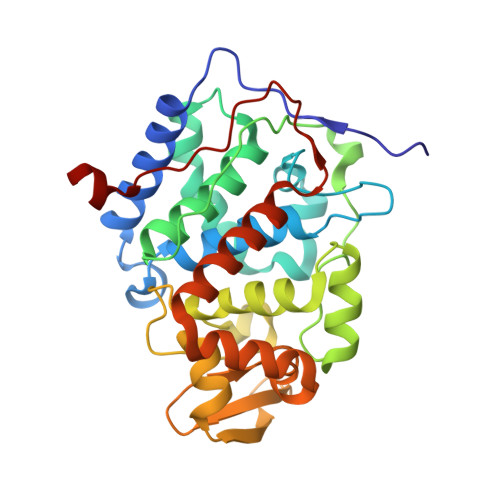
Engineering Calcium-binding site into Cytochrome c Peroxidase (CcP)


Experimental Data Snapshot

  • Method: X-RAY DIFFRACTION
  • Resolution: 2.00 Å
  • R-Value Work: 
    0.192 (Depositor) 

Starting Model: experimental
View more details

wwPDB Validation 3D Report Full Report

Validation slider image for 1KRJ

This is version 1.6 of the entry. See complete history

Literature

Conversion of an engineered potassium-binding site into a calcium-selective site in cytochrome c peroxidase.

Bonagura, C.A.Bhaskar, B.Sundaramoorthy, M.Poulos, T.L.

(1999) J Biological Chem 274: 37827-37833

  • DOI: https://doi.org/10.1074/jbc.274.53.37827
  • Primary Citation Related Structures: 
    1KRJ

  • PubMed Abstract: 

    We have previously shown that the K(+) site found in ascorbate peroxidase can be successfully engineered into the closely homologous peroxidase, cytochrome c peroxidase (CCP) (Bonagura, C. A. , Sundaramoorthy, M., Pappa, H. S., Patterson, W. R., and Poulos, T. L. (1996) Biochemistry 35, 6107-6115; Bonagura, C. A., Sundaramoorthy, M., Bhaskar, B., and Poulos, T. L. (1999) Biochemistry 38, 5538-5545). All other peroxidases bind Ca(2+) rather than K(+). Using the K(+)-binding CCP mutant (CCPK2) as a template protein, together with observations from structural modeling, mutants were designed that should bind Ca(2+) selectively. The crystal structure of the first generation mutant, CCPCA1, showed that a smaller cation, perhaps Na(+), is bound instead of Ca(2+). This is probably because the full eight-ligand coordination sphere did not form owing to a local disordering of one of the essential cation ligands. Based on these observations, a second mutant, CCPCA2, was designed. The crystal structure showed Ca(2+) binding in the CCPCA2 mutant and a well ordered cation-binding loop with the full complement of eight protein to cation ligands. Because cation binding to the engineered loop results in diminished CCP activity and destabilization of the essential Trp(191) radical as measured by EPR spectroscopy, these measurements can be used as sensitive methods for determining cation-binding selectivity. Both activity and EPR titration studies show that CCPCA2 binds Ca(2+) more effectively than K(+), demonstrating that an iterative protein engineering-based approach is important in switching protein cation selectivity.


  • Organizational Affiliation
    • Department of Molecular Biology, Program in Macromolecular Structure, University of California, Irvine, California 92697-3900, USA.

Macromolecule Content 

  • Total Structure Weight: 34.32 kDa 
  • Atom Count: 3,049 
  • Modeled Residue Count: 294 
  • Deposited Residue Count: 294 
  • Unique protein chains: 1

Macromolecules

Find similar proteins by:|  3D Structure
Entity ID: 1
MoleculeChains  Sequence LengthOrganismDetailsImage
Cytochrome c Peroxidase294Saccharomyces cerevisiaeMutation(s): 5 
Gene Names: OPBYC
EC: 1.11.1.5
UniProt
Find proteins for P00431 (Saccharomyces cerevisiae (strain ATCC 204508 / S288c))
Explore P00431 
Go to UniProtKB:  P00431
Entity Groups
Sequence Clusters30% Identity50% Identity70% Identity90% Identity95% Identity100% Identity
UniProt GroupP00431
Sequence Annotations
Expand
Reference Sequence

Small Molecules

Ligands 2 Unique
IDChains Name / Formula / InChI Key2D Diagram3D Interactions
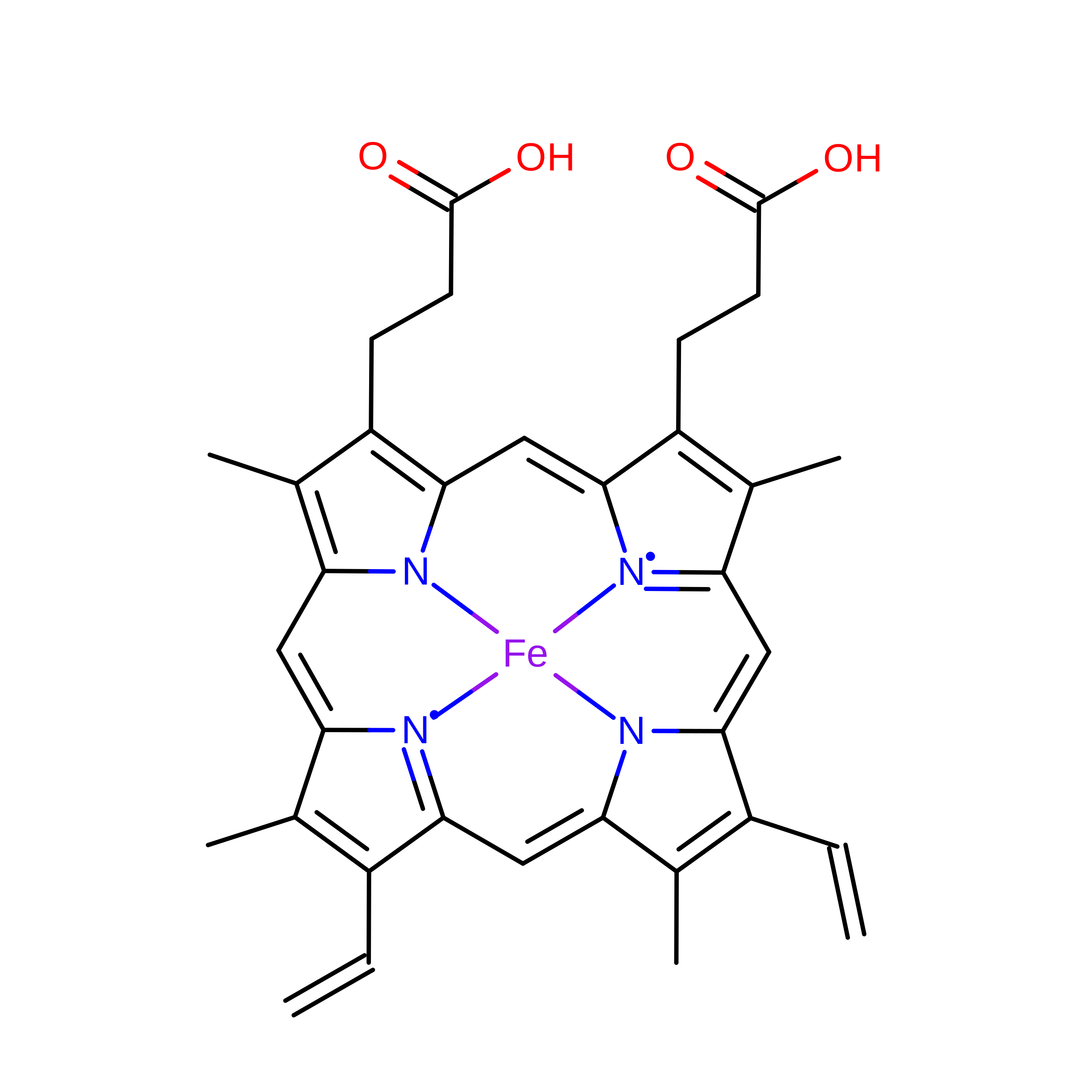
HEM

Query on HEM


Download:Ideal Coordinates CCD File
C [auth A]PROTOPORPHYRIN IX CONTAINING FE
C34 H32 Fe N4 O4
KABFMIBPWCXCRK-RGGAHWMASA-L
K

Query on K


Download:Ideal Coordinates CCD File
B [auth A]POTASSIUM ION
K
NPYPAHLBTDXSSS-UHFFFAOYSA-N

Experimental Data & Validation

Experimental Data

  • Method: X-RAY DIFFRACTION
  • Resolution: 2.00 Å
  • R-Value Work:  0.192 (Depositor) 
Space Group: P 21 21 21
Unit Cell:
Length ( Å )Angle ( ˚ )
a = 107.034α = 90
b = 75.458β = 90
c = 51.1γ = 90
Software Package:
Software NamePurpose
X-PLORmodel building
X-PLORrefinement
SCALEPACKdata scaling
X-PLORphasing

Structure Validation

View Full Validation Report


Entry History 

Deposition Data

Revision History  (Full details and data files)

  • Version 1.0: 2002-01-23
    Type: Initial release
  • Version 1.1: 2008-04-27
    Changes: Version format compliance
  • Version 1.2: 2011-07-13
    Changes: Version format compliance
  • Version 1.3: 2017-10-11
    Changes: Refinement description
  • Version 1.4: 2021-10-27
    Changes: Database references, Derived calculations
  • Version 1.5: 2024-02-14
    Changes: Data collection
  • Version 1.6: 2024-04-03
    Changes: Refinement description