1KP5 | pdb_00001kp5

Cyclic Green Fluorescent Protein


Experimental Data Snapshot

  • Method: X-RAY DIFFRACTION
  • Resolution: 2.60 Å
  • R-Value Free: 
    0.256 (Depositor), 0.251 (DCC) 
  • R-Value Work: 
    0.208 (Depositor), 0.214 (DCC) 

Starting Model: experimental
View more details

wwPDB Validation 3D Report Full Report

Validation slider image for 1KP5

This is version 3.0 of the entry. See complete history

Literature

Structure of cyclized green fluorescent protein.

Hofmann, A.Iwai, H.Hess, S.Pluckthun, A.Wlodawer, A.

(2002) Acta Crystallogr D Biol Crystallogr 58: 1400-1406

  • DOI: https://doi.org/10.1107/S0907444902010454
  • Primary Citation Related Structures: 
    1KP5

  • PubMed Abstract: 

    Crystals of cyclic green fluorescent protein (cGFP) engineered by the previously reported split intein technology [Iwai et al. (2001), J. Biol. Chem. 276, 16548-16554] were obtained and the structure was solved using molecular replacement. Although the core of the protein can unambiguously be fitted from the first to the last residue of the genuine sequence, the electron density in the region of the linker peptide is rather poor owing to the high water content of the crystals. Therefore, it is concluded that this part of the protein is highly disordered in the present structure and is very flexible. This is supported by the absence of crystal contacts in the linker-peptide region and the fact that the core of the protein exhibits a very similar conformation to that known from other GFP structures, thereby not implicating any constraints arising from the presence of the artificial linker. Nevertheless, the density is consistent with the loop being intact, as confirmed by mass spectroscopy of dissolved crystals. The present structure contains an antiparallel cGFP dimer where the dimer interface is clearly different from other crystal structures featuring two GFP molecules. This adds further support to the fact that the cylinder surface of GFP is rather versatile and can employ various polar and non-polar patches in protein-protein interactions.


  • Organizational Affiliation
    • Macromolecular Crystallography Laboratory, NCI at Frederick, Frederick, MD 21702, USA. hofmanna@ncifcrf.gov

Macromolecule Content 

  • Total Structure Weight: 56.7 kDa 
  • Atom Count: 3,936 
  • Modeled Residue Count: 486 
  • Deposited Residue Count: 492 
  • Unique protein chains: 1

Macromolecules

Find similar proteins by:|  3D Structure
Entity ID: 1
MoleculeChains  Sequence LengthOrganismDetailsImage
Green Fluorescent Protein
A, B
246Aequorea victoriaMutation(s): 20 
UniProt
Find proteins for P42212 (Aequorea victoria)
Explore P42212 
Go to UniProtKB:  P42212
Entity Groups
Sequence Clusters30% Identity50% Identity70% Identity90% Identity95% Identity100% Identity
UniProt GroupP42212
Sequence Annotations
Expand
Reference Sequence

Small Molecules

Modified Residues  1 Unique
IDChains TypeFormula2D DiagramParent
GYS
Query on GYS
A, B
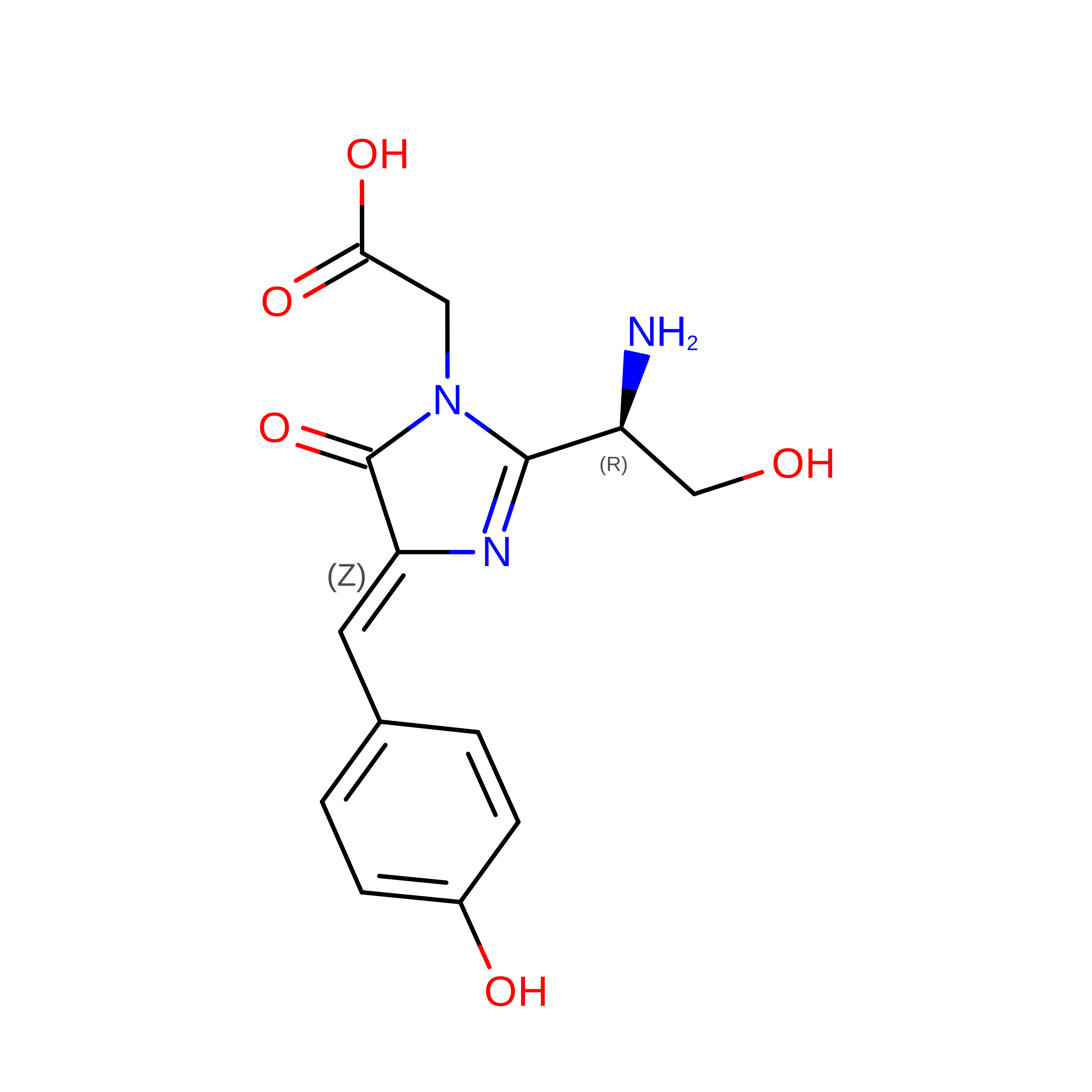
L-PEPTIDE LINKINGC14 H15 N3 O5SER, TYR, GLY

Experimental Data & Validation

Experimental Data

  • Method: X-RAY DIFFRACTION
  • Resolution: 2.60 Å
  • R-Value Free:  0.256 (Depositor), 0.251 (DCC) 
  • R-Value Work:  0.208 (Depositor), 0.214 (DCC) 
Space Group: P 65 2 2
Unit Cell:
Length ( Å )Angle ( ˚ )
a = 142.447α = 90
b = 142.447β = 90
c = 183.809γ = 120
Software Package:
Software NamePurpose
AMoREphasing
CNSrefinement
DENZOdata reduction
SCALEPACKdata scaling

Structure Validation

View Full Validation Report


Entry History 

Deposition Data

Revision History  (Full details and data files)

  • Version 1.0: 2002-08-28
    Type: Initial release
  • Version 1.1: 2008-04-27
    Changes: Version format compliance
  • Version 1.2: 2011-07-13
    Changes: Version format compliance
  • Version 1.3: 2015-01-21
    Changes: Structure summary
  • Version 1.4: 2021-10-27
    Changes: Database references, Derived calculations
  • Version 1.5: 2023-08-16
    Changes: Data collection, Refinement description
  • Version 2.0: 2023-11-15
    Changes: Advisory, Atomic model, Data collection, Derived calculations
  • Version 2.1: 2024-10-16
    Changes: Structure summary
  • Version 3.0: 2026-03-18
    Changes: Polymer sequence