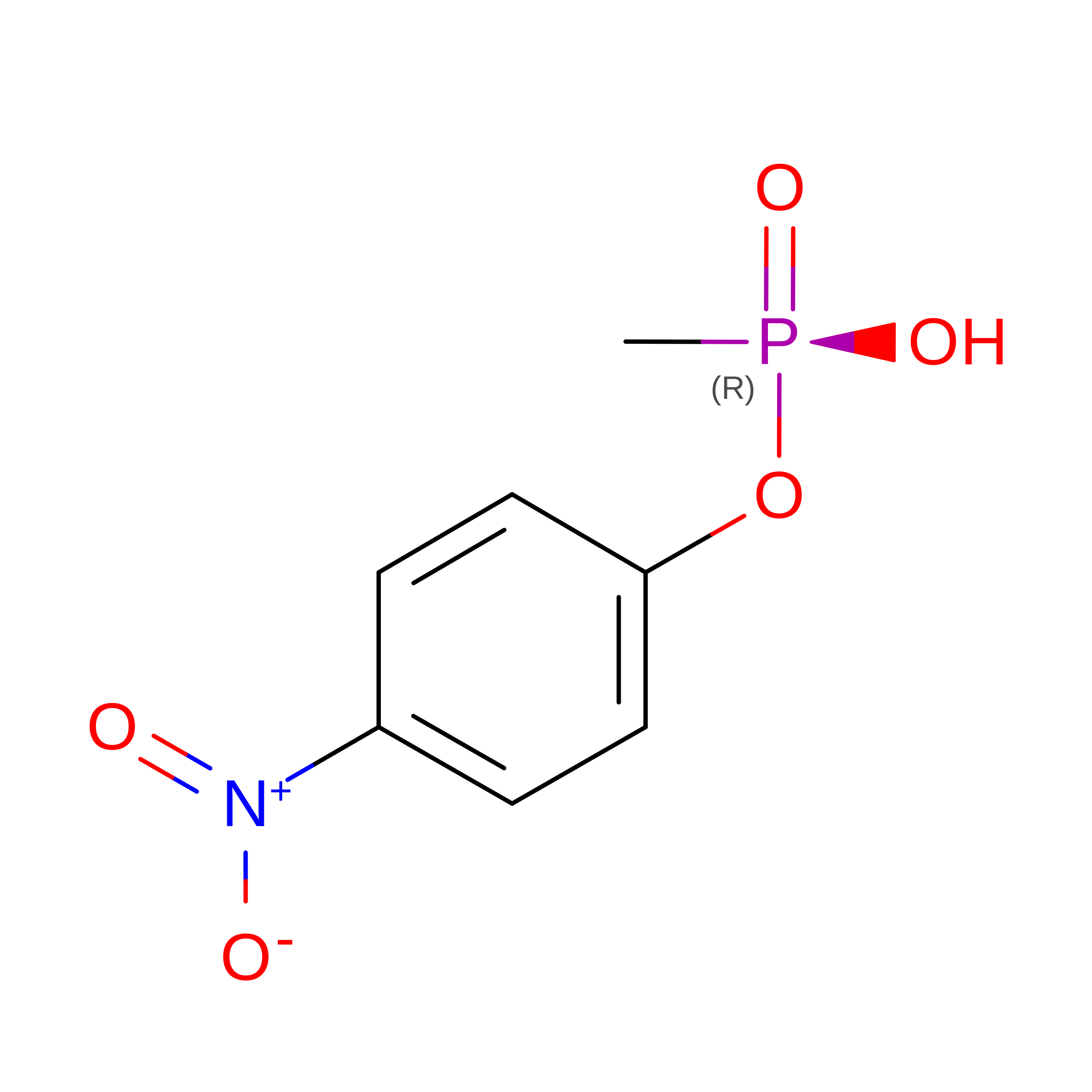
1KNO | pdb_00001kno

CRYSTAL STRUCTURE OF THE COMPLEX OF A CATALYTIC ANTIBODY FAB WITH A TRANSITION STATE ANALOG: STRUCTURAL SIMILARITIES IN ESTERASE-LIKE ABZYMES


Experimental Data Snapshot

  • Method: X-RAY DIFFRACTION
  • Resolution: 3.20 Å
  • R-Value Free: 
    0.272 (Depositor) 
  • R-Value Work: 
    0.200 (Depositor) 
  • R-Value Observed: 
    0.200 (Depositor) 

wwPDB Validation 3D Report Full Report

Validation slider image for 1KNO

This is version 1.3 of the entry. See complete history

Literature

Crystal structure of the complex of a catalytic antibody Fab fragment with a transition state analog: structural similarities in esterase-like catalytic antibodies.

Charbonnier, J.B.Carpenter, E.Gigant, B.Golinelli-Pimpaneau, B.Eshhar, Z.Green, B.S.Knossow, M.

(1995) Proc Natl Acad Sci U S A 92: 11721-11725

  • DOI: https://doi.org/10.1073/pnas.92.25.11721
  • Primary Citation Related Structures: 
    1KNO

  • PubMed Abstract: 

    The x-ray structure of the complex of a catalytic antibody Fab fragment with a phosphonate transition-state analog has been determined. The antibody (CNJ206) catalyzes the hydrolysis of p-nitrophenyl esters with significant rate enhancement and substrate specificity. Comparison of this structure with that of the uncomplexed Fab fragment suggests hapten-induced conformational changes: the shape of the combining site changes from a shallow groove in the uncomplexed Fab to a deep pocket where the hapten is buried. Three hydrogen-bond donors appear to stabilize the charged phosphonate group of the hapten: two NH groups of the heavy (H) chain complementarity-determining region 3 (H3 CDR) polypeptide chain and the side-chain of histidine-H35 in the H chain (His-H35) in the H1 CDR. The combining site shows striking structural similarities to that of antibody 17E8, which also has esterase activity. Both catalytic antibody ("abzyme") structures suggest that oxyanion stabilization plays a significant role in their rate acceleration. Additional catalytic groups that improve efficiency are not necessarily induced by the eliciting hapten; these groups may occur because of the variability in the combining sites of different monoclonal antibodies that bind to the same hapten.


  • Organizational Affiliation
    • Laboratoire de Biologie Structurale, Centre National de la Recherche Scientifique, Université Paris Sud, Gif-sur-Yvette, France.

Macromolecule Content 

  • Total Structure Weight: 141.72 kDa 
  • Atom Count: 9,949 
  • Modeled Residue Count: 1,302 
  • Deposited Residue Count: 1,302 
  • Unique protein chains: 2

Macromolecules

Find similar proteins by:|  3D Structure
Entity ID: 1
MoleculeChains  Sequence LengthOrganismDetailsImage
IGG2A FAB FRAGMENT CNJ206
A, C, E
214Mus musculusMutation(s): 0 
UniProt
Find proteins for P01837 (Mus musculus)
Explore P01837 
Go to UniProtKB:  P01837
Entity Groups
Sequence Clusters30% Identity50% Identity70% Identity90% Identity95% Identity100% Identity
UniProt GroupP01837
Sequence Annotations
Expand
Reference Sequence
Find similar proteins by:|  3D Structure
Entity ID: 2
MoleculeChains  Sequence LengthOrganismDetailsImage
IGG2A FAB FRAGMENT CNJ206
B, D, F
220Mus musculusMutation(s): 0 
UniProt
Find proteins for P01863 (Mus musculus)
Explore P01863 
Go to UniProtKB:  P01863
Entity Groups
Sequence Clusters30% Identity50% Identity70% Identity90% Identity95% Identity100% Identity
UniProt GroupP01863
Sequence Annotations
Expand
Reference Sequence

Experimental Data & Validation

Experimental Data

  • Method: X-RAY DIFFRACTION
  • Resolution: 3.20 Å
  • R-Value Free:  0.272 (Depositor) 
  • R-Value Work:  0.200 (Depositor) 
  • R-Value Observed: 0.200 (Depositor) 
Space Group: P 1
Unit Cell:
Length ( Å )Angle ( ˚ )
a = 74.1α = 93.8
b = 76.9β = 93.9
c = 88.3γ = 115.6
Software Package:
Software NamePurpose
MOSFLMdata reduction
X-PLORmodel building
X-PLORrefinement
X-PLORphasing

Structure Validation

View Full Validation Report


Entry History 

Deposition Data

Revision History  (Full details and data files)

  • Version 1.0: 1996-01-29
    Type: Initial release
  • Version 1.1: 2008-03-24
    Changes: Version format compliance
  • Version 1.2: 2011-07-13
    Changes: Version format compliance
  • Version 1.3: 2024-10-30
    Changes: Data collection, Database references, Derived calculations, Structure summary