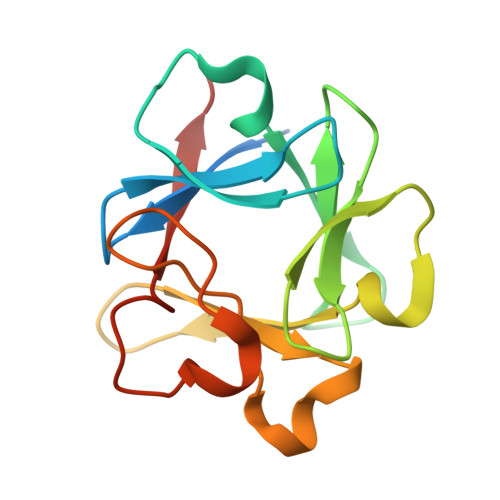
1K5U | pdb_00001k5u

Human acidic fibroblast growth factor. 141 amino acid form with amino terminal His tag with His93 replaced by Gly (H93G).


Experimental Data Snapshot

  • Method: X-RAY DIFFRACTION
  • Resolution: 2.00 Å
  • R-Value Free: 
    0.293 (Depositor) 
  • R-Value Work: 
    0.219 (Depositor), 0.222 (DCC) 
  • R-Value Observed: 
    0.233 (Depositor) 

Starting Model: experimental
View more details

wwPDB Validation 3D Report Full Report

Validation slider image for 1K5U

This is version 1.4 of the entry. See complete history

Literature

Alternative type I and I' turn conformations in the beta8/beta9 beta-hairpin of human acidic fibroblast growth factor.

Kim, J.Blaber, S.I.Blaber, M.

(2002) Protein Sci 11: 459-466

  • DOI: https://doi.org/10.1110/ps.43802
  • Primary Citation Related Structures: 
    1K5U, 1K5V

  • PubMed Abstract: 

    Human acidic fibroblast growth factor (FGF-1) has a beta-trefoil structure, one of the fundamental protein superfolds. The X-ray crystal structures of wild-type and various mutant forms of FGF-1 have been solved in five different space groups: C2, C222(1), P2(1) (four molecules/asu), P2(1) (three molecules/asu), and P2(1)2(1)2(1). These structures reveal two characteristically different conformations for the beta8/beta9 beta-hairpin comprising residue positions 90-94. This region in the wild-type FGF-1 structure (P2(1), four molecules/asu), a his-tagged His93-->Gly mutant (P2(1), three molecules/asu) and a his-tagged Asn106-->Gly mutant (P2(1)2(1)2(1)) adopts a 3:5 beta-hairpin known as a type I (1-4) G1 beta-bulge (containing a type I turn). However, a his-tagged form of wild-type FGF-1 (C222(1)) and a his-tagged Leu44-->Phe mutant (C2) adopt a 3:3 beta-hairpin (containing a type I' turn) for this same region. A feature that distinguishes these two types of beta-hairpin structures is the number and location of side chain positions with eclipsed C(beta) and main-chain carbonyl oxygen groups (Psi is equivalent to +60 degrees). The effects of glycine mutations upon stability, at positions within the hairpin, have been used to identify the most likely structure in solution. Type I' turns in the structural data bank are quite rare, and a survey of these turns reveals that a large percentage exhibit crystal contacts within 3.0 A. This suggests that many of the type I' turns in X-ray structures may be adopted due to crystal packing effects.


  • Organizational Affiliation
    • Institute of Molecular Biophysics and Department of Chemistry and Biochemistry, Florida State University, Tallahassee, Florida 32306-4380, USA.

Macromolecule Content 

  • Total Structure Weight: 50.11 kDa 
  • Atom Count: 3,091 
  • Modeled Residue Count: 386 
  • Deposited Residue Count: 438 
  • Unique protein chains: 1

Macromolecules

Find similar proteins by:|  3D Structure
Entity ID: 1
MoleculeChains  Sequence LengthOrganismDetailsImage
Acidic fibroblast growth factor
A, B, C
146Homo sapiensMutation(s): 1 
UniProt & NIH Common Fund Data Resources
Find proteins for P05230 (Homo sapiens)
Explore P05230 
Go to UniProtKB:  P05230
PHAROS:  P05230
GTEx:  ENSG00000113578 
Entity Groups
Sequence Clusters30% Identity50% Identity70% Identity90% Identity95% Identity100% Identity
UniProt GroupP05230
Sequence Annotations
Expand
Reference Sequence

Experimental Data & Validation

Experimental Data

  • Method: X-RAY DIFFRACTION
  • Resolution: 2.00 Å
  • R-Value Free:  0.293 (Depositor) 
  • R-Value Work:  0.219 (Depositor), 0.222 (DCC) 
  • R-Value Observed: 0.233 (Depositor) 
Space Group: P 1 21 1
Unit Cell:
Length ( Å )Angle ( ˚ )
a = 33.63α = 90
b = 97.71β = 104.3
c = 57.46γ = 90
Software Package:
Software NamePurpose
TNTrefinement
DENZOdata reduction
SCALEPACKdata scaling
TNTphasing

Structure Validation

View Full Validation Report


Entry History 

Deposition Data

Revision History  (Full details and data files)

  • Version 1.0: 2002-02-27
    Type: Initial release
  • Version 1.1: 2008-04-27
    Changes: Version format compliance
  • Version 1.2: 2011-07-13
    Changes: Version format compliance
  • Version 1.3: 2021-10-27
    Changes: Database references, Derived calculations
  • Version 1.4: 2023-08-16
    Changes: Data collection, Refinement description