1JXT | pdb_00001jxt

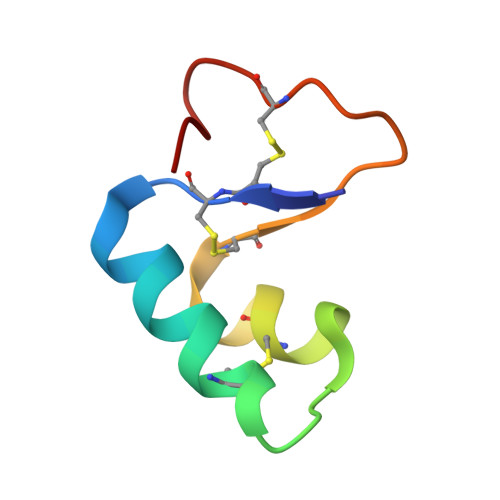
CRAMBIN MIXED SEQUENCE FORM AT 160 K. PROTEIN/WATER SUBSTATES


Experimental Data Snapshot

  • Method: X-RAY DIFFRACTION
  • Resolution: 0.89 Å
  • R-Value Work: 
    0.145 (Depositor), 0.229 (DCC) 
  • R-Value Observed: 
    0.145 (Depositor) 

Starting Model: experimental
View more details

wwPDB Validation 3D Report Full Report

Validation slider image for 1JXT

This is version 1.4 of the entry. See complete history

Literature

On the nature of a glassy state of matter in a hydrated protein: Relation to protein function.

Teeter, M.M.Yamano, A.Stec, B.Mohanty, U.

(2001) Proc Natl Acad Sci U S A 98: 11242-11247

  • DOI: https://doi.org/10.1073/pnas.201404398
  • Primary Citation Related Structures: 
    1JXT, 1JXU, 1JXW, 1JXX, 1JXY

  • PubMed Abstract: 

    Diverse biochemical and biophysical experiments indicate that all proteins, regardless of size or origin, undergo a dynamic transition near 200 K. The cause of this shift in dynamic behavior, termed a "glass transition," and its relation to protein function are important open questions. One explanation postulated for the transition is solidification of correlated motions in proteins below the transition. We verified this conjecture by showing that crambin's radius of gyration (Rg) remains constant below approximately 180 K. We show that both atom position and dynamics of protein and solvent are physically coupled, leading to a novel cooperative state. This glassy state is identified by negative slopes of the Debye-Waller (B) factor vs. temperature. It is composed of multisubstate side chains and solvent. Based on generalization of Adam-Gibbs' notion of a cooperatively rearranging region and decrease of the total entropy with temperature, we calculate the slope of the Debye-Waller factor. The results are in accord with experiment.


  • Organizational Affiliation
    • Eugene F. Merkert Chemistry Center, Boston College, Chestnut Hill, MA 02467, USA. teeter@bc.edu

Macromolecule Content 

  • Total Structure Weight: 4.77 kDa 
  • Atom Count: 419 
  • Modeled Residue Count: 48 
  • Deposited Residue Count: 48 
  • Unique protein chains: 1

Macromolecules

Find similar proteins by:|  3D Structure
Entity ID: 1
MoleculeChains  Sequence LengthOrganismDetailsImage
Crambin46Crambe hispanica subsp. abyssinicaMutation(s): 2 
UniProt
Find proteins for P01542 (Crambe hispanica subsp. abyssinica)
Explore P01542 
Go to UniProtKB:  P01542
Entity Groups
Sequence Clusters30% Identity50% Identity70% Identity90% Identity95% Identity100% Identity
UniProt GroupP01542
Sequence Annotations
Expand
Reference Sequence

Small Molecules

Ligands 1 Unique
IDChains Name / Formula / InChI Key2D Diagram3D Interactions
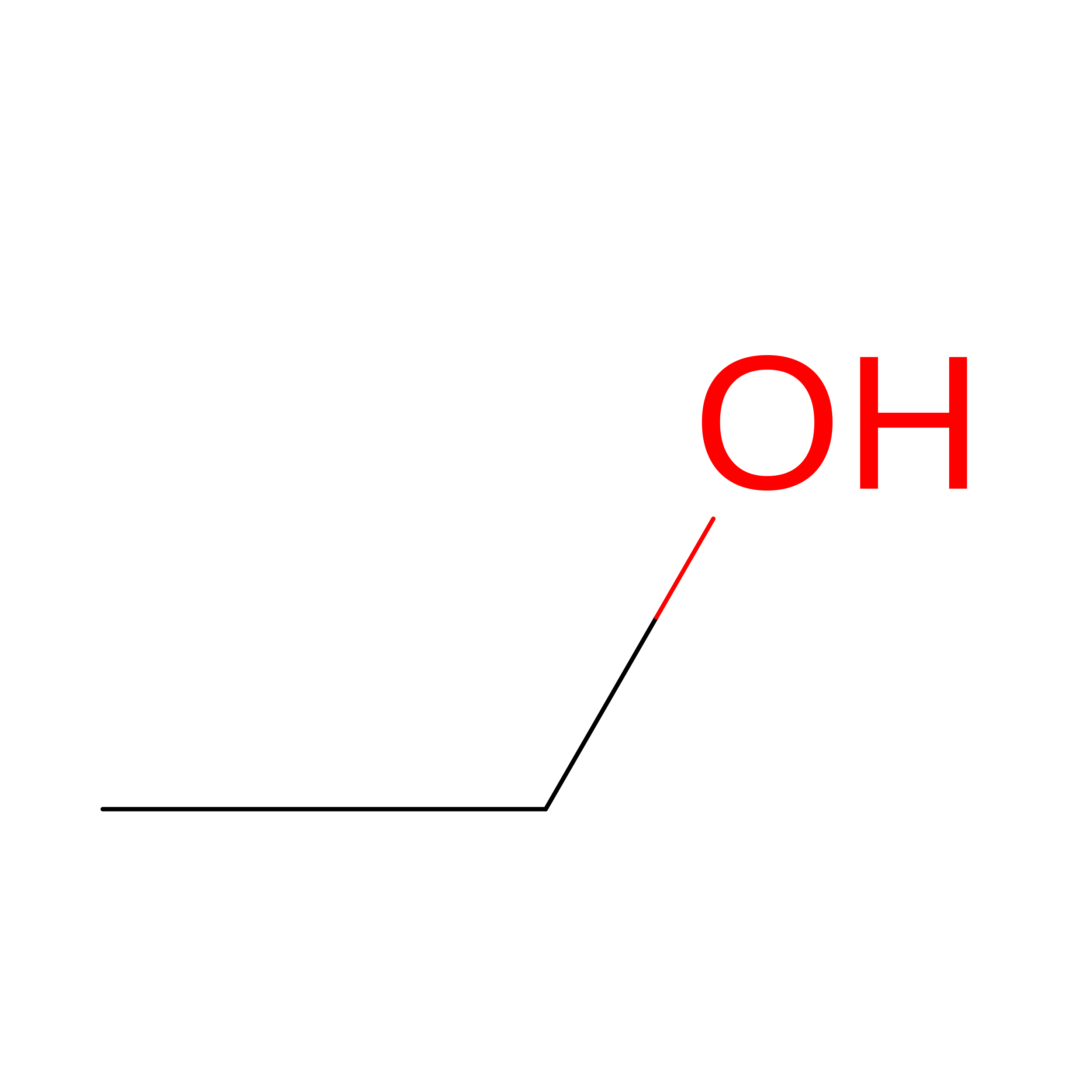
EOH

Query on EOH


Download:Ideal Coordinates CCD File
B [auth A]ETHANOL
C2 H6 O
LFQSCWFLJHTTHZ-UHFFFAOYSA-N

Experimental Data & Validation

Experimental Data

  • Method: X-RAY DIFFRACTION
  • Resolution: 0.89 Å
  • R-Value Work:  0.145 (Depositor), 0.229 (DCC) 
  • R-Value Observed: 0.145 (Depositor) 
Space Group: P 1 21 1
Unit Cell:
Length ( Å )Angle ( ˚ )
a = 40.84α = 90
b = 18.47β = 90.8
c = 22.34γ = 90
Software Package:
Software NamePurpose
LEHMANN-LARSENdata collection
TEXSANdata reduction
MADSYSphasing
PROLSQrefinement
LEHMANN-LARSENdata reduction
TEXSANdata scaling

Structure Validation

View Full Validation Report


Entry History 

Deposition Data

Revision History  (Full details and data files)

  • Version 1.0: 2001-10-31
    Type: Initial release
  • Version 1.1: 2007-10-21
    Changes: Version format compliance
  • Version 1.2: 2011-07-13
    Changes: Atomic model, Version format compliance
  • Version 1.3: 2023-08-16
    Changes: Data collection, Database references, Derived calculations, Refinement description
  • Version 1.4: 2024-10-30
    Changes: Structure summary