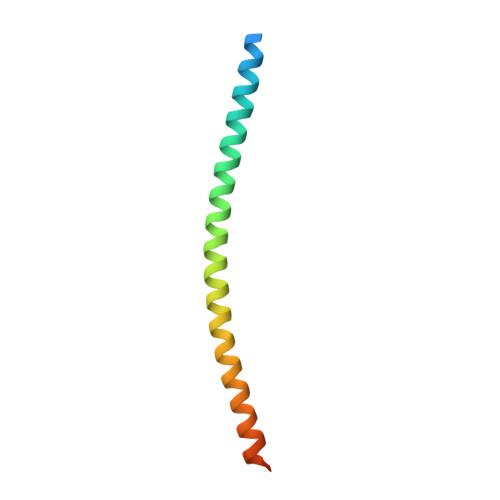
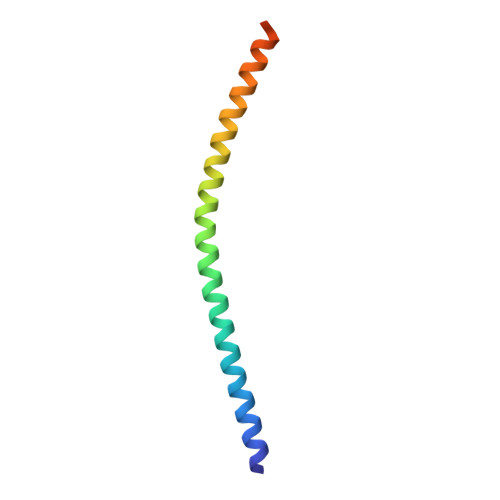
1JTH | pdb_00001jth

Crystal structure and biophysical properties of a complex between the N-terminal region of SNAP25 and the SNARE region of syntaxin 1a


Experimental Data Snapshot

  • Method: X-RAY DIFFRACTION
  • Resolution: 2.00 Å
  • R-Value Free: 
    0.289 (Depositor), 0.291 (DCC) 
  • R-Value Work: 
    0.266 (Depositor), 0.266 (DCC) 

wwPDB Validation 3D Report Full Report

Validation slider image for 1JTH

This is version 1.6 of the entry. See complete history

Literature

Crystal structure and biophysical properties of a complex between the N-terminal SNARE region of SNAP25 and syntaxin 1a.

Misura, K.M.Gonzalez Jr., L.C.May, A.P.Scheller, R.H.Weis, W.I.

(2001) J Biological Chem 276: 41301-41309

  • DOI: https://doi.org/10.1074/jbc.M106853200
  • Primary Citation Related Structures: 
    1JTH

  • PubMed Abstract: 

    SNARE proteins are required for intracellular membrane fusion. In the neuron, the plasma membrane SNAREs syntaxin 1a and SNAP25 bind to VAMP2 found on neurotransmitter-containing vesicles. These three proteins contain "SNARE regions" that mediate their association into stable tetrameric coiled-coil structures. Syntaxin 1a contributes one such region, designated H3, and SNAP25 contributes two SNARE regions to the fusogenic complex with VAMP2. Syntaxin 1a H3 (syn1aH3) and SNAP25 can form a stable assembly, which can then be bound by VAMP2 to form the full SNARE complex. Here we show that syn1aH3 can also form a stable but kinetically trapped complex with the N-terminal SNARE region of SNAP25 (S25N). The crystal structure of this complex reveals an extended parallel four-helix bundle similar to that of the core SNARE and the syn1aH3-SNAP25 complexes. The inherent ability of syn1aH3 and S25N to associate stably in vitro implies that the intracellular fusion machinery must prevent formation of, or remove, any non-productive complexes. Comparison with the syn1aH3-SNAP25 complex suggests that the linkage of the N- and C-terminal SNAP25 SNARE regions is kinetically advantageous in preventing formation of the non-productive syn1aH3-S25N complex. We also demonstrate that the syn1aH3-S25N complex can be disassembled by alpha-SNAP and N-ethylmaleimide-sensitive factor.


  • Organizational Affiliation
    • Department of Structural Biology, Stanford University School of Medicine, Stanford, California 94305-5126, USA.

Macromolecule Content 

  • Total Structure Weight: 37.26 kDa 
  • Atom Count: 2,057 
  • Modeled Residue Count: 249 
  • Deposited Residue Count: 318 
  • Unique protein chains: 2

Macromolecules

Find similar proteins by:|  3D Structure
Entity ID: 1
MoleculeChains  Sequence LengthOrganismDetailsImage
SNAP25
A, C
82Rattus norvegicusMutation(s): 0 
UniProt
Find proteins for P60881 (Rattus norvegicus)
Explore P60881 
Go to UniProtKB:  P60881
Entity Groups
Sequence Clusters30% Identity50% Identity70% Identity90% Identity95% Identity100% Identity
UniProt GroupP60881
Sequence Annotations
Expand
Reference Sequence
Find similar proteins by:|  3D Structure
Entity ID: 2
MoleculeChains  Sequence LengthOrganismDetailsImage
syntaxin 1a
B, D
77Rattus norvegicusMutation(s): 0 
UniProt
Find proteins for P32851 (Rattus norvegicus)
Explore P32851 
Go to UniProtKB:  P32851
Entity Groups
Sequence Clusters30% Identity50% Identity70% Identity90% Identity95% Identity100% Identity
UniProt GroupP32851
Sequence Annotations
Expand
Reference Sequence

Experimental Data & Validation

Experimental Data

  • Method: X-RAY DIFFRACTION
  • Resolution: 2.00 Å
  • R-Value Free:  0.289 (Depositor), 0.291 (DCC) 
  • R-Value Work:  0.266 (Depositor), 0.266 (DCC) 
Space Group: C 1 2 1
Unit Cell:
Length ( Å )Angle ( ˚ )
a = 59.4α = 90
b = 65.78β = 99.5
c = 80.1γ = 90
Software Package:
Software NamePurpose
CNSrefinement
DENZOdata reduction
SCALEPACKdata scaling
CNSphasing

Structure Validation

View Full Validation Report


Entry History 

Deposition Data

Revision History  (Full details and data files)

  • Version 1.0: 2001-11-28
    Type: Initial release
  • Version 1.1: 2008-04-27
    Changes: Version format compliance
  • Version 1.2: 2011-07-13
    Changes: Version format compliance
  • Version 1.3: 2011-11-16
    Changes: Atomic model
  • Version 1.4: 2014-04-16
    Changes: Other
  • Version 1.5: 2019-10-23
    Changes: Data collection
  • Version 1.6: 2024-03-13
    Changes: Data collection, Database references