Download Mendeley
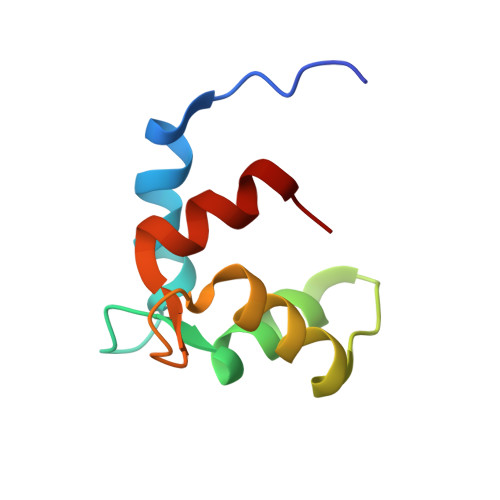
Structure, dynamics, and thermodynamics of the structural domain of troponin C in complex with the regulatory peptide 1-40 of troponin I
Mercier, P., Spyracopoulos, L., Sykes, B.D.(2001) Biochemistry 40: 10063-10077
- PubMed: 11513585 Search on PubMed
- DOI: https://doi.org/10.1021/bi010748+
- Primary Citation Related Structures:
1JC2 - PubMed Abstract:
The structure of the calcium-saturated C-domain of skeletal troponin C (CTnC) in complex with a regulatory peptide comprising residues 1-40 (Rp40) of troponin I (TnI) was determined using nuclear magnetic resonance (NMR) spectroscopy. The solution structure determined by NMR is similar to the structure of the C-domain from intact TnC in complex with TnI(1)(-)(47) determined by X-ray crystallography [Vassylyev, D. G., Takeda, S., Wakatsuki, S., Maeda, K., and Maeda, Y. (1998) Proc. Natl. Acad. Sci. U.S.A. 95, 4847-4852]. Changes in the dynamic properties of CTnC.2Ca2+ induced by Rp40 binding were investigated using backbone amide (15)N NMR relaxation measurements. Analysis of NMR relaxation data allows for extraction of motional order parameters on a per residue basis, from which the contribution of changes in picosecond to nanosecond time scale motions to the conformational entropy associated with complex formation can be estimated. The results indicate that binding of Rp40 decreases backbone flexibility in CTnC, particularly at the end of the C-terminal helix. The backbone conformational entropy change (-TDeltaS) associated with binding of Rp40 to CTnC.2Ca2+ determined from (15)N relaxation data is 9.6 +/- 0.7 kcal mol(-1) at 30 degrees C. However, estimation of thermodynamic quantities using a structural approach [Lavigne, P., Bagu, J. R., Boyko, R., Willard, L., Holmes, C. F., and Sykes, B. D. (2000) Protein Sci. 9, 252-264] reveals that the change in solvation entropy upon complex formation is dominant and overcomes the thermodynamic "cost" associated with "stiffening" of the protein backbone upon Rp40 binding. Additionally, backbone amide (15)N relaxation data measured at different concentrations of CTnC.2Ca2+.Rp40 reveal that the complex dimerizes in solution. Fitting of the apparent global rotational correlation time as a function of concentration to a monomer-dimer equilibrium yields a dimerization constant of approximately 8.3 mM.
- CIHR Group in Protein Structure and Function, Department of Biochemistry, University of Alberta, Edmonton, Alberta, Canada.
Organizational Affiliation: