1IVP | pdb_00001ivp

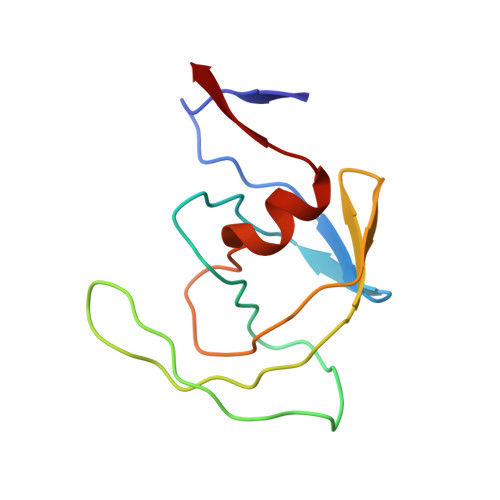
THE CRYSTALLOGRAPHIC STRUCTURE OF THE PROTEASE FROM HUMAN IMMUNODEFICIENCY VIRUS TYPE 2 WITH TWO SYNTHETIC PEPTIDIC TRANSITION STATE ANALOG INHIBITORS


Experimental Data Snapshot

  • Method: X-RAY DIFFRACTION
  • Resolution: 2.50 Å
  • R-Value Observed: 
    0.197 (Depositor) 

wwPDB Validation 3D Report Full Report

Validation slider image for 1IVP

This is version 1.5 of the entry. See complete history

Literature

The crystallographic structure of the protease from human immunodeficiency virus type 2 with two synthetic peptidic transition state analog inhibitors.

Mulichak, A.M.Hui, J.O.Tomasselli, A.G.Heinrikson, R.L.Curry, K.A.Tomich, C.S.Thaisrivongs, S.Sawyer, T.K.Watenpaugh, K.D.

(1993) J Biological Chem 268: 13103-13109

  • Primary Citation Related Structures: 
    1IVP, 1IVQ

  • PubMed Abstract: 

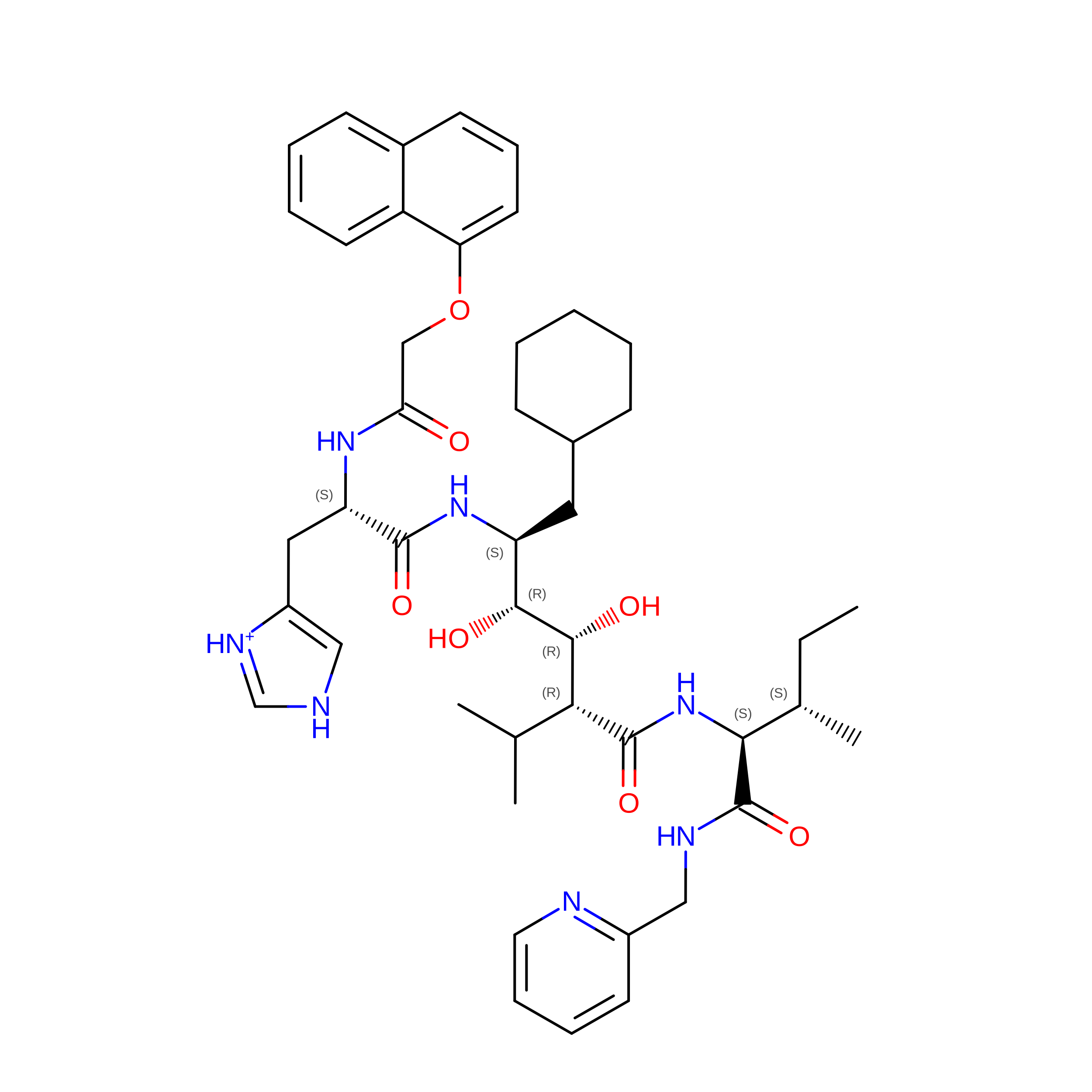
    The crystal structure of human immunodeficiency virus (HIV) type 2 protease has been determined in complexes with peptidic inhibitors Noa-His-Cha psi [CH(OH)CH(OH)]Val-Ile-Amp (U75875) and Qnc-Asn-Cha psi [CH(OH)CH2]Val-Npt(U92163) (where Noa is naphthyloxyacetyl, Cha is cyclohexylalanine, Amp is 2-aminomethylpyridine, Qnc is quinoline-2-carbonyl, and Npt is neopentylamine), which have dihydroxyethylene and hydroxyethylene moieties, respectively, in place of the normal scissile bond of the natural ligand. The complexes crystallize in space group P2(1)2(1)2(1), with one dimer-inhibitor complex per asymmetric unit and average cell dimensions of a = 33.28 A, b = 45.35 A, c = 135.84 A. Data were collected to approximately 2.5-A resolution. The model structures were refined with resulting R-factors of around 0.19. As expected, the HIV-2 protease structure is approximately C2-symmetric with a gross structure very similar to that of the HIV-1 enzyme. The inhibitors bind in an extended conformation positioned lengthwise in the binding cleft in a manner similar to that found in the HIV-1 protease-inhibitor complexes previously reported. The substitution of the bulkier Ile82 side chain in the HIV-2 protease may help explain the better ability of HIV-2 protease to bind and hydrolyze ligands with small P1 and P1' side groups. It appears that differences in specificity between the proteases of HIV-1 and HIV-2 are not merely a result of simple side chain substitutions, but may be complicated by differences in main chain flexibility as well.


  • Organizational Affiliation
    • Discovery Research, Upjohn Company, Kalamazoo, Michigan 49007.

Macromolecule Content 

  • Total Structure Weight: 22.24 kDa 
  • Atom Count: 1,579 
  • Modeled Residue Count: 198 
  • Deposited Residue Count: 198 
  • Unique protein chains: 1

Macromolecules

Find similar proteins by:|  3D Structure
Entity ID: 1
MoleculeChains  Sequence LengthOrganismDetailsImage
HIV-2 PROTEASE
A, B
99Human immunodeficiency virus 2Mutation(s): 0 
UniProt
Find proteins for P04584 (Human immunodeficiency virus type 2 subtype A (isolate ROD))
Explore P04584 
Go to UniProtKB:  P04584
Entity Groups
Sequence Clusters30% Identity50% Identity70% Identity90% Identity95% Identity100% Identity
UniProt GroupP04584
Sequence Annotations
Expand
Reference Sequence

Small Molecules

Ligands 1 Unique
IDChains Name / Formula / InChI Key2D Diagram3D Interactions
1ZK

Query on 1ZK


Download:Ideal Coordinates CCD File
C [auth B]4-[(2R)-3-{[(1S,2S,3R,4S)-1-(cyclohexylmethyl)-2,3-dihydroxy-5-methyl-4-({(1S,2R)-2-methyl-1-[(pyridin-2-ylmethyl)carba moyl]butyl}carbamoyl)hexyl]amino}-2-{[(naphthalen-1-yloxy)acetyl]amino}-3-oxopropyl]-1H-imidazol-3-ium
C45 H62 N7 O7
ZTKCGLWIXHAITR-JIFWBGJESA-O

Biologically Interesting Molecules (External Reference) 

1 Unique

Experimental Data & Validation

Experimental Data

  • Method: X-RAY DIFFRACTION
  • Resolution: 2.50 Å
  • R-Value Observed: 0.197 (Depositor) 
Space Group: P 21 21 21
Unit Cell:
Length ( Å )Angle ( ˚ )
a = 33.19α = 90
b = 44.95β = 90
c = 135.65γ = 90
Software Package:
Software NamePurpose
PROLSQrefinement

Structure Validation

View Full Validation Report


Entry History 

Deposition Data

Revision History  (Full details and data files)

  • Version 1.0: 1993-07-15
    Type: Initial release
  • Version 1.1: 2008-03-24
    Changes: Version format compliance
  • Version 1.2: 2011-07-13
    Changes: Atomic model, Database references, Derived calculations, Non-polymer description, Structure summary, Version format compliance
  • Version 1.3: 2012-12-12
    Changes: Other
  • Version 1.4: 2017-11-29
    Changes: Derived calculations, Other
  • Version 1.5: 2024-02-07
    Changes: Data collection, Database references, Derived calculations, Structure summary