1IOZ | pdb_00001ioz

Crystal Structure of the C-HA-RAS Protein Prepared by the Cell-Free Synthesis


Experimental Data Snapshot

  • Method: X-RAY DIFFRACTION
  • Resolution: 2.00 Å
  • R-Value Free: 
    0.283 (Depositor) 
  • R-Value Work: 
    0.238 (Depositor) 
  • R-Value Observed: 
    0.244 (Depositor) 

wwPDB Validation 3D Report Full Report

Validation slider image for 1IOZ

This is version 1.3 of the entry. See complete history

Literature

Selenomethionine incorporation into a protein by cell-free synthesis

Kigawa, T.Yamaguchi-Nunokawa, E.Kodama, K.Matsuda, T.Yabuki, T.Matsuda, N.Ishitani, R.Nureki, O.Yokoyama, S.

(2001) J Struct Funct Genomics 2: 29-35

  • DOI: https://doi.org/10.1023/a:1013203532303
  • Primary Citation Related Structures: 
    1IOZ

  • PubMed Abstract: 

    Multi-wavelength anomalous diffraction phasing is especially useful for high-throughput structure determinations. Selenomethionine substituted proteins are commonly used for this purpose. However, the cytotoxicity of selenomethionine drastically reduces the efficiency of its incorporation in in vivo expression systems. In the present study, an improved E. coli cell-free protein synthesis system was used to incorporate selenomethionine into a protein, so that highly efficient incorporation could be achieved. A milligram quantity of selenomethionine-containing Ras was obtained using the cell-free system with dialysis. The mass spectrometry analysis showed that more than 95% of the methionine residues were substituted with selenomethionine. The crystal of this protein grew under the same conditions and had the same unit cell constants as those of the native Ras protein. The three-dimensional structure of this protein, determined by multi-wavelength anomalous diffraction phasing, was almost the same as that of the Ras protein prepared by in vivo expression. Therefore, the cell-free synthesis system could become a powerful protein expression method for high-throughput structure determinations by X-ray crystallography.


  • Organizational Affiliation
    • RIKEN Genomic Sciences Center, 1-7-22 Suehiro-cho, Tsurumi, Yokohama, 230-0045 Japan.

Macromolecule Content 

  • Total Structure Weight: 19.96 kDa 
  • Atom Count: 1,500 
  • Modeled Residue Count: 162 
  • Deposited Residue Count: 171 
  • Unique protein chains: 1

Macromolecules

Find similar proteins by:|  3D Structure
Entity ID: 1
MoleculeChains  Sequence LengthOrganismDetailsImage
TRANSFORMING PROTEIN P21/H-RAS-1171Homo sapiensMutation(s): 0 
EC: 3.6.5.2
UniProt & NIH Common Fund Data Resources
Find proteins for P01112 (Homo sapiens)
Explore P01112 
Go to UniProtKB:  P01112
PHAROS:  P01112
GTEx:  ENSG00000174775 
Entity Groups
Sequence Clusters30% Identity50% Identity70% Identity90% Identity95% Identity100% Identity
UniProt GroupP01112
Sequence Annotations
Expand
Reference Sequence

Small Molecules

Ligands 1 Unique
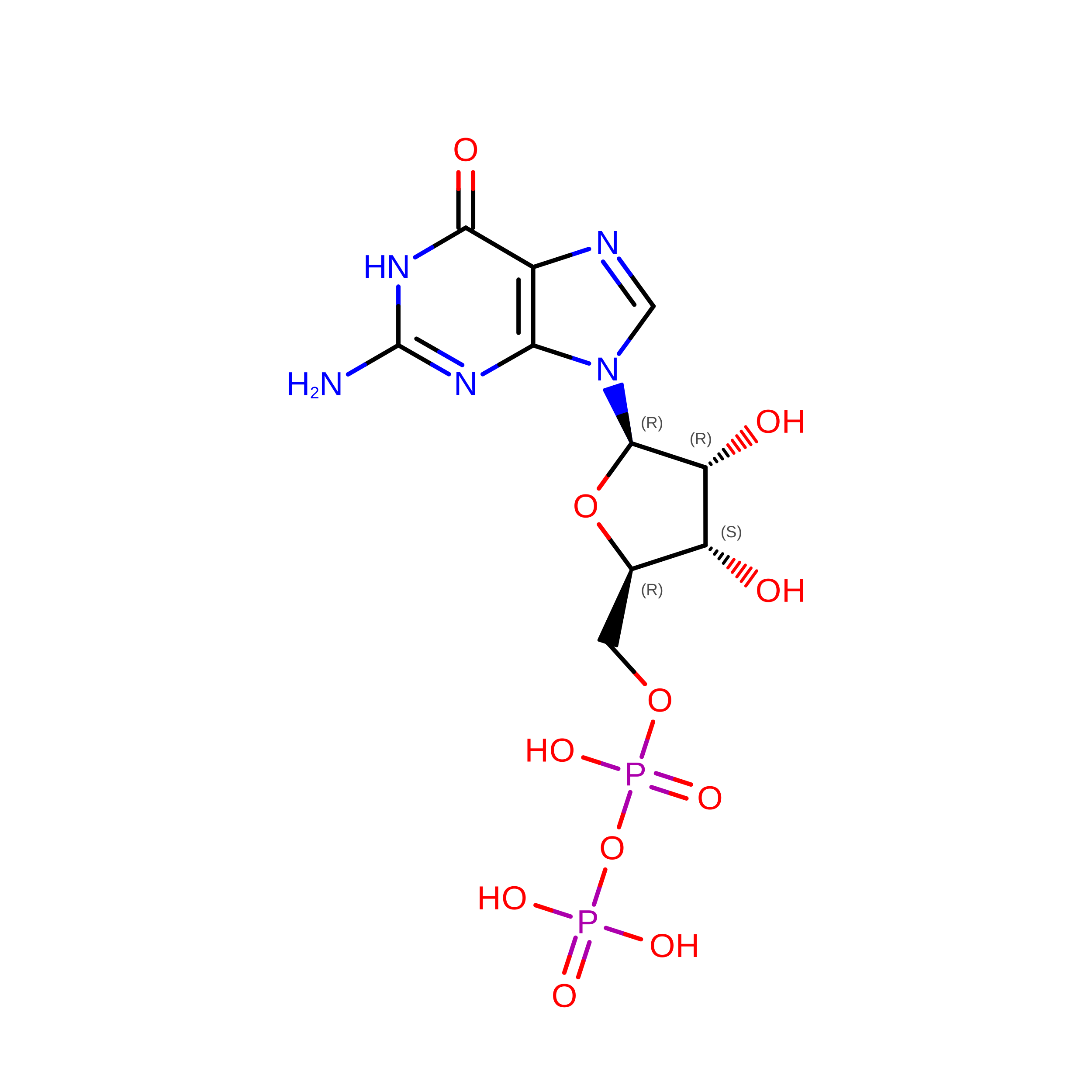
IDChains Name / Formula / InChI Key2D Diagram3D Interactions
GDP

Query on GDP


Download:Ideal Coordinates CCD File
B [auth A]GUANOSINE-5'-DIPHOSPHATE
C10 H15 N5 O11 P2
QGWNDRXFNXRZMB-UUOKFMHZSA-N

Experimental Data & Validation

Experimental Data

  • Method: X-RAY DIFFRACTION
  • Resolution: 2.00 Å
  • R-Value Free:  0.283 (Depositor) 
  • R-Value Work:  0.238 (Depositor) 
  • R-Value Observed: 0.244 (Depositor) 
Space Group: P 65 2 2
Unit Cell:
Length ( Å )Angle ( ˚ )
a = 82.645α = 90
b = 82.645β = 90
c = 102.794γ = 120
Software Package:
Software NamePurpose
SHARPphasing
CNSrefinement
DENZOdata reduction
SCALEPACKdata scaling

Structure Validation

View Full Validation Report


Entry History 

Revision History  (Full details and data files)

  • Version 1.0: 2001-10-03
    Type: Initial release
  • Version 1.1: 2007-10-21
    Changes: Version format compliance
  • Version 1.2: 2011-07-13
    Changes: Version format compliance
  • Version 1.3: 2023-12-27
    Changes: Data collection, Database references, Derived calculations