1IAZ | pdb_00001iaz

EQUINATOXIN II


Experimental Data Snapshot

  • Method: X-RAY DIFFRACTION
  • Resolution: 1.90 Å
  • R-Value Free: 
    0.235 (Depositor) 
  • R-Value Work: 
    0.185 (Depositor), 0.186 (DCC) 
  • R-Value Observed: 
    0.190 (Depositor) 

wwPDB Validation 3D Report Full Report

Validation slider image for 1IAZ

This is version 1.4 of the entry. See complete history

Literature

Crystal structure of the soluble form of equinatoxin II, a pore-forming toxin from the sea anemone Actinia equina.

Athanasiadis, A.Anderluh, G.Macek, P.Turk, D.

(2001) Structure 9: 341-346

  • DOI: https://doi.org/10.1016/s0969-2126(01)00592-5
  • Primary Citation Related Structures: 
    1IAZ

  • PubMed Abstract: 

    Membrane pore-forming toxins have a remarkable property: they adopt a stable soluble form structure, which, when in contact with a membrane, undergoes a series of transformations, leading to an active, membrane-bound form. In contrast to bacterial toxins, no structure of a pore-forming toxin from an eukaryotic organism has been determined so far, an indication that structural studies of equinatoxin II (EqtII) may unravel a novel mechanism. The crystal structure of the soluble form of EqtII from the sea anemone Actinia equina has been determined at 1.9 A resolution. EqtII is shown to be a single-domain protein based on a 12 strand beta sandwich fold with a hydrophobic core and a pair of alpha helices, each of which is associated with the face of a beta sheet. The structure of the 30 N-terminal residues is the largest segment that can adopt a different structure without disrupting the fold of the beta sandwich core. This segment includes a three-turn alpha helix that lies on the surface of a beta sheet and ends in a stretch of three positively charged residues, Lys-30, Arg-31, and Lys-32. On the basis of gathered data, it is suggested that this segment forms the membrane pore, whereas the beta sandwich structure remains unaltered and attaches to a membrane as do other structurally related extrinsic membrane proteins or their domains. The use of a structural data site-directed mutagenesis study should reveal the residues involved in membrane pore formation.


  • Organizational Affiliation
    • Department of Biochemistry and Molecular Biology, Jozef Stefan Institute, Ljubljana, Slovenia.

Macromolecule Content 

  • Total Structure Weight: 40.75 kDa 
  • Atom Count: 3,186 
  • Modeled Residue Count: 350 
  • Deposited Residue Count: 358 
  • Unique protein chains: 1

Macromolecules

Find similar proteins by:|  3D Structure
Entity ID: 1
MoleculeChains  Sequence LengthOrganismDetailsImage
EQUINATOXIN II
A, B
179Actinia equinaMutation(s): 0 
Membrane Entity: Yes 
UniProt
Find proteins for P61914 (Actinia equina)
Explore P61914 
Go to UniProtKB:  P61914
Entity Groups
Sequence Clusters30% Identity50% Identity70% Identity90% Identity95% Identity100% Identity
UniProt GroupP61914
Sequence Annotations
Expand
Reference Sequence

Small Molecules

Ligands 1 Unique
IDChains Name / Formula / InChI Key2D Diagram3D Interactions
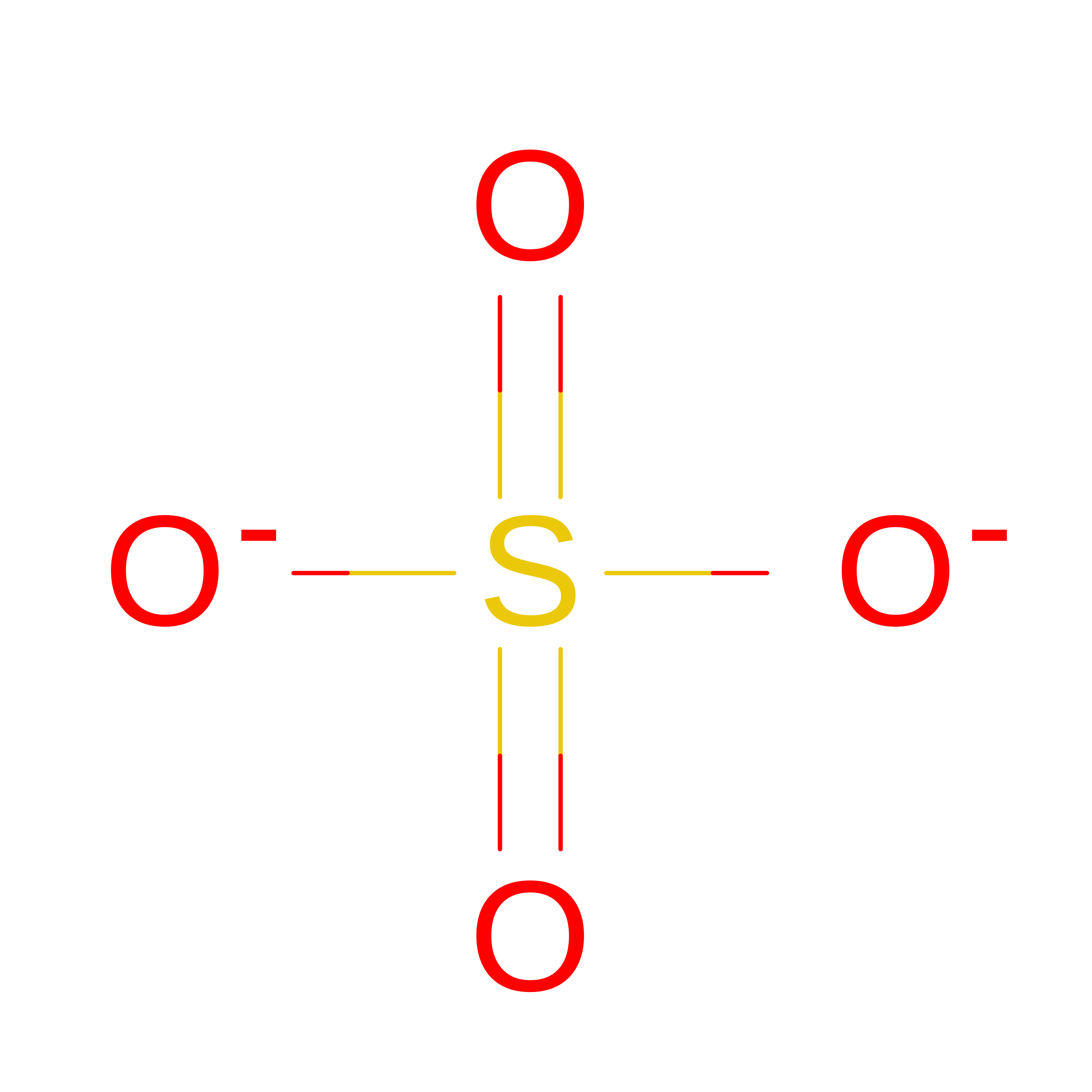
SO4

Query on SO4


Download:Ideal Coordinates CCD File
C [auth A]
D [auth A]
E [auth A]
F [auth A]
G [auth A]
C [auth A],
D [auth A],
E [auth A],
F [auth A],
G [auth A],
H [auth A],
I [auth A],
J [auth B],
K [auth B],
L [auth B],
M [auth B]
SULFATE ION
O4 S
QAOWNCQODCNURD-UHFFFAOYSA-L

Experimental Data & Validation

Experimental Data

  • Method: X-RAY DIFFRACTION
  • Resolution: 1.90 Å
  • R-Value Free:  0.235 (Depositor) 
  • R-Value Work:  0.185 (Depositor), 0.186 (DCC) 
  • R-Value Observed: 0.190 (Depositor) 
Space Group: P 21 21 21
Unit Cell:
Length ( Å )Angle ( ˚ )
a = 81.62α = 90
b = 129.04β = 90
c = 31.76γ = 90
Software Package:
Software NamePurpose
MOSFLMdata reduction
SCALAdata scaling
SHARPphasing
MAINrefinement
CCP4data scaling

Structure Validation

View Full Validation Report


Entry History 

Deposition Data

Revision History  (Full details and data files)

  • Version 1.0: 2001-04-04
    Type: Initial release
  • Version 1.1: 2008-04-27
    Changes: Version format compliance
  • Version 1.2: 2011-07-13
    Changes: Version format compliance
  • Version 1.3: 2018-10-03
    Changes: Advisory, Data collection
  • Version 1.4: 2024-02-07
    Changes: Advisory, Data collection, Database references, Derived calculations