1IAE | pdb_00001iae

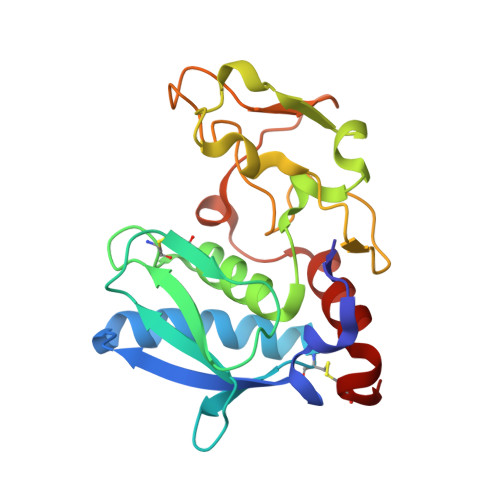
CRYSTAL STRUCTURES, SPECTROSCOPIC FEATURES, AND CATALYTIC PROPERTIES OF COBALT(II), COPPER(II), NICKEL(II), AND MERCURY(II) DERIVATIVES OF THE ZINC ENDOPEPTIDASE ASTACIN. A CORRELATION OF STRUCTURE AND PROTEOLYTIC ACTIVITY


Experimental Data Snapshot

  • Method: X-RAY DIFFRACTION
  • Resolution: 1.83 Å
  • R-Value Work: 
    0.143 (Depositor) 
  • R-Value Observed: 
    0.143 (Depositor) 

wwPDB Validation 3D Report Full Report

Validation slider image for 1IAE

This is version 1.4 of the entry. See complete history

Literature

Crystal structures, spectroscopic features, and catalytic properties of cobalt(II), copper(II), nickel(II), and mercury(II) derivatives of the zinc endopeptidase astacin. A correlation of structure and proteolytic activity.

Gomis-Ruth, F.X.Grams, F.Yiallouros, I.Nar, H.Kusthardt, U.Zwilling, R.Bode, W.Stocker, W.

(1994) J Biological Chem 269: 17111-17117

  • Primary Citation Related Structures: 
    1IAA, 1IAB, 1IAE

  • PubMed Abstract: 

    The catalytic zinc ion of astacin, a prototypical metalloproteinase from crayfish, has been substituted by Co(II), Cu(II), Hg(II), and Ni(II) in order to probe the role of the metal for both catalysis and structure. Compared to Zn(II)-astacin, Co(II)- and Cu(II)-astacin display enzymatic activities of about 140 and 37%, respectively, while Ni(II)- and Hg(II)-astacin are almost inactive. The electron paramagnetic resonance spectrum of Cu(II)-astacin is typical of 5-fold coordinated copper(II), and its intense absorption maxima at 445 and 325 nm are probably due to ligand-metal charge-transfer transitions involving Tyr-149. This residue had been identified previously by x-ray crystallography of the zinc enzyme as a zinc ligand, in addition to three imidazoles and a glutamic acid-bound water molecule. We present now the refined high-resolution x-ray crystal structures of Cu(II)-, Co(II)-, and Ni(II)-astacin, which exhibit a virtually identical protein framework to the previously analyzed structures of Zn(II)-, apo-, and Hg(II)-astacin. In Co(II)- and Cu(II)-astacin, the metal is penta-coordinated similarly to the native zinc enzyme. In the Ni(II) derivative, however, an additional solvent molecule expands the metal coordination sphere to a distorted octahedral ligand geometry, while in Hg(II)-astacin, no ordered solvent molecule at all is observed in the inner coordination sphere of the metal. This indicates a close correlation between catalytic properties and ground-state metal coordination of astacin.


  • Organizational Affiliation
    • Max-Planck-Institut für Biochemie, Martinsried, Germany.

Macromolecule Content 

  • Total Structure Weight: 22.68 kDa 
  • Atom Count: 1,776 
  • Modeled Residue Count: 200 
  • Deposited Residue Count: 200 
  • Unique protein chains: 1

Macromolecules

Find similar proteins by:|  3D Structure
Entity ID: 1
MoleculeChains  Sequence LengthOrganismDetailsImage
ASTACIN200Astacus astacusMutation(s): 0 
EC: 3.4.24.21
UniProt
Find proteins for P07584 (Astacus astacus)
Explore P07584 
Go to UniProtKB:  P07584
Entity Groups
Sequence Clusters30% Identity50% Identity70% Identity90% Identity95% Identity100% Identity
UniProt GroupP07584
Sequence Annotations
Expand
Reference Sequence

Small Molecules

Ligands 1 Unique
IDChains Name / Formula / InChI Key2D Diagram3D Interactions
NI

Query on NI


Download:Ideal Coordinates CCD File
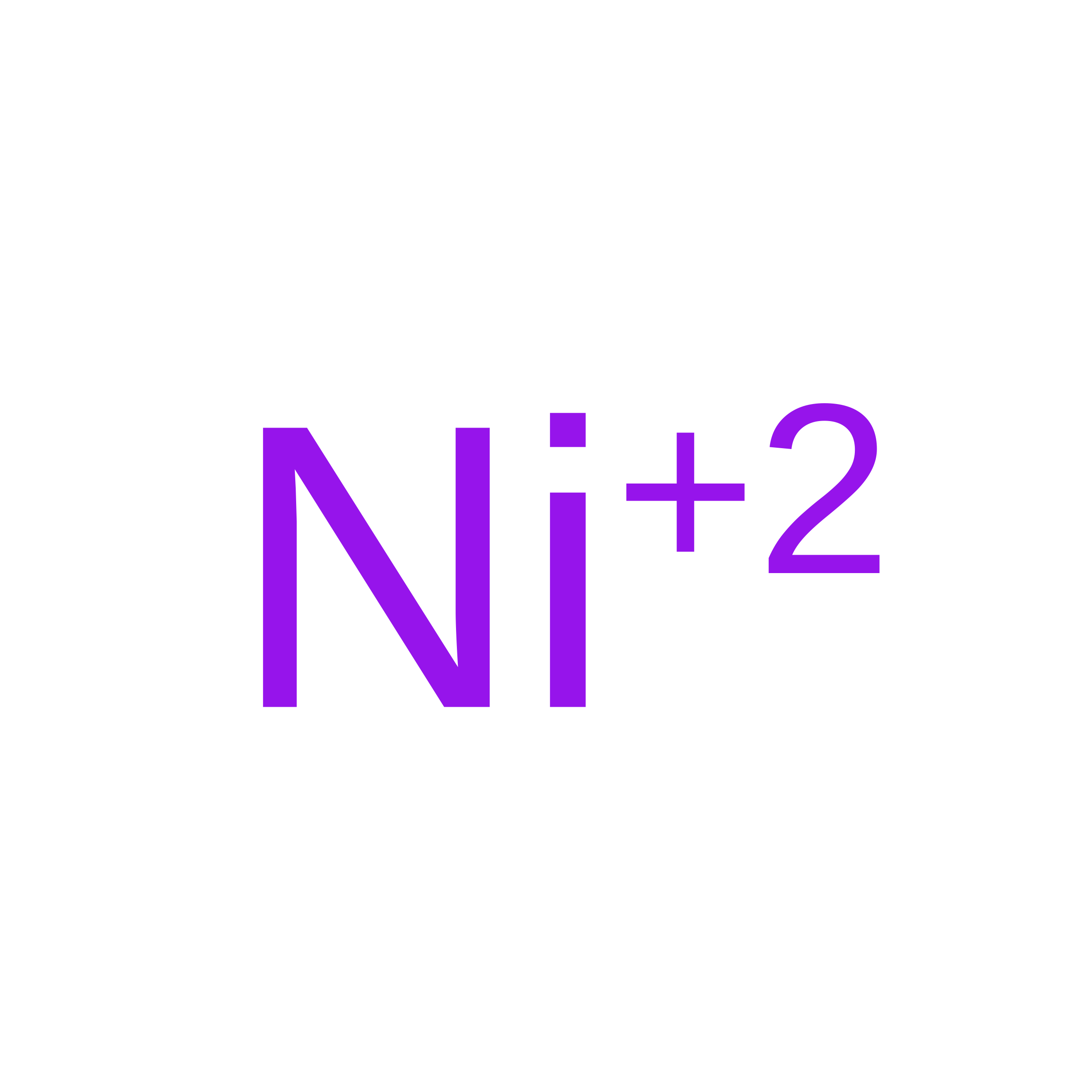
B [auth A]NICKEL (II) ION
Ni
VEQPNABPJHWNSG-UHFFFAOYSA-N

Experimental Data & Validation

Experimental Data

  • Method: X-RAY DIFFRACTION
  • Resolution: 1.83 Å
  • R-Value Work:  0.143 (Depositor) 
  • R-Value Observed: 0.143 (Depositor) 
Space Group: P 31 2 1
Unit Cell:
Length ( Å )Angle ( ˚ )
a = 61.89α = 90
b = 61.89β = 90
c = 98.55γ = 120
Software Package:
Software NamePurpose
X-PLORmodel building
X-PLORrefinement
X-PLORphasing

Structure Validation

View Full Validation Report


Entry History 

Deposition Data

Revision History  (Full details and data files)

  • Version 1.0: 1994-08-31
    Type: Initial release
  • Version 1.1: 2008-03-24
    Changes: Version format compliance
  • Version 1.2: 2011-07-13
    Changes: Version format compliance
  • Version 1.3: 2024-06-05
    Changes: Data collection, Database references, Derived calculations, Other
  • Version 1.4: 2024-11-13
    Changes: Structure summary