1I8Q | pdb_00001i8q

CRYSTAL STRUCTURE OF STREPTOCOCCUS AGALACTIAE HYALURONATE LYASE COMPLEXED WITH ENZYME PRODUCT, UNSATURATED DISACCHARIDE HYALURONAN


Experimental Data Snapshot

  • Method: X-RAY DIFFRACTION
  • Resolution: 2.20 Å
  • R-Value Free: 
    0.252 (Depositor) 
  • R-Value Work: 
    0.182 (Depositor), 0.214 (DCC) 

Starting Model: experimental
View more details

wwPDB Validation 3D Report Full Report

Validation slider image for 1I8Q

This is version 2.2 of the entry. See complete history

Literature

Hyaluronan binding and degradation by Streptococcus agalactiae hyaluronate lyase.

Li, S.Jedrzejas, M.J.

(2001) J Biological Chem 276: 41407-41416

  • DOI: https://doi.org/10.1074/jbc.M106634200
  • Primary Citation Related Structures: 
    1F1S, 1I8Q

  • PubMed Abstract: 

    Streptococcus agalactiae hyaluronate lyase is a virulence factor that helps this pathogen to break through the biophysical barrier of the host tissues by the enzymatic degradation of hyaluronan and certain chondroitin sulfates at beta-1,4 glycosidic linkages. Crystal structures of the native enzyme and the enzyme-product complex were determined at 2.1- and 2.2-A resolutions, respectively. An elongated cleft transversing the middle of the molecule has been identified as the substrate-binding place. Two product molecules of hyaluronan degradation were observed bound to the cleft. The enzyme catalytic site was identified to comprise three residues: His(479), Tyr(488), and Asn(429). The highly positively charged cleft facilitates the binding of the negatively charged polymeric substrate chain. The matching between the aromatic patch of the enzyme and the hydrophobic patch of the substrate chain anchors the substrate chain into degradation position. A pair of proton exchanges between the enzyme and the substrate results in the cleavage of the beta-1,4 glycosidic linkage of the substrate chain and the unsaturation of the product. Phe(423) likely determines the size of the product at the product release side of the catalytic region. Hyaluronan chain is processively degraded from the reducing end toward the nonreducing end. The unsulfated or 6-sulfated regions of chondroitin sulfate can also be degraded in the same manner as hyaluronan.


  • Organizational Affiliation
    • Department of Microbiology, University of Alabama at Birmingham, Birmingham, Alabama 35294, USA.

Macromolecule Content 

  • Total Structure Weight: 93.27 kDa 
  • Atom Count: 6,794 
  • Modeled Residue Count: 814 
  • Deposited Residue Count: 814 
  • Unique protein chains: 1

Macromolecules

Find similar proteins by:|  3D Structure
Entity ID: 1
MoleculeChains  Sequence LengthOrganismDetailsImage
HYALURONATE LYASE814Streptococcus agalactiaeMutation(s): 0 
Gene Names: HYL
EC: 4.2.2.1
UniProt
Find proteins for Q53591 (Streptococcus agalactiae serotype III (strain NEM316))
Explore Q53591 
Go to UniProtKB:  Q53591
Entity Groups
Sequence Clusters30% Identity50% Identity70% Identity90% Identity95% Identity100% Identity
UniProt GroupQ53591
Sequence Annotations
Expand
Reference Sequence

Oligosaccharides

Help  
Entity ID: 2
MoleculeChains Length2D Diagram GlycosylationD Interactions
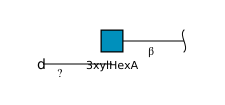
4-deoxy-beta-D-glucopyranuronic acid-(1-3)-2-acetamido-2-deoxy-beta-D-glucopyranose
B, C
2N/A
Glycosylation Resources
GlyTouCan: G40515XE
GlyCosmos: G40515XE

Experimental Data & Validation

Experimental Data

  • Method: X-RAY DIFFRACTION
  • Resolution: 2.20 Å
  • R-Value Free:  0.252 (Depositor) 
  • R-Value Work:  0.182 (Depositor), 0.214 (DCC) 
Space Group: C 2 2 21
Unit Cell:
Length ( Å )Angle ( ˚ )
a = 51.03α = 90
b = 155.017β = 90
c = 237.268γ = 90
Software Package:
Software NamePurpose
AMoREphasing
X-PLORrefinement
DENZOdata reduction
SCALEPACKdata scaling

Structure Validation

View Full Validation Report


Entry History 

Deposition Data

Revision History  (Full details and data files)

  • Version 1.0: 2002-01-16
    Type: Initial release
  • Version 1.1: 2008-04-27
    Changes: Version format compliance
  • Version 1.2: 2011-07-13
    Changes: Non-polymer description, Version format compliance
  • Version 2.0: 2020-07-29
    Type: Remediation
    Reason: Carbohydrate remediation
    Changes: Atomic model, Data collection, Derived calculations, Structure summary
  • Version 2.1: 2024-02-07
    Changes: Data collection, Database references, Structure summary
  • Version 2.2: 2024-04-03
    Changes: Refinement description