1HVX | pdb_00001hvx

BACILLUS STEAROTHERMOPHILUS ALPHA-AMYLASE


Experimental Data Snapshot

  • Method: X-RAY DIFFRACTION
  • Resolution: 2.00 Å
  • R-Value Free: 
    0.197 (Depositor) 
  • R-Value Work: 
    0.154 (Depositor), 0.149 (DCC) 

wwPDB Validation 3D Report Full Report

Validation slider image for 1HVX

This is version 1.5 of the entry. See complete history

Literature

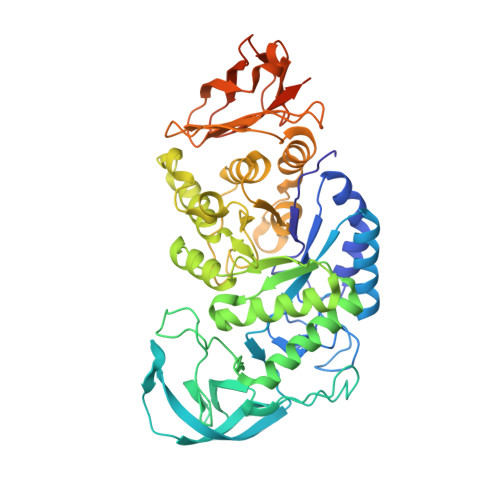
Crystal structure of Bacillus stearothermophilus alpha-amylase: possible factors determining the thermostability.

Suvd, D.Fujimoto, Z.Takase, K.Matsumura, M.Mizuno, H.

(2001) J Biochem 129: 461-468

  • DOI: https://doi.org/10.1093/oxfordjournals.jbchem.a002878
  • Primary Citation Related Structures: 
    1HVX

  • PubMed Abstract: 

    The crystal structure of a thermostable alpha-amylase from Bacillus stearothermophilus (BSTA) has been determined at 2.0 A resolution. The main-chain fold is almost identical to that of the known crystal structure of Bacillus licheniformis alpha-amylase (BLA). BLA is known to be more stable than BSTA. A structural comparison between the crystal structures of BSTA and BLA showed significant differences that may account for the difference in their thermostabilities, as follows. (i) The two-residue insertion in BSTA, Ile181-Gly182, pushes away the spatially contacting region including Asp207, which corresponds to Ca(2+)-coordinating Asp204 in BLA. As a result, Asp207 cannot coordinate the Ca(2+). (ii) BSTA contains nine fewer hydrogen bonds than BLA, which costs about 12 kcal/mol. This tendency is prominent in the (beta/alpha)(8)-barrel, where 10 fewer hydrogen bonds were observed in BSTA. BLA forms a denser hydrogen bond network in the inter-helical region, which may stabilize alpha-helices in the barrel. (iii) A few small voids observed in the alpha-helical region of the (beta/alpha)(8)-barrel in BSTA decrease inter-helical compactness and hydrophobic interactions. (iv) The solvent-accessible surface area of charged residues in BLA is about two times larger than that in BSTA.


  • Organizational Affiliation
    • Institute of Applied Biochemistry, University of Tsukuba, Tsukuba, Ibaraki 305-8572, Japan. mizuno@abr.affrc.go.jp

Macromolecule Content 

  • Total Structure Weight: 59.03 kDa 
  • Atom Count: 4,224 
  • Modeled Residue Count: 483 
  • Deposited Residue Count: 515 
  • Unique protein chains: 1

Macromolecules

Find similar proteins by:|  3D Structure
Entity ID: 1
MoleculeChains  Sequence LengthOrganismDetailsImage
ALPHA-AMYLASE515Geobacillus stearothermophilusMutation(s): 0 
Gene Names: AMYT631
EC: 3.2.1.1
UniProt
Find proteins for P06279 (Geobacillus stearothermophilus)
Explore P06279 
Go to UniProtKB:  P06279
Entity Groups
Sequence Clusters30% Identity50% Identity70% Identity90% Identity95% Identity100% Identity
UniProt GroupP06279
Sequence Annotations
Expand
Reference Sequence

Experimental Data & Validation

Experimental Data

  • Method: X-RAY DIFFRACTION
  • Resolution: 2.00 Å
  • R-Value Free:  0.197 (Depositor) 
  • R-Value Work:  0.154 (Depositor), 0.149 (DCC) 
Space Group: P 1 21 1
Unit Cell:
Length ( Å )Angle ( ˚ )
a = 53.55α = 90
b = 93.119β = 109.31
c = 53.275γ = 90
Software Package:
Software NamePurpose
DENZOdata reduction
SCALEPACKdata scaling
X-PLORmodel building
X-PLORrefinement
X-PLORphasing

Structure Validation

View Full Validation Report


Entry History 

Deposition Data

Revision History  (Full details and data files)

  • Version 1.0: 2001-01-31
    Type: Initial release
  • Version 1.1: 2008-04-27
    Changes: Version format compliance
  • Version 1.2: 2011-07-13
    Changes: Version format compliance
  • Version 1.3: 2012-02-15
    Changes: Database references
  • Version 1.4: 2019-11-06
    Changes: Data collection, Database references
  • Version 1.5: 2024-03-13
    Changes: Data collection, Database references, Derived calculations