1HUY | pdb_00001huy

CRYSTAL STRUCTURE OF CITRINE, AN IMPROVED YELLOW VARIANT OF GREEN FLUORESCENT PROTEIN


Experimental Data Snapshot

  • Method: X-RAY DIFFRACTION
  • Resolution: 2.20 Å
  • R-Value Free: 
    0.208 (Depositor), 0.209 (DCC) 
  • R-Value Work: 
    0.164 (Depositor), 0.164 (DCC) 
  • R-Value Observed: 
    0.164 (Depositor) 

Starting Model: experimental
View more details

wwPDB Validation 3D Report Full Report

Validation slider image for 1HUY

This is version 2.0 of the entry. See complete history

Literature

Reducing the environmental sensitivity of yellow fluorescent protein. Mechanism and applications

Griesbeck, O.Baird, G.S.Campbell, R.E.Zacharias, D.A.Tsien, R.Y.

(2001) J Biological Chem 276: 29188-29194

  • DOI: https://doi.org/10.1074/jbc.M102815200
  • Primary Citation Related Structures: 
    1HUY

  • PubMed Abstract: 

    Yellow mutants of the green fluorescent protein (YFP) are crucial constituents of genetically encoded indicators of signal transduction and fusions to monitor protein-protein interactions. However, previous YFPs show excessive pH sensitivity, chloride interference, poor photostability, or poor expression at 37 degrees C. Protein evolution in Escherichia coli has produced a new YFP named Citrine, in which the mutation Q69M confers a much lower pK(a) (5.7) than for previous YFPs, indifference to chloride, twice the photostability of previous YFPs, and much better expression at 37 degrees C and in organelles. The halide resistance is explained by a 2.2-A x-ray crystal structure of Citrine, showing that the methionine side chain fills what was once a large halide-binding cavity adjacent to the chromophore. Insertion of calmodulin within Citrine or fusion of cyan fluorescent protein, calmodulin, a calmodulin-binding peptide and Citrine has generated improved calcium indicators. These chimeras can be targeted to multiple cellular locations and have permitted the first single-cell imaging of free [Ca(2+)] in the Golgi. Citrine is superior to all previous YFPs except when pH or halide sensitivity is desired and is particularly advantageous within genetically encoded fluorescent indicators of physiological signals.


  • Organizational Affiliation
    • Howard Hughes Medical Institute, University of California, San Diego, La Jolla, California 92093-0647, USA.

Macromolecule Content 

  • Total Structure Weight: 27.32 kDa 
  • Atom Count: 1,949 
  • Modeled Residue Count: 231 
  • Deposited Residue Count: 239 
  • Unique protein chains: 1

Macromolecules

Find similar proteins by:|  3D Structure
Entity ID: 1
MoleculeChains  Sequence LengthOrganismDetailsImage
GREEN FLUORESCENT PROTEIN239Aequorea victoriaMutation(s): 5 
Gene Names: GFP
UniProt
Find proteins for P42212 (Aequorea victoria)
Explore P42212 
Go to UniProtKB:  P42212
Entity Groups
Sequence Clusters30% Identity50% Identity70% Identity90% Identity95% Identity100% Identity
UniProt GroupP42212
Sequence Annotations
Expand
Reference Sequence

Small Molecules

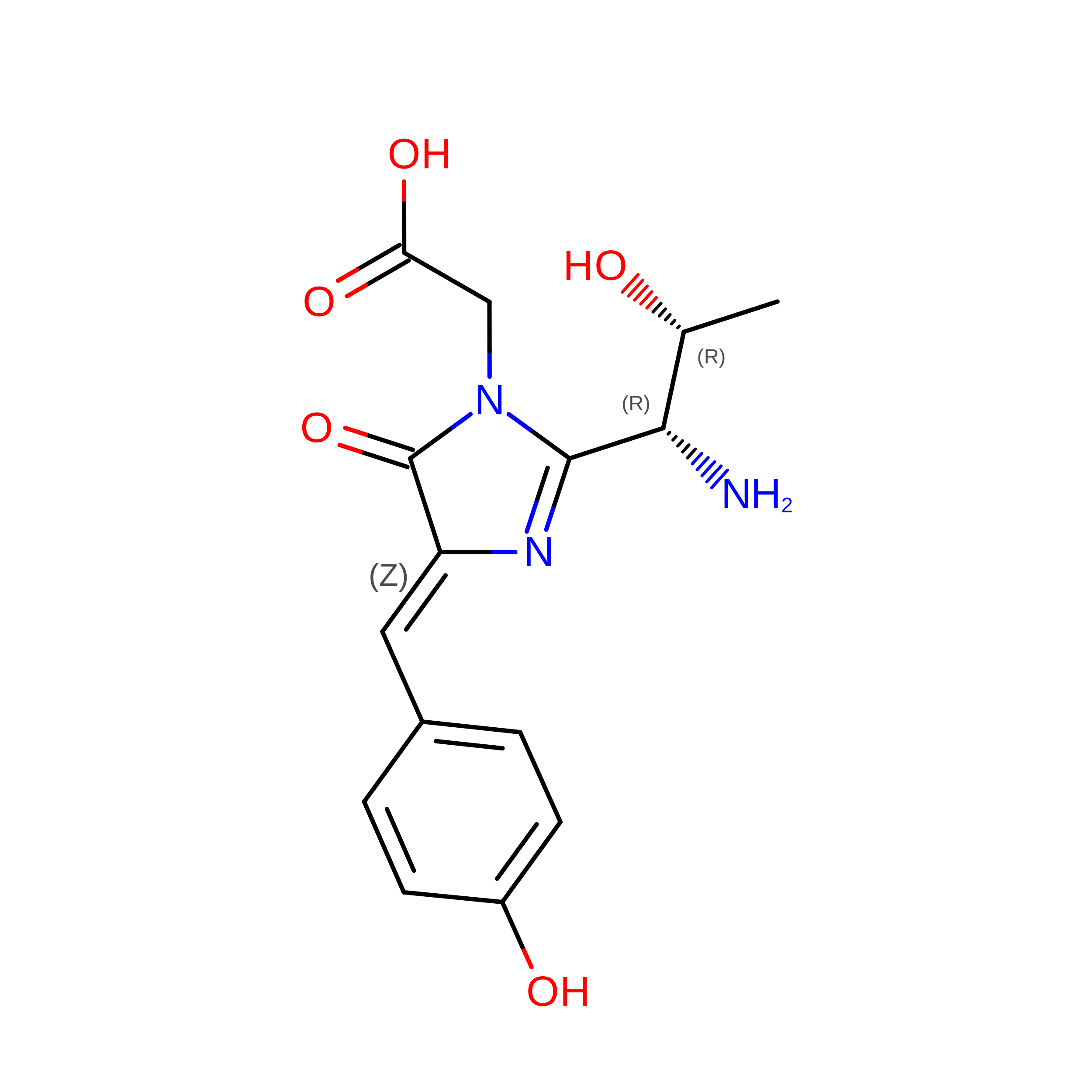
Modified Residues  1 Unique
IDChains TypeFormula2D DiagramParent
CRO
Query on CRO
A
L-PEPTIDE LINKINGC15 H17 N3 O5THR, TYR, GLY

Experimental Data & Validation

Experimental Data

  • Method: X-RAY DIFFRACTION
  • Resolution: 2.20 Å
  • R-Value Free:  0.208 (Depositor), 0.209 (DCC) 
  • R-Value Work:  0.164 (Depositor), 0.164 (DCC) 
  • R-Value Observed: 0.164 (Depositor) 
Space Group: P 21 21 21
Unit Cell:
Length ( Å )Angle ( ˚ )
a = 52.504α = 90
b = 61.758β = 90
c = 70.684γ = 90
Software Package:
Software NamePurpose
MAR345data collection
SCALEPACKdata scaling
CNSrefinement
CNSphasing

Structure Validation

View Full Validation Report


Entry History 

Deposition Data

Revision History  (Full details and data files)

  • Version 1.0: 2001-07-04
    Type: Initial release
  • Version 1.1: 2008-04-27
    Changes: Version format compliance
  • Version 1.2: 2011-07-13
    Changes: Version format compliance
  • Version 1.3: 2017-10-04
    Changes: Refinement description
  • Version 1.4: 2021-10-27
    Changes: Database references, Derived calculations
  • Version 1.5: 2023-08-09
    Changes: Data collection, Refinement description
  • Version 1.6: 2023-11-15
    Changes: Data collection
  • Version 1.7: 2024-11-20
    Changes: Structure summary
  • Version 2.0: 2026-03-18
    Changes: Polymer sequence