1HPS | pdb_00001hps

RATIONAL DESIGN, SYNTHESIS AND CRYSTALLOGRAPHIC ANALYSIS OF A HYDROXYETHYLENE-BASED HIV-1 PROTEASE INHIBITOR CONTAINING A HETEROCYCLIC P1'-P2' AMIDE BOND ISOSTERE


Experimental Data Snapshot

  • Method: X-RAY DIFFRACTION
  • Resolution: 2.30 Å
  • R-Value Observed: 
    0.194 (Depositor) 

wwPDB Validation 3D Report Full Report

Validation slider image for 1HPS

This is version 1.5 of the entry. See complete history

Literature

Rational design, synthesis, and crystallographic analysis of a hydroxyethylene-based HIV-1 protease inhibitor containing a heterocyclic P1'--P2' amide bond isostere.

Thompson, S.K.Murthy, K.H.Zhao, B.Winborne, E.Green, D.W.Fisher, S.M.DesJarlais, R.L.Tomaszek Jr., T.A.Meek, T.D.Gleason, J.G.Abdel-Meguid, S.S.

(1994) J Med Chem 37: 3100-3107

  • DOI: https://doi.org/10.1021/jm00045a015
  • Primary Citation Related Structures: 
    1HPS

  • PubMed Abstract: 

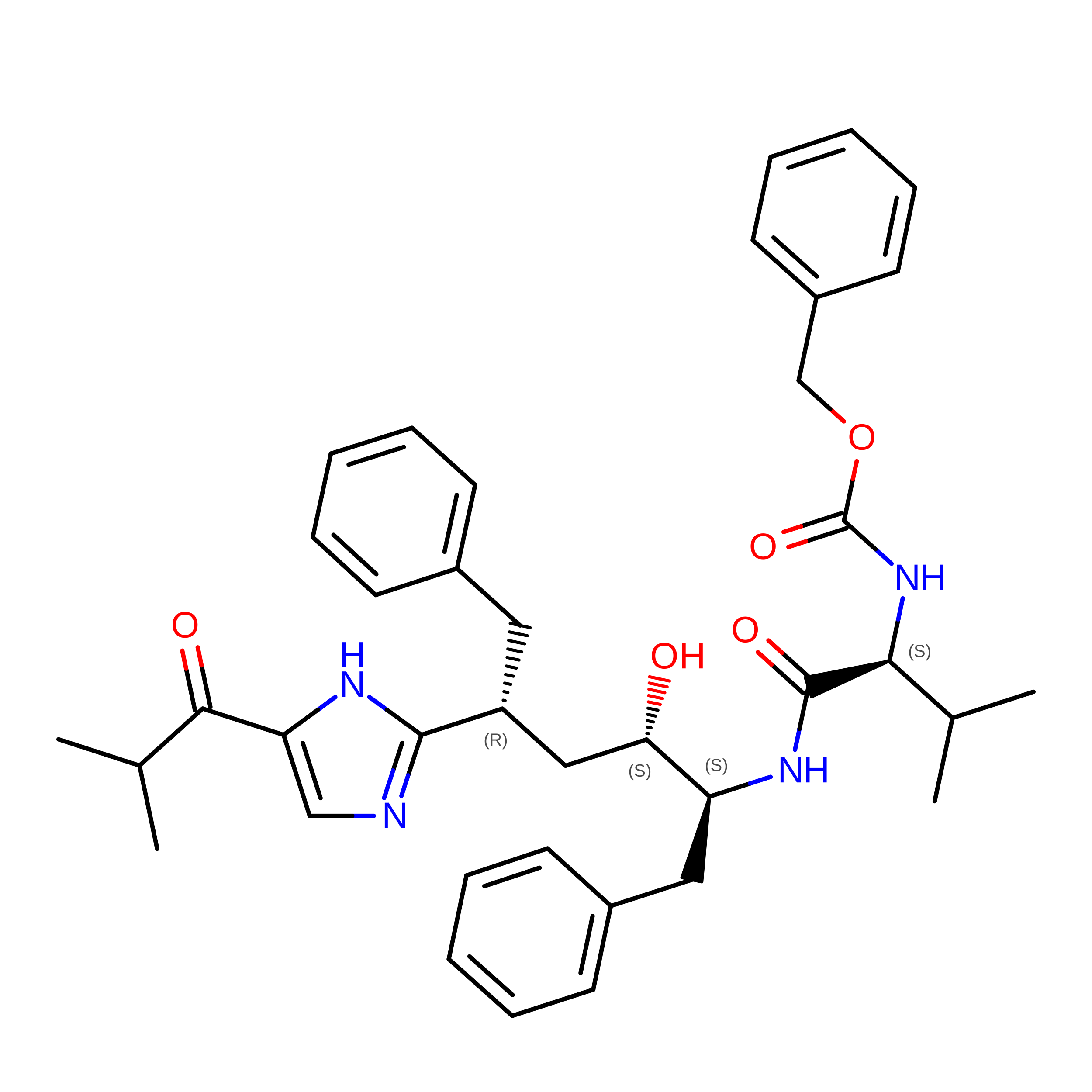
    The rational design and synthesis of a highly potent inhibitor of HIV-1 protease have been accomplished. The inhibitor, SB 206343, is based on a model derived from the structure of the MVT-101/HIV-1 protease complex and contains a 4(5)-acylimidazole ring as an isosteric replacement for the P1'--P2' amide bond. It is a competitive inhibitor with an apparent inhibition constant of 0.6 nM at pH 6.0. The three-dimensional structure of SB 206343 bound in the active site of HIV-1 protease has been determined at 2.3 A resolution by X-ray diffraction techniques and refined to a crystallographic discrepancy factor, R (= sigma parallel Fo magnitude of/Fc parallel/sigma magnitude of), of 0.194. The inhibitor is held in the enzyme by a set of hydrophobic and polar interactions. N-3 of the imidazole ring participates in a novel hydrogen-bonding interaction with the bound water molecule, demonstrating the effectiveness of the imidazole ring as an isosteric replacement for the P1'--P2' amide bond in hydroxyethylene-based HIV-1 protease inhibitors. Also present are hydrogen-bonding interactions between N-1 of the imidazole ring and the carbonyl of Gly-127 as well as between the imidazole acyl carbonyl oxygen and the amide nitrogen of Asp-129, exemplifying the peptidomimetic nature of the 4(5)-acylimidazole isostere. All of these interactions are in qualitative agreement with those predicted by the model.


  • Organizational Affiliation
    • Department of Medicinal Chemistry, SmithKline Beecham Pharmaceuticals, King of Prussia, Pennsylvania 19406.

Macromolecule Content 

  • Total Structure Weight: 22.89 kDa 
  • Atom Count: 1,625 
  • Modeled Residue Count: 198 
  • Deposited Residue Count: 198 
  • Unique protein chains: 1

Macromolecules

Find similar proteins by:|  3D Structure
Entity ID: 1
MoleculeChains  Sequence LengthOrganismDetailsImage
HIV-1 PROTEASE
A, B
99Human immunodeficiency virus 1Mutation(s): 0 
UniProt
Find proteins for P03366 (Human immunodeficiency virus type 1 group M subtype B (isolate BH10))
Explore P03366 
Go to UniProtKB:  P03366
Entity Groups
Sequence Clusters30% Identity50% Identity70% Identity90% Identity95% Identity100% Identity
UniProt GroupP03366
Sequence Annotations
Expand
Reference Sequence

Small Molecules

Ligands 1 Unique
IDChains Name / Formula / InChI Key2D Diagram3D Interactions
RUN

Query on RUN


Download:Ideal Coordinates CCD File
C [auth B],
D [auth B]
2-[(1R,3S,4S)-1-BENZYL-4-[N-(BENZYLOXYCARBONYL)-L-VALYL]AMINO-3-PHENYLPENTYL]-4(5)-(2-METHYLPROPIONYL)IMIDAZOLE
C38 H46 N4 O5
RQAVEWKEUKIFLD-LVPKLHHISA-N

Experimental Data & Validation

Experimental Data

  • Method: X-RAY DIFFRACTION
  • Resolution: 2.30 Å
  • R-Value Observed: 0.194 (Depositor) 
Space Group: P 61
Unit Cell:
Length ( Å )Angle ( ˚ )
a = 63α = 90
b = 63β = 90
c = 83.3γ = 120
Software Package:
Software NamePurpose
X-PLORmodel building
PROLSQrefinement
X-PLORrefinement
X-PLORphasing

Structure Validation

View Full Validation Report


Entry History 

Deposition Data

Revision History  (Full details and data files)

  • Version 1.0: 1994-08-31
    Type: Initial release
  • Version 1.1: 2008-03-24
    Changes: Version format compliance
  • Version 1.2: 2011-07-13
    Changes: Version format compliance
  • Version 1.3: 2012-02-22
    Changes: Database references
  • Version 1.4: 2017-11-29
    Changes: Derived calculations, Other
  • Version 1.5: 2024-02-07
    Changes: Data collection, Database references, Derived calculations