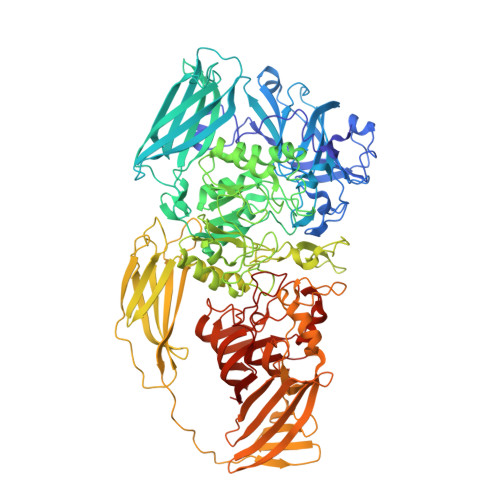
1HN1 | pdb_00001hn1

E. COLI (LAC Z) BETA-GALACTOSIDASE (ORTHORHOMBIC)


Experimental Data Snapshot

  • Method: X-RAY DIFFRACTION
  • Resolution: 3.00 Å
  • R-Value Free: 
    0.299 (Depositor) 
  • R-Value Work: 
    0.148 (Depositor), 0.134 (DCC) 

Starting Model: experimental
View more details

wwPDB Validation 3D Report Full Report

Validation slider image for 1HN1

This is version 1.5 of the entry. See complete history

Literature

Reversible lattice repacking illustrates the temperature dependence of macromolecular interactions.

Juers, D.H.Matthews, B.W.

(2001) J Mol Biology 311: 851-862

  • DOI: https://doi.org/10.1006/jmbi.2001.4891
  • Primary Citation Related Structures: 
    1HN1

  • PubMed Abstract: 

    Flash-freezing, which has become routine in macromolecular X-ray crystallography, causes the crystal to contract substantially. In the case of Escherichia coli beta-galactosidase the changes are reversible and are shown to be due to lattice repacking. On cooling, the area of the protein surface involved in lattice contacts increases by 50 %. There are substantial alterations in intermolecular contacts, these changes being dominated by the long, polar side-chains. For entropic reasons such side-chains, as well as surface solvent molecules, tend to be somewhat disordered at room temperature but can form extensive hydrogen-bonded networks on cooling. Low-temperature density measurements suggest that, at least in some cases, the beneficial effect of cryosolvents may be due to a density increase on vitrification which reduces the volume of bulk solvent that needs to be expelled from the crystal. Analysis of beta-galactosidase and several other proteins suggests that both intramolecular and intermolecular contact interfaces can be perturbed by cryocooling but that the changes tend to be more dramatic in the latter case. The temperature-dependence of the intermolecular interactions suggests that caution may be necessary in interpreting protein-protein and protein-nucleic acid interactions based on low-temperature crystal structures.


  • Organizational Affiliation
    • Institute of Molecular Biology Howard Hughes Medical Institute and Department of Physics, 1229 University of Oregon, Eugene, OR 97403-1229, USA.

Macromolecule Content 

  • Total Structure Weight: 466.38 kDa 
  • Atom Count: 32,954 
  • Modeled Residue Count: 4,044 
  • Deposited Residue Count: 4,092 
  • Unique protein chains: 1

Macromolecules

Find similar proteins by:|  3D Structure
Entity ID: 1
MoleculeChains  Sequence LengthOrganismDetailsImage
BETA-GALACTOSIDASE
A, B, C, D
1,023Escherichia coliMutation(s): 0 
Gene Names: LAC Z
EC: 3.1.2.23 (PDB Primary Data), 3.2.1.23 (UniProt)
UniProt
Find proteins for P00722 (Escherichia coli (strain K12))
Explore P00722 
Go to UniProtKB:  P00722
Entity Groups
Sequence Clusters30% Identity50% Identity70% Identity90% Identity95% Identity100% Identity
UniProt GroupP00722
Sequence Annotations
Expand
Reference Sequence

Small Molecules

Ligands 2 Unique
IDChains Name / Formula / InChI Key2D Diagram3D Interactions
MG

Query on MG


Download:Ideal Coordinates CCD File
E [auth A]
F [auth A]
I [auth B]
J [auth B]
M [auth C]
E [auth A],
F [auth A],
I [auth B],
J [auth B],
M [auth C],
N [auth C],
Q [auth D],
R [auth D]
MAGNESIUM ION
Mg
JLVVSXFLKOJNIY-UHFFFAOYSA-N
NA

Query on NA


Download:Ideal Coordinates CCD File
G [auth A]
H [auth A]
K [auth B]
L [auth B]
O [auth C]
G [auth A],
H [auth A],
K [auth B],
L [auth B],
O [auth C],
P [auth C],
S [auth D]
SODIUM ION
Na
FKNQFGJONOIPTF-UHFFFAOYSA-N

Experimental Data & Validation

Experimental Data

  • Method: X-RAY DIFFRACTION
  • Resolution: 3.00 Å
  • R-Value Free:  0.299 (Depositor) 
  • R-Value Work:  0.148 (Depositor), 0.134 (DCC) 
Space Group: P 21 21 21
Unit Cell:
Length ( Å )Angle ( ˚ )
a = 153.9α = 90
b = 171.4β = 90
c = 204.5γ = 90
Software Package:
Software NamePurpose
TNTrefinement
SCALEPACKdata scaling
TNTphasing

Structure Validation

View Full Validation Report


Entry History 

Deposition Data

Revision History  (Full details and data files)

  • Version 1.0: 2001-12-12
    Type: Initial release
  • Version 1.1: 2008-04-27
    Changes: Version format compliance
  • Version 1.2: 2011-07-13
    Changes: Version format compliance
  • Version 1.3: 2017-10-04
    Changes: Refinement description
  • Version 1.4: 2017-11-29
    Changes: Database references
  • Version 1.5: 2023-08-09
    Changes: Data collection, Database references, Derived calculations, Refinement description