1GQC | pdb_00001gqc

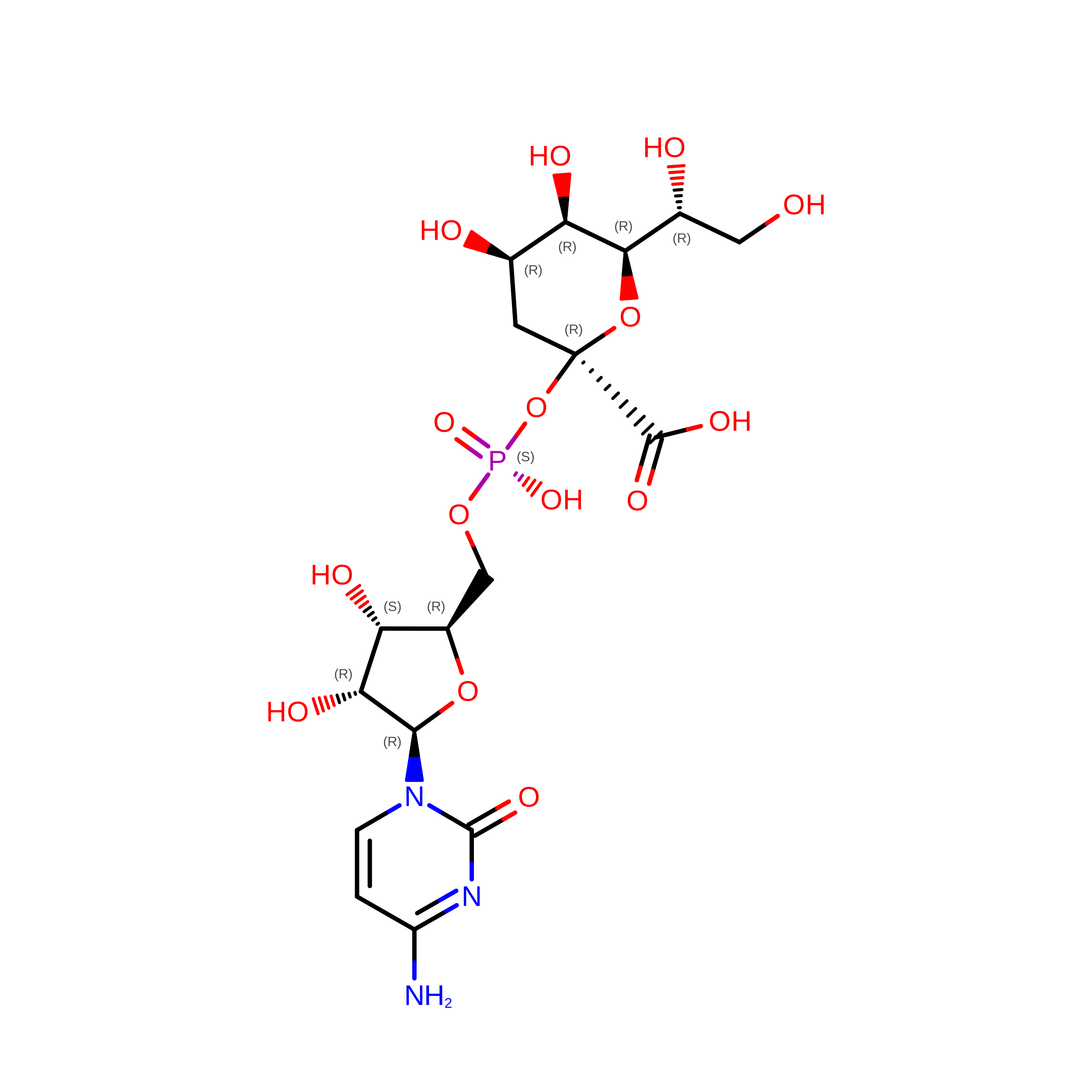
THE STRUCTURE OF CMP:2-KETO-3-DEOXY-MANNO-OCTONIC ACID SYNTHETASE COMPLEXED WITH CMP-Kdo at 100K


Experimental Data Snapshot

  • Method: X-RAY DIFFRACTION
  • Resolution: 2.60 Å
  • R-Value Free: 
    0.240 (Depositor), 0.240 (DCC) 
  • R-Value Work: 
    0.178 (Depositor), 0.177 (DCC) 
  • R-Value Observed: 
    0.178 (Depositor) 

wwPDB Validation 3D Report Full Report

Validation slider image for 1GQC

Ligand Structure Quality Assessment 


This is version 1.3 of the entry. See complete history

Literature

Catalytic Mechanism of Cmp:2-Keto-3-Deoxy-Manno-Octonic Acid Synthetase as Derived from Complexes with Reaction Educt and Product.

Jelakovic, S.Schulz, G.E.

(2002) Biochemistry 41: 1174

  • DOI: https://doi.org/10.1021/bi0119060
  • Primary Citation Related Structures: 
    1GQ9, 1GQC

  • PubMed Abstract: 

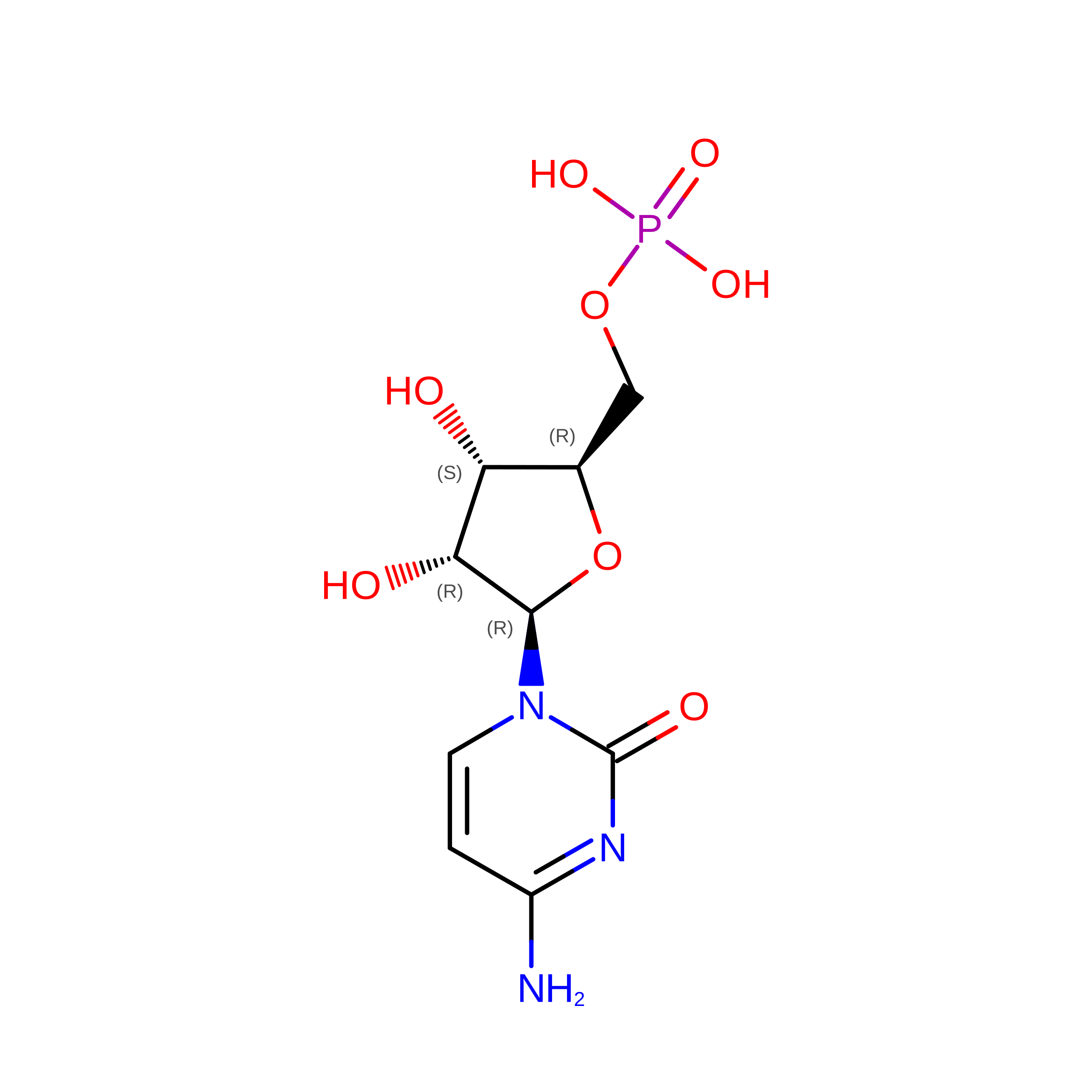
    The activation of the sugar 2-keto-3-deoxy-manno-octonic acid (Kdo) is catalyzed by CMP-Kdo synthetase (EC 2.7.7.38) and results in a monophosphate diester with CMP. The enzyme is a pharmaceutical target because CMP-Kdo is required for the biosynthesis of lipopolysaccharides that are vital for Gram-negative bacteria. We have established the structures of an enzyme complex with the educt CTP and of a complex with the product CMP-Kdo by X-ray diffraction analyses at 100 K, both at 2.6 A resolution. The N-terminal domains of the dimeric enzyme bind CTP in a peculiar nucleotide-binding fold with the beta- and gamma-phosphates located at the so-called "PP-loop", whereas the C-terminal domains participate in Kdo binding and in the dimer interface. The unstable nucleotide-sugar CMP-Kdo was produced in a crystal and stabilized by freezing to 100 K. Its formation is accompanied by an induced fit involving mainchain displacements in the 2 A range. The observed binding conformations together with the amino acid conservation pattern during evolution and the putative location of the required Mg(2+) ion suggest a reaction pathway. The enzyme is structurally homologous to the CMP-N-acetylneuraminic acid synthetases in all parts except for the dimer interface. Moreover, the chainfold and the substrate-binding positions resemble those of other enzymes processing nucleotide sugars.


  • Organizational Affiliation
    • Institut für Organische Chemie und Biochemie, Albert-Ludwigs-Universität, Albertstrasse 21, Freiburg im Breisgau, Germany 79104.

Macromolecule Content 

  • Total Structure Weight: 55.04 kDa 
  • Atom Count: 4,069 
  • Modeled Residue Count: 483 
  • Deposited Residue Count: 490 
  • Unique protein chains: 1

Macromolecules

Find similar proteins by:|  3D Structure
Entity ID: 1
MoleculeChains  Sequence LengthOrganismDetailsImage
3-DEOXY-MANNO-OCTULOSONATE CYTIDYLYLTRANSFERASE
A, B
245Escherichia coliMutation(s): 0 
EC: 2.7.7.38
UniProt
Find proteins for P42216 (Escherichia coli)
Explore P42216 
Go to UniProtKB:  P42216
Entity Groups
Sequence Clusters30% Identity50% Identity70% Identity90% Identity95% Identity100% Identity
UniProt GroupP42216
Sequence Annotations
Expand
Reference Sequence

Experimental Data & Validation

Experimental Data

  • Method: X-RAY DIFFRACTION
  • Resolution: 2.60 Å
  • R-Value Free:  0.240 (Depositor), 0.240 (DCC) 
  • R-Value Work:  0.178 (Depositor), 0.177 (DCC) 
  • R-Value Observed: 0.178 (Depositor) 
Space Group: P 1 21 1
Unit Cell:
Length ( Å )Angle ( ˚ )
a = 45.944α = 90
b = 130.996β = 102.31
c = 48.148γ = 90
Software Package:
Software NamePurpose
CNSrefinement

Structure Validation

View Full Validation Report


Ligand Structure Quality Assessment 


Entry History 

Deposition Data

Revision History  (Full details and data files)

  • Version 1.0: 2002-02-11
    Type: Initial release
  • Version 1.1: 2011-05-08
    Changes: Version format compliance
  • Version 1.2: 2011-07-13
    Changes: Version format compliance
  • Version 1.3: 2024-05-08
    Changes: Data collection, Database references, Derived calculations, Other