Download Mendeley
Refined structure of spinach glycolate oxidase at 2 A resolution.
Lindqvist, Y.(1989) J Mol Biol 209: 151-166
- PubMed: 2681790 Search on PubMed
- DOI: https://doi.org/10.1016/0022-2836(89)90178-2
- Primary Citation Related Structures:
1GOX - PubMed Abstract:
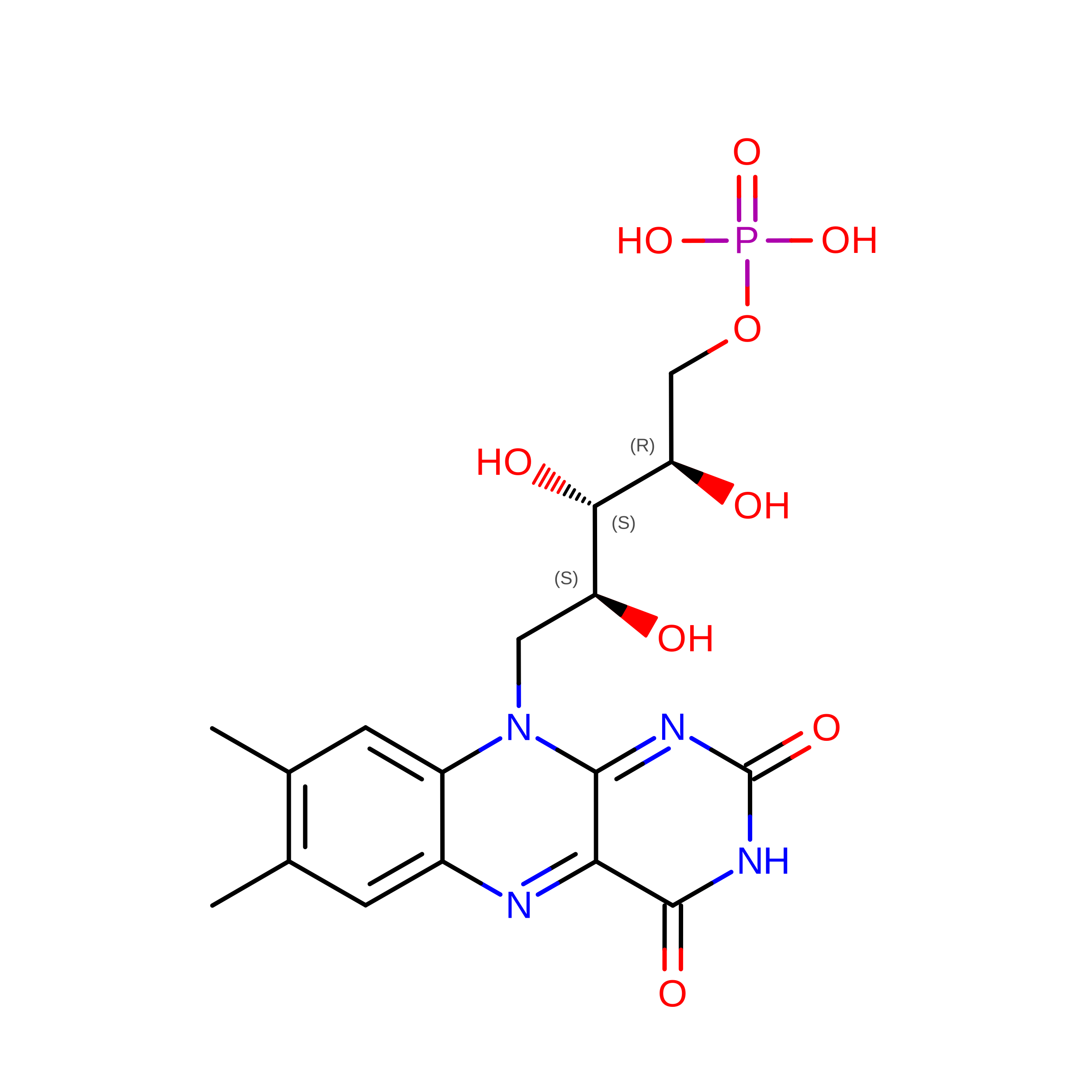
The amino acid sequence of glycolate oxidase from spinach has been fitted to an electron density map of 2.0 A nominal resolution and the structure has been refined using the restrained parameter least-squares refinement of Hendrickson and Konnert. A final crystallographic R-factor of 18.9% was obtained for 32,888 independent reflections from 5.5 to 2 A resolution. The geometry of the model, consisting of 350 amino acid residues, the cofactor flavin mononucleotide and 298 solvent molecules, is close to ideal with root-mean-square deviations of 0.015 A in bond lengths and 2.6 degrees in bond angles. The expected trimodal distribution with preference for staggered conformation is obtained for the side-chain chi 1-angles. The core of the subunit is built up from the eight beta-strands in the beta/alpha-barrel. This core consists of two hydrophobic layers. One in the center is made up of residues pointing in from the beta-strands towards the barrel axis and the second, consisting of two segments of residues, pointing out from the beta-strands towards the eight alpha-helices of the barrel and pointing from the helices towards the strands. The hydrogen bond pattern for the beta-strands in the beta/alpha-barrel is described. There are a number of residues with 3(10)-helix conformation, in particular there is one left-handed helix. The ordered solvent molecules are organized mainly in clusters. The average isotropic temperature factor is quite high, 27.1 A2, perhaps a reflection of the high solvent content in the crystal. The octameric glycolate oxidase molecule, which has 422 symmetry, makes strong interactions around the 4-fold axis forming a tight tetramer, but only weak interactions between the two tetramers forming the octamer.
- Department of Molecular Biology, Swedish University of Agricultural Sciences, Uppsala.
Organizational Affiliation: