1GKQ | pdb_00001gkq

D-Hydantoinase (Dihydropyrimidinase) from Thermus sp. in space group P212121


Experimental Data Snapshot

  • Method: X-RAY DIFFRACTION
  • Resolution: 2.60 Å
  • R-Value Free: 
    0.211 (Depositor), 0.210 (DCC) 
  • R-Value Work: 
    0.188 (Depositor), 0.189 (DCC) 
  • R-Value Observed: 
    0.188 (Depositor) 

Starting Model: experimental
View more details

wwPDB Validation 3D Report Full Report

Validation slider image for 1GKQ

This is version 1.4 of the entry. See complete history

Literature

X-Ray Structure of a Dihydropyrimidinase from Thermus Sp. At 1.3 A Resolution

Abendroth, J.Niefind, K.Schomburg, D.

(2002) J Mol Biology 320: 143

  • DOI: https://doi.org/10.1016/S0022-2836(02)00422-9
  • Primary Citation Related Structures: 
    1GKP, 1GKQ

  • PubMed Abstract: 

    Dihydropyrimidinases (hydantoinases) catalyse the reversible hydrolytic ring-opening of cyclic diamides such as dihydropyrimidines in the catabolism of pyrimidines. In biotechnology, these enzymes find application in the enantiospecific production of amino acids from racemic hydantoins. The crystal structure of a D-enantio-specific dihydropyrimidinase from Thermus sp. (D-hydantoinase) was solved de novo by multiwavelength anomalous diffraction phasing. In spite of a large unit cell the D-hydantoinase crystals exhibit excellent diffraction properties. The structure was subsequently refined at 1.30 A resolution against native data. The core of D-hydantoinase consists of a (alpha/beta)(8)-barrel, which is flanked by a beta-sheet domain and some additional helices. In the active site, a carboxylated lysine residue and the catalytically active hydroxide ion bridge a binuclear zinc centre. The tertiary structure and shape of the active site show strong homology to that of ureases, dihydroorotases, and phosphotriesterases. The homology of the active site was exploited for in silicio docking of substrates in the active site. This could shed light both on the substrate binding in hydantoinases and on the recently highly discussed origin of the proton in the course of hydantoinase catalysis.


  • Organizational Affiliation
    • Institut für Biochemie, Universität zu Köln, Zülpicher Str. 47, 50674 Cologne, Germany.

Macromolecule Content 

  • Total Structure Weight: 203.65 kDa 
  • Atom Count: 14,801 
  • Modeled Residue Count: 1,832 
  • Deposited Residue Count: 1,832 
  • Unique protein chains: 1

Macromolecules

Find similar proteins by:|  3D Structure
Entity ID: 1
MoleculeChains  Sequence LengthOrganismDetailsImage
HYDANTOINASE
A, B, C, D
458Thermus sp.Mutation(s): 1 
EC: 3.5.2.2

Small Molecules

Modified Residues  1 Unique
IDChains TypeFormula2D DiagramParent
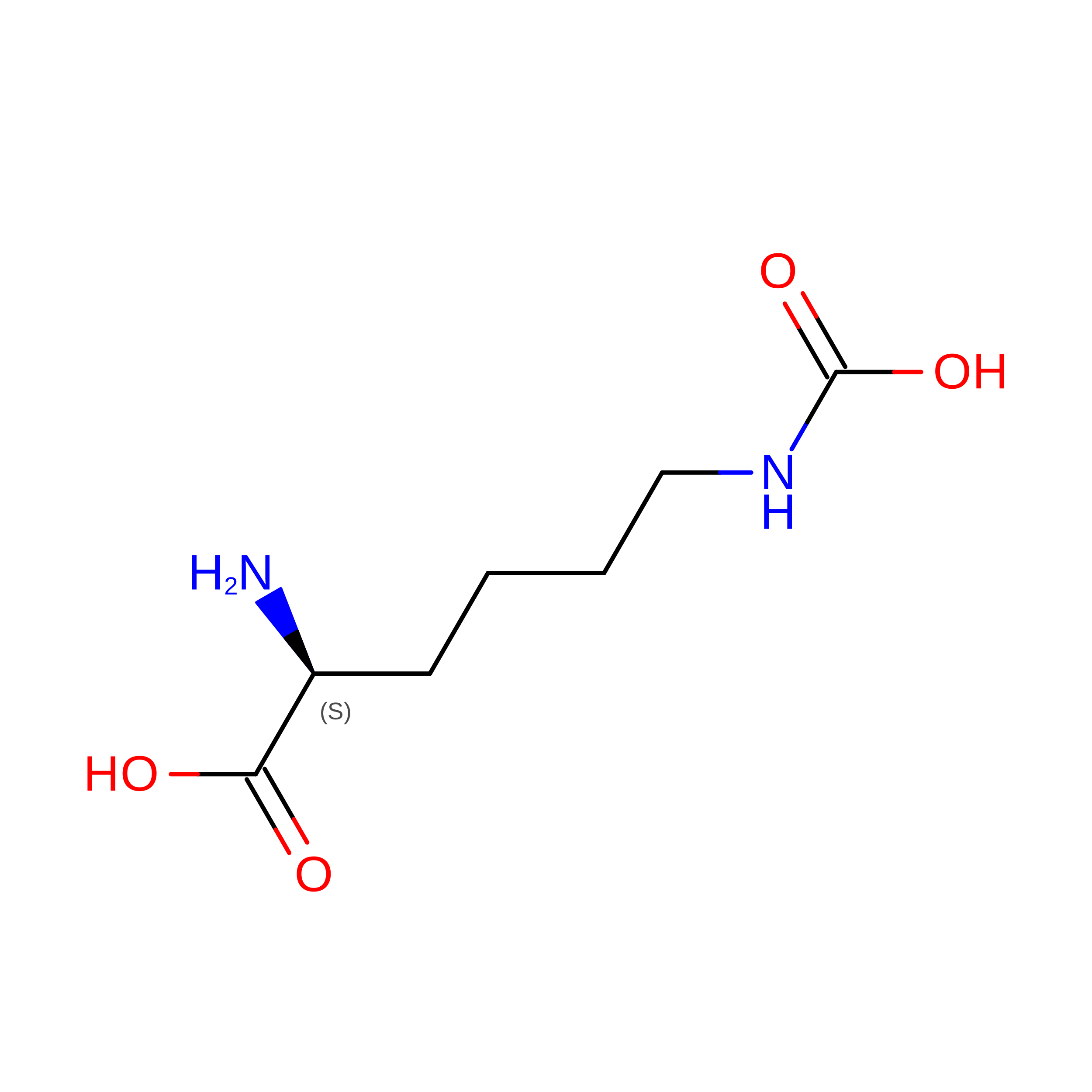
KCX
Query on KCX
A, B, C, D
L-PEPTIDE LINKINGC7 H14 N2 O4LYS

Experimental Data & Validation

Experimental Data

  • Method: X-RAY DIFFRACTION
  • Resolution: 2.60 Å
  • R-Value Free:  0.211 (Depositor), 0.210 (DCC) 
  • R-Value Work:  0.188 (Depositor), 0.189 (DCC) 
  • R-Value Observed: 0.188 (Depositor) 
Space Group: P 21 21 21
Unit Cell:
Length ( Å )Angle ( ˚ )
a = 83.2α = 90
b = 161.5β = 90
c = 168.5γ = 90
Software Package:
Software NamePurpose
CNSrefinement
DENZOdata reduction
SCALEPACKdata scaling
CNSphasing

Structure Validation

View Full Validation Report


Entry History 

Deposition Data

Revision History  (Full details and data files)

  • Version 1.0: 2002-06-27
    Type: Initial release
  • Version 1.1: 2011-05-08
    Changes: Version format compliance
  • Version 1.2: 2011-07-13
    Changes: Version format compliance
  • Version 1.3: 2017-07-05
    Changes: Data collection
  • Version 1.4: 2023-12-13
    Changes: Data collection, Database references, Derived calculations, Other, Refinement description