1GA1 | pdb_00001ga1

CRYSTAL STRUCTURE ANALYSIS OF PSCP (PSEUDOMONAS SERINE-CARBOXYL PROTEINASE) COMPLEXED WITH A FRAGMENT OF IODOTYROSTATIN (THIS ENZYME RENAMED "SEDOLISIN" IN 2003)


Experimental Data Snapshot

  • Method: X-RAY DIFFRACTION
  • Resolution: 1.40 Å
  • R-Value Free: 
    0.136 (Depositor) 
  • R-Value Work: 
    0.113 (Depositor), 0.123 (DCC) 
  • R-Value Observed: 
    0.108 (Depositor) 

wwPDB Validation 3D Report Full Report

Validation slider image for 1GA1

This is version 1.3 of the entry. See complete history

Literature

Practical experience with the use of halides for phasing macromolecular structures: a powerful tool for structural genomics.

Dauter, Z.Li, M.Wlodawer, A.

(2001) Acta Crystallogr D Biol Crystallogr 57: 239-249

  • DOI: https://doi.org/10.1107/s0907444900015249
  • Primary Citation Related Structures: 
    1GA1

  • PubMed Abstract: 

    The crystal structure of pepstatin-insensitive carboxyl proteinase (PCP) from Pseudomonas sp. 101, an enzyme with no overall sequence similarity to any other proteinases of known structure, was solved using crystals soaked in sodium bromide solution and then cryocooled. A data set collected at the bromine peak absorption wavelength was sufficient for calculation of an excellent map and the entire process of phasing and tracing the maps required almost no direct human intervention. The process of structure solution using single-wavelength data was compared with three-wavelength multiwavelength anomalous diffraction (MAD); although the latter resulted in slightly better maps, the use of this much more labor-intensive approach did not significantly improve the ability to solve the structure. The successful phasing approaches are compared with several less successful attempts utilizing other crystal forms of the enzyme and the practical aspects of the use of bromine as a heavy-atom derivative are discussed. In conclusion, the use of halides with single-wavelength diffraction data fulfills the requirements of being a first-choice method of high-throughput structure solution for the emerging field of structural genomics.


  • Organizational Affiliation
    • Synchrotron Radiation Research Section, Macromolecular Crystallography Laboratory, Program in Structural Biology, National Cancer Institute and NSLS, Brookhaven National Laboratory, Building 725A-X9, Upton, NY 11973, USA. dauter@bnl.gov

Macromolecule Content 

  • Total Structure Weight: 39.08 kDa 
  • Atom Count: 3,221 
  • Modeled Residue Count: 373 
  • Deposited Residue Count: 375 
  • Unique protein chains: 2

Macromolecules

Find similar proteins by:|  3D Structure
Entity ID: 1
MoleculeChains  Sequence LengthOrganismDetailsImage
SERINE-CARBOXYL PROTEINASE372Pseudomonas sp.Mutation(s): 0 
EC: 3.4.23.37 (PDB Primary Data), 3.4.21.100 (UniProt)
UniProt
Find proteins for P42790 (Pseudomonas sp. (strain 101))
Explore P42790 
Go to UniProtKB:  P42790
Entity Groups
Sequence Clusters30% Identity50% Identity70% Identity90% Identity95% Identity100% Identity
UniProt GroupP42790
Sequence Annotations
Expand
Reference Sequence
Find similar proteins by:  Sequence   |   3D Structure  
Entity ID: 2
MoleculeChains  Sequence LengthOrganismDetailsImage
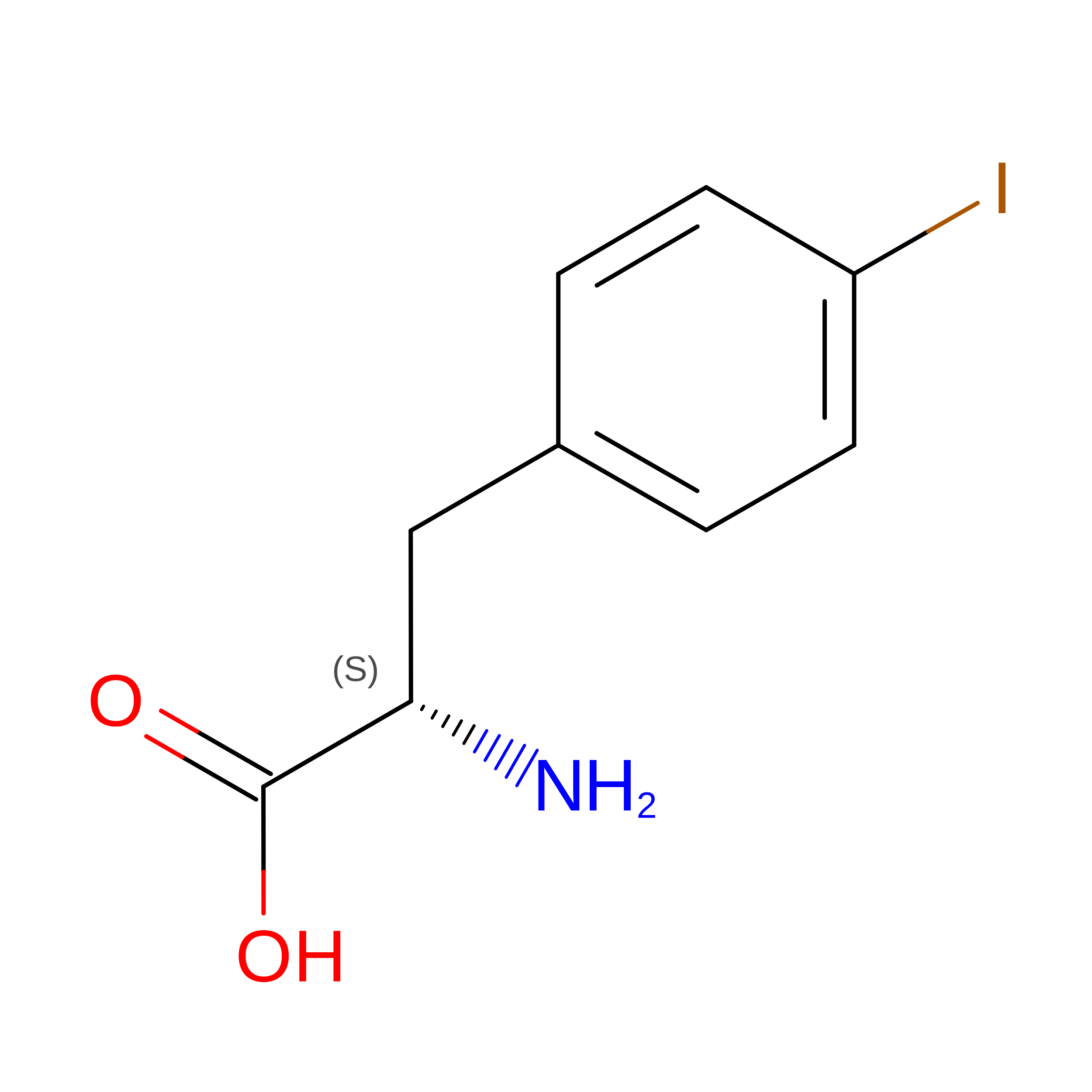
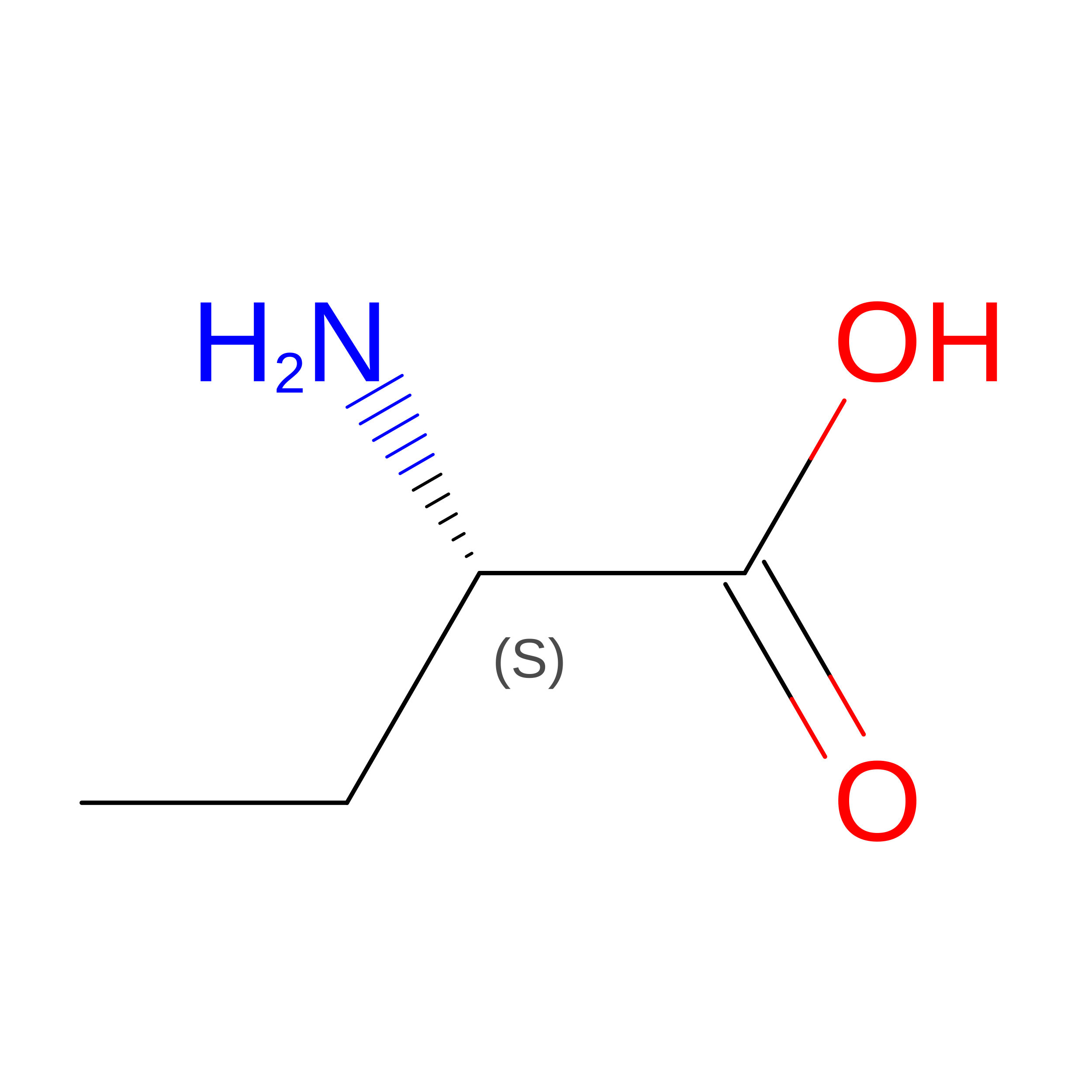
FRAGMENT OF IODOTYROSTATINB [auth I]3N/AMutation(s): 0 

Small Molecules

Modified Residues  1 Unique
IDChains TypeFormula2D DiagramParent
PHI
Query on PHI
B [auth I]L-PEPTIDE LINKINGC9 H10 I N O2PHE
UNK
Query on UNK
B [auth I]L-PEPTIDE LINKINGC4 H9 N O2

--

Experimental Data & Validation

Experimental Data

  • Method: X-RAY DIFFRACTION
  • Resolution: 1.40 Å
  • R-Value Free:  0.136 (Depositor) 
  • R-Value Work:  0.113 (Depositor), 0.123 (DCC) 
  • R-Value Observed: 0.108 (Depositor) 
Space Group: P 62
Unit Cell:
Length ( Å )Angle ( ˚ )
a = 97.19α = 90
b = 97.19β = 90
c = 83.37γ = 120
Software Package:
Software NamePurpose
HKL-2000data collection
HKL-2000data reduction
SHELXDphasing
SHARPphasing
DMmodel building
WARPmodel building
SHELXL-97refinement
HKL-2000data scaling
DMphasing
ARP/wARPmodel building

Structure Validation

View Full Validation Report


Entry History 

Deposition Data

Revision History  (Full details and data files)

  • Version 1.0: 2000-12-13
    Type: Initial release
  • Version 1.1: 2008-04-27
    Changes: Version format compliance
  • Version 1.2: 2011-07-13
    Changes: Non-polymer description, Version format compliance
  • Version 1.3: 2025-03-26
    Changes: Data collection, Database references, Derived calculations, Structure summary