1G9H | pdb_00001g9h

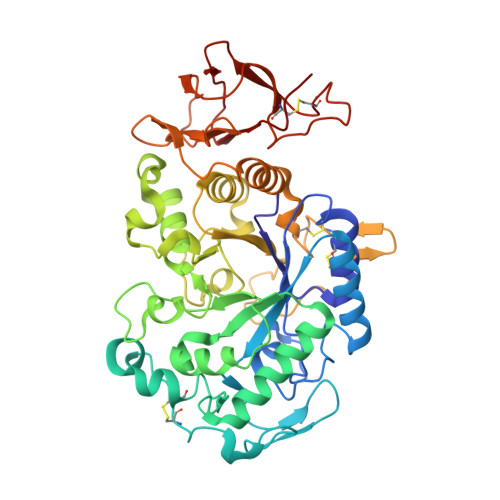
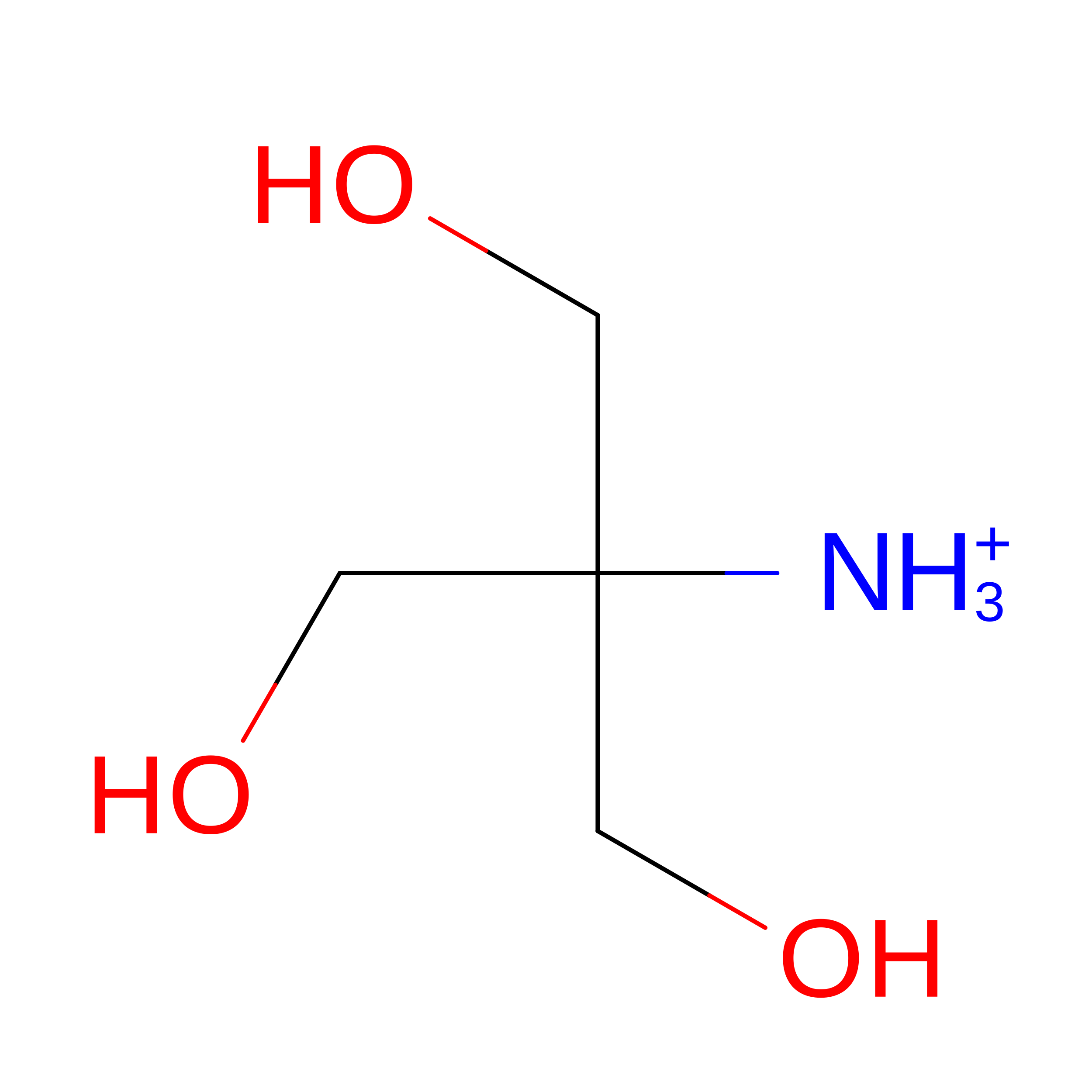
TERNARY COMPLEX BETWEEN PSYCHROPHILIC ALPHA-AMYLASE, COMII (PSEUDO TRI-SACCHARIDE FROM BAYER) AND TRIS (2-AMINO-2-HYDROXYMETHYL-PROPANE-1,3-DIOL)


Experimental Data Snapshot

  • Method: X-RAY DIFFRACTION
  • Resolution: 1.80 Å
  • R-Value Free: 
    0.201 (Depositor) 
  • R-Value Work: 
    0.168 (Depositor), 0.172 (DCC) 

Starting Model: experimental
View more details

wwPDB Validation 3D Report Full Report

Validation slider image for 1G9H

This is version 2.2 of the entry. See complete history

Literature

Crystallographic evidence of a transglycosylation reaction: ternary complexes of a psychrophilic alpha-amylase.

AGHAJARI, N.ROTH, M.HASER, R.

(2002) Biochemistry 41: 4273-4280

  • DOI: https://doi.org/10.1021/bi0160516
  • Primary Citation Related Structures: 
    1G94, 1G9H, 1KXH

  • PubMed Abstract: 

    The psychrophilic Pseudoalteromonas haloplanctis alpha-amylase is shown to form ternary complexes with two alpha-amylase inhibitors present in the active site region, namely, a molecule of Tris and a trisaccharide inhibitor or heptasaccharide inhibitor, respectively. The crystal structures of these complexes have been determined by X-ray crystallography to 1.80 and 1.74 A resolution, respectively. In both cases, the prebound inhibitor Tris is expelled from the active site by the incoming oligosaccharide inhibitor substrate analogue, but stays linked to it, forming well-defined ternary complexes with the enzyme. These results illustrate competition in the crystalline state between two inhibitors, an oligosaccharide substrate analogue and a Tris molecule, bound at the same time in the active site region. Taken together, these structures show that the enzyme performs transglycosylation in the complex with the pseudotetrasaccharide acarbose (confirmed by a mutant structure), leading to a well-defined heptasaccharide, considered as a more potent inhibitor. Furthermore, the substrate-induced ordering of water molecules within a channel highlights a possible pathway used for hydrolysis of starch and related poly- and oligosaccharides.


  • Organizational Affiliation
    • Institut de Biologie et Chimie des Protéines, UMR 5086 CNRS and Université Claude Bernard Lyon 1, Laboratoire de Bio-Cristallographie, 7 Passage du Vercors, 69367 Lyon Cedex 07, France.

Macromolecule Content 

  • Total Structure Weight: 49.62 kDa 
  • Atom Count: 3,822 
  • Modeled Residue Count: 448 
  • Deposited Residue Count: 448 
  • Unique protein chains: 1

Macromolecules

Find similar proteins by:|  3D Structure
Entity ID: 1
MoleculeChains  Sequence LengthOrganismDetailsImage
ALPHA-AMYLASE448Pseudoalteromonas haloplanktisMutation(s): 0 
EC: 3.2.1.1
UniProt
Find proteins for P29957 (Pseudoalteromonas haloplanktis)
Explore P29957 
Go to UniProtKB:  P29957
Entity Groups
Sequence Clusters30% Identity50% Identity70% Identity90% Identity95% Identity100% Identity
UniProt GroupP29957
Sequence Annotations
Expand
Reference Sequence

Oligosaccharides

Help  
Entity ID: 2
MoleculeChains Length2D Diagram GlycosylationD Interactions
4,6-dideoxy-4-{[(1S,5R,6S)-3-formyl-5,6-dihydroxy-4-oxocyclohex-2-en-1-yl]amino}-alpha-D-xylo-hex-5-enopyranose-(1-4)-beta-D-glucopyranose
B
2N/AN/A

Experimental Data & Validation

Experimental Data

  • Method: X-RAY DIFFRACTION
  • Resolution: 1.80 Å
  • R-Value Free:  0.201 (Depositor) 
  • R-Value Work:  0.168 (Depositor), 0.172 (DCC) 
Space Group: C 2 2 21
Unit Cell:
Length ( Å )Angle ( ˚ )
a = 71.33α = 90
b = 138.68β = 90
c = 114.81γ = 90
Software Package:
Software NamePurpose
XDSdata scaling
ROTAVATAdata reduction
X-PLORmodel building
X-PLORrefinement
XDSdata reduction
CCP4data scaling
ROTAVATAdata scaling
X-PLORphasing

Structure Validation

View Full Validation Report


Entry History 

Deposition Data

Revision History  (Full details and data files)

  • Version 1.0: 2002-06-26
    Type: Initial release
  • Version 1.1: 2008-04-27
    Changes: Version format compliance
  • Version 1.2: 2011-07-13
    Changes: Version format compliance
  • Version 1.3: 2017-10-04
    Changes: Refinement description
  • Version 1.4: 2018-01-24
    Changes: Database references
  • Version 1.5: 2018-04-04
    Changes: Data collection
  • Version 1.6: 2018-04-11
    Changes: Data collection
  • Version 2.0: 2020-07-29
    Type: Remediation
    Reason: Carbohydrate remediation
    Changes: Atomic model, Data collection, Derived calculations, Structure summary
  • Version 2.1: 2023-08-09
    Changes: Data collection, Database references, Refinement description, Structure summary
  • Version 2.2: 2024-11-20
    Changes: Structure summary