1G5A | pdb_00001g5a

AMYLOSUCRASE FROM NEISSERIA POLYSACCHAREA


Experimental Data Snapshot

  • Method: X-RAY DIFFRACTION
  • Resolution: 1.40 Å
  • R-Value Free: 
    0.204 (Depositor) 
  • R-Value Work: 
    0.189 (Depositor) 
  • R-Value Observed: 
    0.189 (Depositor) 

wwPDB Validation 3D Report Full Report

Validation slider image for 1G5A

This is version 1.3 of the entry. See complete history

Literature

Amylosucrase, A Glucan-synthesizing Enzyme from the alpha-Amylase Family

Skov, L.K.Mirza, O.Henriksen, A.De Montalk, G.P.Remaud-Simeon, M.Sarcabal, P.Willemot, R.M.Monsan, P.Gajhede, M.

(2001) J Biological Chem 276: 25273-25278

  • DOI: https://doi.org/10.1074/jbc.M010998200
  • Primary Citation Related Structures: 
    1G5A

  • PubMed Abstract: 

    Amylosucrase (E.C. 2.4.1.4) is a member of Family 13 of the glycoside hydrolases (the alpha-amylases), although its biological function is the synthesis of amylose-like polymers from sucrose. The structure of amylosucrase from Neisseria polysaccharea is divided into five domains: an all helical N-terminal domain that is not similar to any known fold, a (beta/alpha)(8)-barrel A-domain, B- and B'-domains displaying alpha/beta-structure, and a C-terminal eight-stranded beta-sheet domain. In contrast to other Family 13 hydrolases that have the active site in the bottom of a large cleft, the active site of amylosucrase is at the bottom of a pocket at the molecular surface. A substrate binding site resembling the amylase 2 subsite is not found in amylosucrase. The site is blocked by a salt bridge between residues in the second and eight loops of the (beta/alpha)(8)-barrel. The result is an exo-acting enzyme. Loop 7 in the amylosucrase barrel is prolonged compared with the loop structure found in other hydrolases, and this insertion (forming domain B') is suggested to be important for the polymer synthase activity of the enzyme. The topology of the B'-domain creates an active site entrance with several ravines in the molecular surface that could be used specifically by the substrates/products (sucrose, glucan polymer, and fructose) that have to get in and out of the active site pocket.


  • Organizational Affiliation
    • Protein Structure Group, Department of Chemistry, University of Copenhagen, Universitetsparken 5, DK-2100 Copenhagen, Denmark.

Macromolecule Content 

  • Total Structure Weight: 71.95 kDa 
  • Atom Count: 5,899 
  • Modeled Residue Count: 628 
  • Deposited Residue Count: 628 
  • Unique protein chains: 1

Macromolecules

Find similar proteins by:|  3D Structure
Entity ID: 1
MoleculeChains  Sequence LengthOrganismDetailsImage
AMYLOSUCRASE628Neisseria polysacchareaMutation(s): 0 
EC: 2.4.1.4
UniProt
Find proteins for Q9ZEU2 (Neisseria polysaccharea)
Explore Q9ZEU2 
Go to UniProtKB:  Q9ZEU2
Entity Groups
Sequence Clusters30% Identity50% Identity70% Identity90% Identity95% Identity100% Identity
UniProt GroupQ9ZEU2
Sequence Annotations
Expand
Reference Sequence

Small Molecules

Ligands 3 Unique
IDChains Name / Formula / InChI Key2D Diagram3D Interactions
EPE

Query on EPE


Download:Ideal Coordinates CCD File
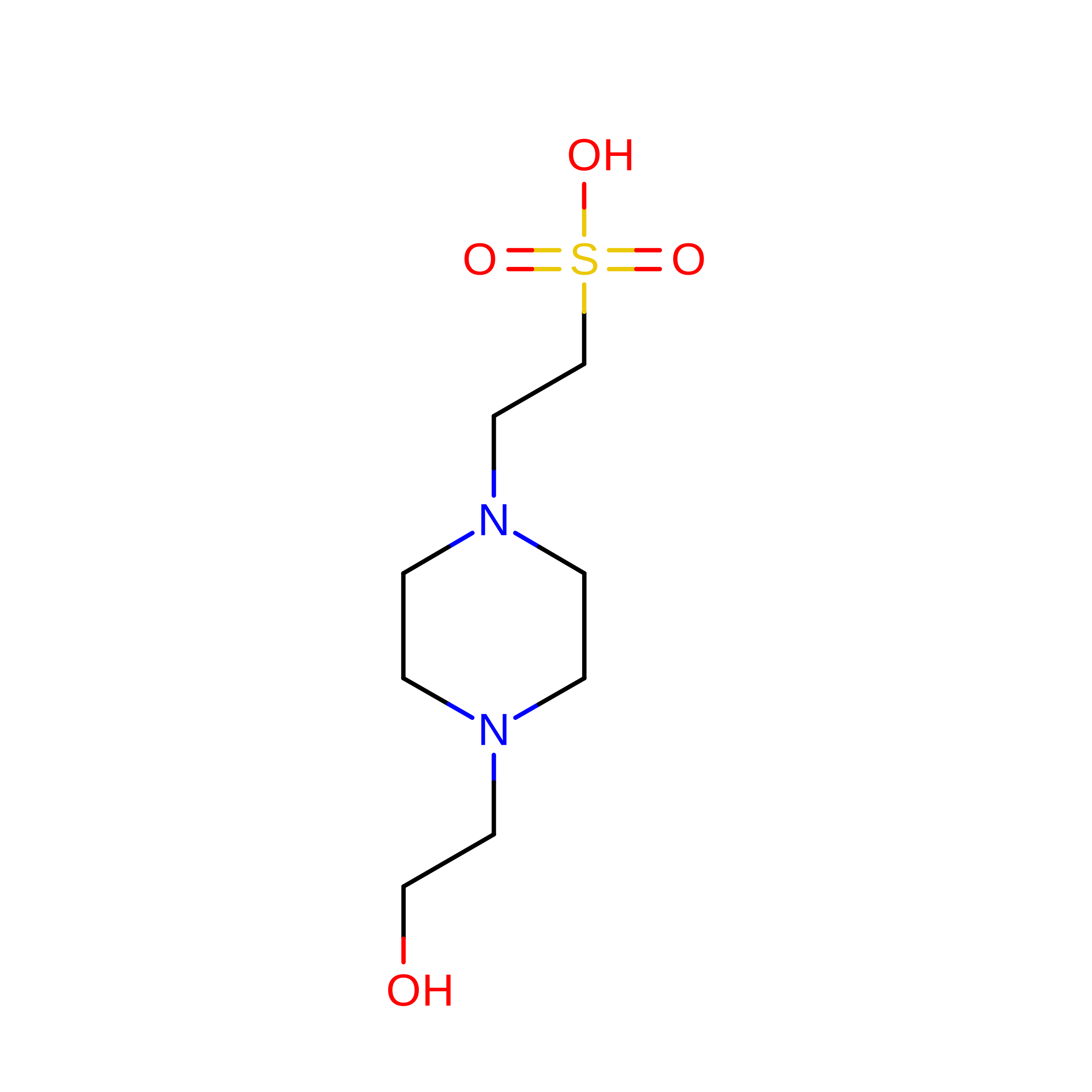
D [auth A]4-(2-HYDROXYETHYL)-1-PIPERAZINE ETHANESULFONIC ACID
C8 H18 N2 O4 S
JKMHFZQWWAIEOD-UHFFFAOYSA-N
TRS

Query on TRS


Download:Ideal Coordinates CCD File
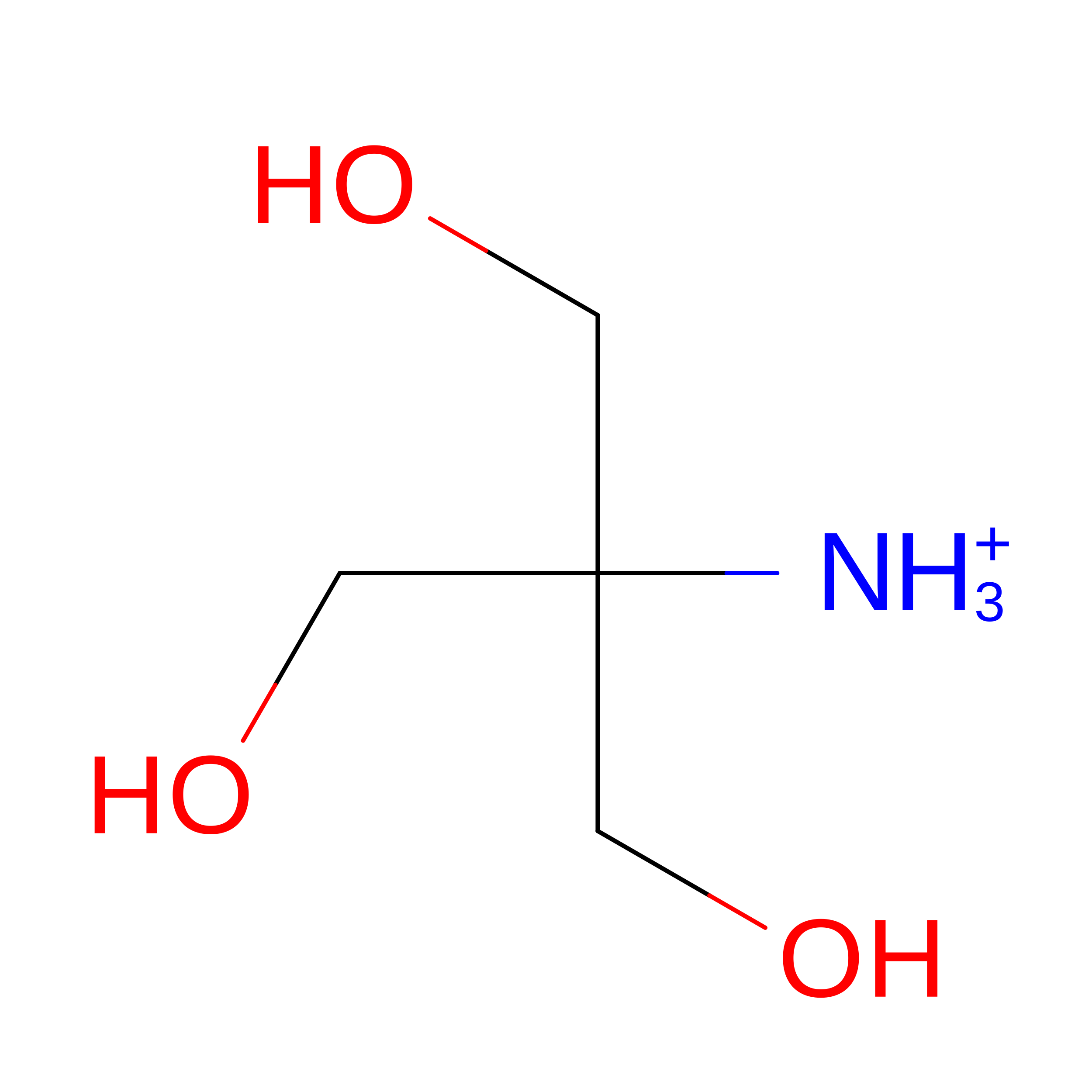
C [auth A]2-AMINO-2-HYDROXYMETHYL-PROPANE-1,3-DIOL
C4 H12 N O3
LENZDBCJOHFCAS-UHFFFAOYSA-O
NA

Query on NA


Download:Ideal Coordinates CCD File
B [auth A]SODIUM ION
Na
FKNQFGJONOIPTF-UHFFFAOYSA-N

Experimental Data & Validation

Experimental Data

  • Method: X-RAY DIFFRACTION
  • Resolution: 1.40 Å
  • R-Value Free:  0.204 (Depositor) 
  • R-Value Work:  0.189 (Depositor) 
  • R-Value Observed: 0.189 (Depositor) 
Space Group: P 21 21 2
Unit Cell:
Length ( Å )Angle ( ˚ )
a = 95.765α = 90
b = 117.11β = 90
c = 60.965γ = 90
Software Package:
Software NamePurpose
SOLVEphasing
CNSrefinement
DENZOdata reduction
SCALEPACKdata scaling

Structure Validation

View Full Validation Report


Entry History 

Deposition Data

Revision History  (Full details and data files)

  • Version 1.0: 2001-10-31
    Type: Initial release
  • Version 1.1: 2008-04-27
    Changes: Version format compliance
  • Version 1.2: 2011-07-13
    Changes: Version format compliance
  • Version 1.3: 2024-02-07
    Changes: Data collection, Database references, Derived calculations